







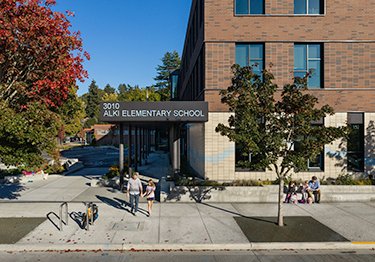
Seattle’s Alki Elementary Sets New Standard for Urban Educational Infrastructure
The landscape of modern education is undergoing a seismic shift, and the recently completed Alki Elementary School in Seattle stands as a definitive blueprint for the future of urban learning environments. By blending high-performance sustainable technology with radical community integration, the project—led by Mahlum Architects and Cornerstone General Contractors—has redefined how metropolitan districts can utilize restricted real estate to foster student growth.
Spanning 88,000 square feet, the new facility replaces a mid-century structure on what was the Seattle Public Schools’ smallest district plot at just 1.4 acres. The success of the project hinged on ingenious spatial management and a commitment to biophilic design, offering a roadmap for how cities can densify educational footprints without sacrificing student well-being.
Engineering Sustainability in a Compact Urban Core
The school’s construction highlights the emerging dominance of mass timber as a primary building material. Beyond its aesthetic appeal, the structural timber serves a functional purpose, creating a warm, organic learning environment that has been shown to improve student focus. To meet aggressive sustainability benchmarks, the team integrated a geothermal heating system directly beneath the building’s footprint. Because of the site’s limited dimensions, the installation required a masterclass in construction sequencing and logistical precision.
This focus on high-performance building systems aligns with broader industry trends toward decarbonized infrastructure. By utilizing renewable materials and energy-efficient climate control, Alki Elementary serves as a living laboratory for carbon-conscious construction, proving that educational facilities can operate as net-positive contributors to a city’s environmental goals rather than just energy-consuming entities.
Bridging the Gap: School and Community Integration
Perhaps the most innovative aspect of the Alki project is its refusal to operate as an isolated “silo.” Recognizing the limitations of its urban site, the design team intentionally wove the school into the fabric of the existing Alki Community Center and the adjacent public playground. Through a shared gymnasium and a newly landscaped pedestrian artery, the school acts as a physical bridge between municipal resources and classroom instruction.
This approach reflects a growing emphasis on “community-centric design.” By co-locating amenities, the district has effectively expanded the square footage available to students while simultaneously offering the neighborhood a revitalized public asset. For urban planners, the Alki model demonstrates that the most effective way to modernize aging school infrastructure is to break down the barriers between institutional property and public space.
Data-Driven Design and the Future of Learning
Alki Elementary is currently the subject of a sophisticated post-occupancy research initiative. Architects and researchers are utilizing the facility to study the tangible effects of biophilic design—such as optimized natural light, acoustic control, and the presence of exposed wood—on student behavior and academic outcomes.
This marriage of physical architecture and data analysis mirrors the ongoing digital transformation within the tech sector, where AI-driven analytics are increasingly used to optimize environments for human performance. By collecting longitudinal feedback from students and educators, the project team is creating a data-backed framework that will inform future school designs across the Pacific Northwest. As districts look toward the next generation of modernization projects, the Alki Elementary model provides a clear, scalable vision: schools that are not just places to house students, but vibrant, sustainable hubs that synthesize technology, environment, and community to catalyze the next generation of learners.
Disclaimer: This content is auto-generated for informational purposes only.
Source: Read Original News