








The Mechanics of the Switch 2 Userland Exploit
The security landscape for next-generation consoles has shifted significantly following the discovery of a software-only, partial jailbreak for the Nintendo Switch 2. Security researcher Sammy Hajhamid, known in the community as Pepsipu, has successfully gained userland access to the console, effectively bypassing standard firmware restrictions. This exploit does not require physical modification of the hardware; rather, it leverages a sophisticated chain of software vulnerabilities to grant unauthorized control over system processes.
At its core, the exploit utilizes SmileBasic 4, an established programming environment that has been ported to the new console. By targeting the interpreter within this software, Hajhamid identified a critical 32-bit integer overflow. This vulnerability occurs during the deletion of elements from an array within the SmileBasic environment. When triggered, the flaw exposes an array pointer, which serves as the gateway for subsequent memory manipulation. By exploiting this pointer, the researcher gained the ability to conduct read and write operations on specific segments of the system memory, a foundational requirement for any further unauthorized code execution.
Technical Chain of Execution
The path to achieving native code execution was far from straightforward, requiring a multi-stage approach. Following the initial memory access provided by the integer overflow, Hajhamid focused his efforts on the console’s internal system modules, or sysmodules. These components manage high-level interactions between hardware and software, serving as the bridge that maintains the console’s security posture.
The researcher identified a buffer overflow within the console’s FileSystem services module. This particular service is responsible for managing data retrieval and storage operations. By triggering the buffer overflow, Hajhamid successfully exposed a cached data pointer. This pointer, when manipulated, allowed for arbitrary read and write privileges, effectively stripping away the protections intended to isolate the filesystem from user-level applications. By simulating a filesystem process, the exploit achieves native code execution, allowing for the deployment of custom software that operates outside the boundaries established by the manufacturer.
Infrastructure Requirements and Implementation
While the exploit is strictly software-based, it is classified as “tethered,” meaning it requires an external connection to function throughout the duration of the exploit’s lifecycle. To facilitate the hack, the console must be connected to a computer running either macOS or Linux. This computer hosts a specific node.js package designed to act as a command-and-control interface.
During the research phase, Hajhamid employed a custom harness to interact with the hardware. This harness was capable of transmitting USB commands directly to the system and monitoring results via HDMI output. In a display of automation, the researcher even utilized a Bluetooth-enabled switch to power-cycle the console remotely. This level of technical orchestration demonstrates the complexity required to transition from a theoretical bug to a reproducible system compromise. The use of OpenAI’s Codex to assist in probing the language interpreter highlights how modern generative tools are increasingly being integrated into the workflows of security researchers, accelerating the identification of vulnerabilities in complex binary systems.
Functionality and Capabilities
The primary impact of this exploit is the realization of homebrew execution. Users with access to the exploit can run unverified code, modify game assets, and interact with the console’s peripheral devices at the hardware level through Memory-Mapped I/O (MMIO). This means that virtually any component accessible via the system bus can potentially be addressed and influenced by custom code.
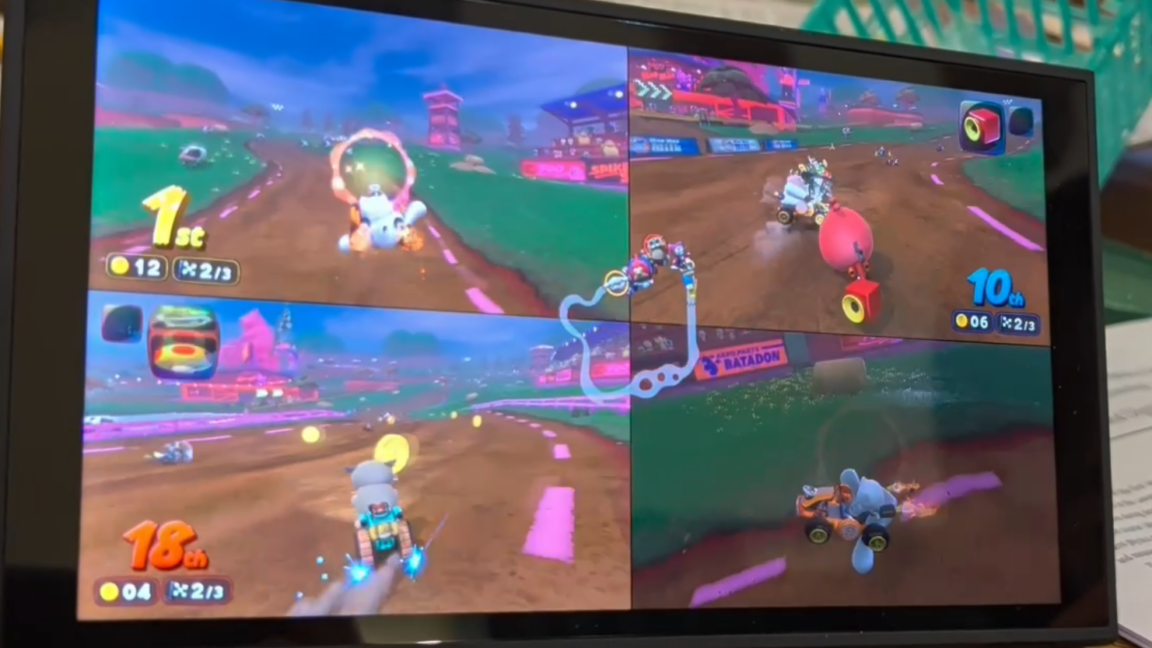
Practical demonstrations of this capability have already appeared online. Pepsipu showcased the ability to replace character models in Mario Kart World, providing a visual proof-of-concept that game data can be reverse-engineered and replaced in real-time. Other developers have successfully utilized this access to initiate Vulkan GPU commands within a userland environment, hinting at the potential for future homebrew developers to access the full graphical capabilities of the Switch 2 hardware. Beyond aesthetic modifications, the exploit enables the backup of save files that were previously restricted by the console’s internal storage protocols, offering users more control over their game progress and data management.
The Broader Impact on Console Security
The emergence of a jailbreak so soon after the release of the Switch 2 hardware presents a significant challenge to the console’s security ecosystem. Because this exploit operates within userland, it serves as a persistent threat that is difficult to mitigate through basic patches. The ability to manipulate the filesystem and inject native code suggests that the console’s layered defense mechanisms are susceptible to chaining multiple minor vulnerabilities together to achieve a total compromise of system integrity.
For the developer community, this represents a new playground for creating custom tools, performance benchmarks, and alternative interfaces. However, for the manufacturer, it signals the need for robust firmware updates that can effectively sanitize memory operations and restrict the permissions assigned to individual sysmodules. As researchers and developers continue to probe the limits of this exploit, the industry will be watching to see how quickly the platform’s security can be hardened to prevent further unauthorized access. For now, the exploit remains a powerful example of how even highly secured modern systems can be unraveled through persistent, systematic analysis of software flaws.
Disclaimer: This content is auto-generated for informational purposes only.
Source: Read Original News