









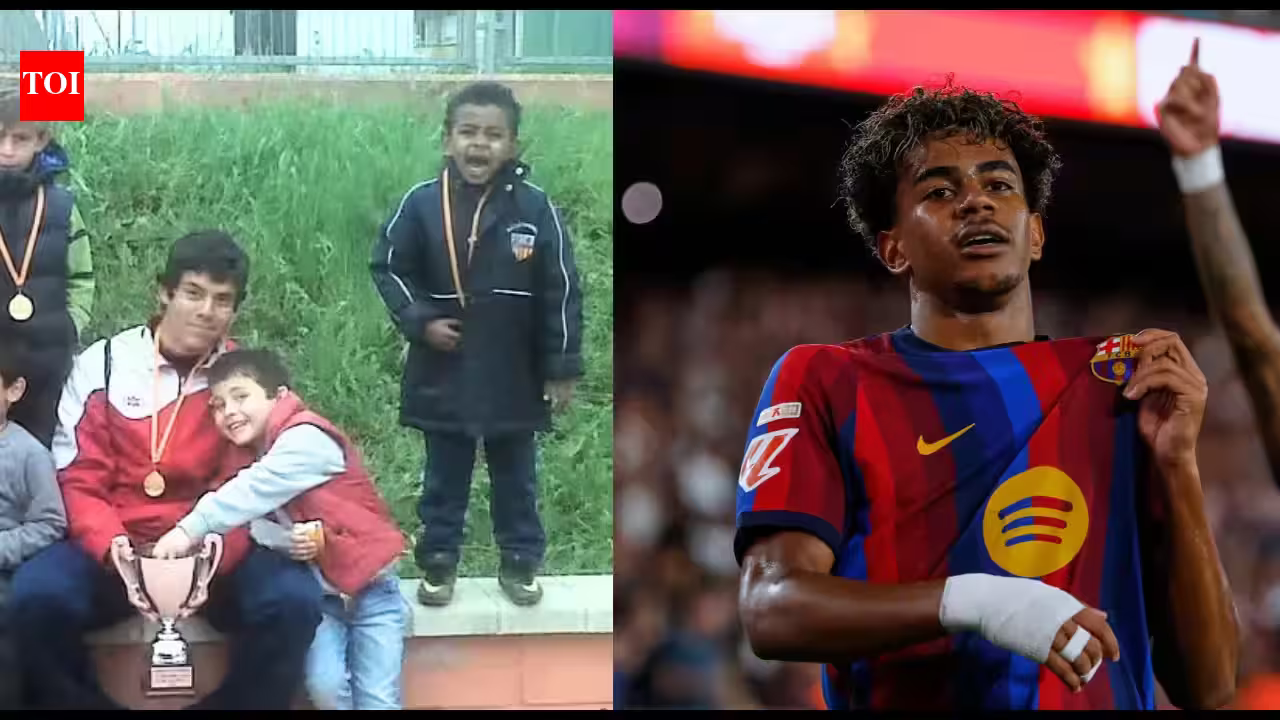
Long before Lamine Yamal stood under the blinding lights of the Camp Nou or hoisted the European Championship trophy, he was a toddler with an insatiable appetite for the ball, haunting the pitches of CF La Torreta with an intensity that defied his years. While the world now views him as a generational phenomenon, his ascent was built on the quiet, committed labor of local coaches who saw a “one in a million” talent long before the scouting reports caught up.
The boy who wanted nothing but the ball
Inocente Diez, the youth coordinator at CF La Torreta, recalls the precise moment he realized he was watching something truly extraordinary. Mounir and Sheila, Yamal’s parents, brought their four-year-old son to the club, hoping to channel his restless energy into organized sport. Diez didn’t need long to recognize the rarity in front of him.
“We put him on the pitch to see what he could do,” Diez remembers. “Some kids cry, some start to play with the rubber pellets or the grass, most get distracted by something. All he wanted was the ball and he would even take it from his teammates. He was obsessed with the ball and all he wanted to do was score goals. When training was over, he didn’t want to leave the pitch. We constantly had to tell him off because he never wanted to leave.”
The distinction wasn’t just in Yamal’s hunger for the game; it was in his cognitive processing. Even at four, his positioning and natural feel for the game were leagues ahead of his peers. Diez describes him as a boy born “under a lucky star,” possessing a preternatural ability to read the movement of the game that no amount of coaching could replicate.
Journeys that built a foundation
The path from those early training sessions to professional stardom was rarely straightforward. Practical obstacles—specifically transportation—often threatened to derail his development. When his father couldn’t make the trip, Diez stepped in, driving the young prodigy to practice himself.
These were not merely functional commutes; they were the informal classrooms where a future star discussed Barcelona’s tactics and results with a man fifty years his senior. These moments represent the unseen architecture of a modern football career—the fast-food restaurant where his mother worked alongside Diez’s daughter, the community support, and the unwavering belief of mentors who ensured that a humble upbringing never stood in the way of a monumental destiny.
The battle to coach a pure talent
If Diez provided the encouragement, another early coach, Leo Giordanella, provided the discipline. Giordanella, an Argentinian expatriate who found his way to La Torreta, first saw Yamal in a local park, where the boy with long, curly hair would chase a ball that seemed physically too large for him to control.
Yet, even at five or six years old, Yamal was a showman. He could stop, turn, execute step-overs, and chip keepers with a precision that bordered on the absurd. However, his brilliance came with a challenge: he was almost exclusively an individualist.
“He stood out above the rest. Every match was a show,” Giordanella notes. But for a coach trying to instill the principles of tiki-taka and collective play, Yamal’s “go it alone” mentality was a hurdle. Giordanella even benched the youngster on several occasions—a decision that baffled onlookers—to force him to learn the value of a teammate. The strategy paid off. Eventually, the boy who dribbled around dining-room chairs at home began to see the open pass, turning himself into an assist-making machine as lethal as his finishing.
From the pitch to the world stage
By 2014, the secret was out. Seven-year-old Yamal chose Barcelona’s La Masia over Espanyol, starting a trajectory that would see him rewrite history. He became a European champion at seventeen years and one day old, and by nineteen, he stood as the centerpiece of a Spanish squad reaching the FIFA World Cup final.
The symmetry of his career is perhaps best captured in a 2007 photograph—a viral sensation showing a nineteen-year-old Lionel Messi bathing a six-month-old Yamal. Now, the torch has clearly passed. Messi, reflecting on the image ahead of their meeting in the World Cup final, remains effusive: “He’s one of the best players in the world and he’s only 19. He has his whole career ahead of him and he has a great opportunity to make history.”
For Giordanella, the final represents a poignant collision of worlds. Having helped cultivate the boy who would eventually face his own homeland, the coach feels the weight of divided loyalties. “I sent Lamine a message saying I love him very much, but I love my country too,” he said with a laugh. “And if he scores against Argentina, I’ll kill him.”
It is a fitting sentiment for a player who, while currently conquering the globe, remains tethered to the coaches and the small-town experiences that first saw the fire in his eyes. From the rubber pellets of La Torreta to the grandest stage of world football, Lamine Yamal’s rise is a testament to what happens when raw, “one in a million” talent meets the collective support of those who refused to let it go unnoticed.
Disclaimer: This content is auto-generated for informational purposes only.
Source: Read Original News