









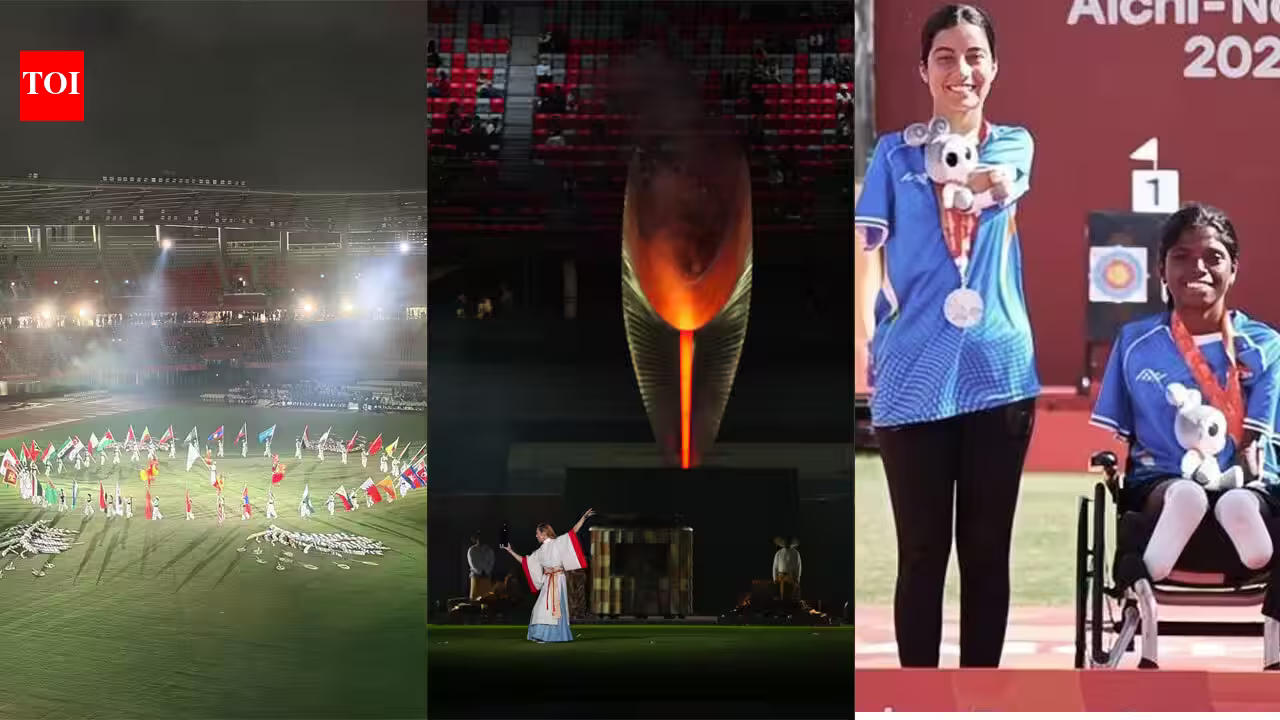
NAGOYA, JAPAN — The curtains have officially fallen on the Aichi-Nagoya 2026 Asian Para Games, but the echoes of a historic campaign will resonate in India for years to come. As the Mizuho Park Athletics Stadium played host to a vibrant closing ceremony this Saturday, the Indian contingent stood tall, capping off an extraordinary week with a record-shattering haul of 114 medals.
Under the glowing lights of Nagoya, double gold medallists Nishad Kumar and Mona Agarwal led the national delegation as flag-bearers, serving as the face of a squad that has fundamentally altered the trajectory of Indian para-sports. With a final tally of 30 gold, 35 silver, and 49 bronze medals, India not only eclipsed its previous best of 108 medals from the 2022 Hangzhou Games but firmly cemented its status as a rising powerhouse on the continental stage.
A Historic Fourth-Place Finish
While China maintained its traditional stranglehold on the medal table—finishing first with a staggering 435 medals, including 207 gold—the competition behind them was fierce. Japan, benefiting from the home-turf advantage, secured second place with 186 medals, while Uzbekistan demonstrated immense growth to claim third with 145.
India’s fourth-place finish is arguably the most impressive narrative of these Games. What makes the achievement particularly remarkable is the efficiency of the Indian effort. While the 2022 campaign involved 309 athletes, this year’s success was driven by a streamlined contingent of just 168 para-athletes. The data speaks for itself: with nearly half the manpower of previous years, the Indian squad maximized its potential, proving that the nation’s investment in grassroots development and high-performance training is yielding high-impact dividends.
President Droupadi Murmu, leading the national chorus of praise, took to social media to laud the athletes. “This unprecedented medal haul reflects the athletes’ hard work, perseverance, and self-belief,” the President stated. “Their journey is an inspiration to young people across the country to dream big and remain resilient in the face of any challenge.”
Para-Athletics Remains the Engine Room
The backbone of India’s success in Nagoya was, once again, the track and field discipline. Para-athletics alone accounted for 65 medals—a haul of 22 gold, 19 silver, and 24 bronze that dwarfed the contributions of other sports. The technical proficiency and physical dominance shown by the Indian track and field athletes suggest that the country has built a sustainable pipeline of talent capable of competing for world-record benchmarks on a consistent basis.
Following the juggernaut of para-athletics, para-badminton continued its rise as a major medal source, contributing 16 medals to the tally. Other sports saw significant diversification in performance, with 11 medals in para-swimming, seven in para-table tennis, six in para-archery, and five in para-shooting. Smaller but equally significant contributions came from para-judo and para-powerlifting, each adding two medals to the total, proving that India’s growth is no longer limited to a singular discipline.
A Platform for Global Inclusion
The Aichi-Nagoya Games, the fifth edition of the event, hosted approximately 4,000 athletes and staff from 45 countries. Over the course of seven days, the event witnessed more than 20 world records, underscoring the rapid progression of talent across the Asian region.
Asian Paralympic Committee President Majid Rashed officially declared the Games closed, reflecting on the importance of the movement beyond the podium. “These Games are a reminder of the profound beauty of human potential and the role of sport in building a more inclusive society,” Rashed noted during the ceremony. His sentiments were echoed by Japanese Prime Minister Sanae Takaichi, who praised the athletes’ displays of camaraderie and indomitable spirit.
Looking Ahead: The Road to 2030
As the Indian contingent prepares to return home, the focus will soon shift toward sustaining this momentum. The success in Japan represents the culmination of years of institutional support, increased funding, and a cultural shift in how para-athletes are perceived and supported within the national framework.
With the torch now passed, the sporting world looks forward to the next installment of the Asian Para Games, which are scheduled to take place in Doha, Qatar, in 2030. For India, the target is clear: build upon the 114-medal benchmark, expand the breadth of competitive sports, and continue to challenge the traditional hierarchy of the Asian Paralympic movement.
The Aichi-Nagoya 2026 Games will be remembered as the moment India stopped being an emerging participant and became a perennial contender. For a nation of 1.4 billion, the success of these 168 athletes is more than just a tally on a scoreboard; it is a profound testament to the power of resolve, training, and the unwavering pursuit of excellence.
Disclaimer: This content is auto-generated for informational purposes only.
Source: Read Original News