








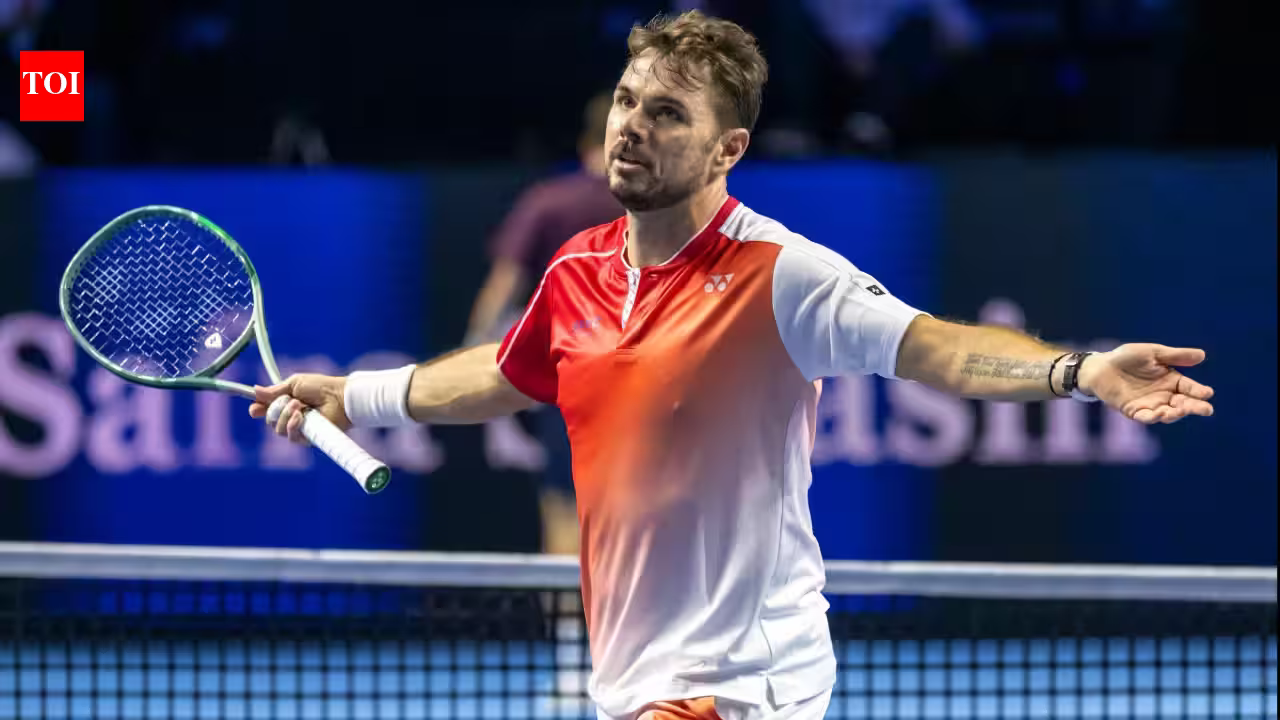
BASEL — The final chapter in one of the most compelling narratives in modern tennis has been written. Stan Wawrinka, the man affectionately known as “Stan the Man,” walked off the court at the Swiss Indoors in Basel for the final time on Tuesday, bringing the curtain down on an illustrious 24-year professional career that redefined what it meant to be a challenger in the era of the “Big Three.”
The 41-year-old veteran faced eighth-seeded Jiri Lehecka in an opening-round clash that served as the bittersweet stage for his retirement. Wawrinka, fighting with the same grit that characterized his two-decade tenure on the ATP Tour, fell 7-5, 7-6 (2). The match ended fittingly with a backhand wide—a stroke that had been his signature weapon throughout his career—drawing a collective, mournful sigh from the home crowd who had come to witness the end of an era.
A Legacy Forged in Fire
Wawrinka’s retirement concludes a journey that began in 2002. While he was a staple of the ATP Tour for over two decades, his legacy will forever be etched in the annals of tennis history by the sheer audacity of his three Grand Slam titles. In an era dominated by the iron grip of Roger Federer, Rafael Nadal, and Novak Djokovic, Wawrinka emerged as the ultimate disruptor.
What set Wawrinka apart was the caliber of his conquests. Each of his three major championships was earned by taking down a world No. 1 in the final, a feat that speaks to his unique ability to elevate his game when the stakes were highest.
In 2014, he dismantled Rafael Nadal at the Australian Open to claim his maiden Slam. A year later, in one of the most iconic performances in Roland Garros history, he stunned Novak Djokovic in the French Open final. He completed his trilogy of brilliance in 2016 at the US Open, once again besting Djokovic to capture his third major crown. These were not merely wins; they were displays of raw power, mental fortitude, and a one-handed backhand that remains arguably the most aesthetically pleasing and destructive shot in the history of the sport.
No Regrets: The Philosophy of a Champion
Speaking to the ATP Tour website ahead of his final match, Wawrinka reflected on the ethos that carried him from a promising young talent to a titan of the game. For Wawrinka, tennis was never just about the trophies; it was about the integrity of the process.
“For me, all I wanted in my career was to give everything, to have no regrets, to always fight, to always give 100% in every match—out of respect for myself, for the opponent, for the tournament, for the fans, for everybody,” Wawrinka said. “That was always the most important thing for more than 20 years, and that’s the only way you can leave the sport: without any regrets.”
That commitment was evident throughout his farewell year. Having announced last December that 2026 would be his final season, Wawrinka treated every tournament—from the grandest stages to smaller tour stops—as an opportunity to pay homage to the sport he loves. He leaves the game with 16 tour-level titles and a career-best world ranking of No. 3, achieved in 2014, the same year he cemented his place as a Swiss sporting icon.
Beyond the Singles Court
While his individual achievements are storied, Wawrinka’s contribution to Swiss tennis is equally monumental. His partnership with compatriot Roger Federer provided some of the most memorable moments in the nation’s sporting history. The duo famously captured the doubles gold medal at the 2008 Beijing Olympics, a triumph that galvanized the Swiss tennis community.
Perhaps even more significant was his role in helping Switzerland secure its first Davis Cup title in 2014. Together with Federer, Wawrinka helped transform Switzerland into a global powerhouse, proving that he could thrive not only as a solitary warrior on the court but as a leader within a team environment.
The Final Bow
As Wawrinka packed his bags in Basel, the tennis world began the process of digesting the void left by his departure. He leaves behind a generation of players who grew up watching his fearless approach to the game. He was the bridge between the dominance of the past and the uncertainty of the future, a player who taught fans that even the most formidable giants could be toppled if one possessed the courage to swing freely.
The atmosphere in Basel was one of profound respect. The fans, who have cheered for him since his early days on the circuit, gave him a standing ovation that echoed through the stadium. There were no tears, only gratitude for a man who had left every ounce of his energy on the court.
Stan Wawrinka exits the stage having fulfilled his own promise: he fought until the end, he showed respect to the game, and he walked away with his head held high, leaving nothing behind but the indelible mark of a true champion. The “Big Three” may have defined the era, but Stan Wawrinka provided the heartbeat of the sport’s most thrilling upsets. Tennis is undoubtedly losing one of its most authentic voices and fiercest competitors.
Disclaimer: This content is auto-generated for informational purposes only.
Source: Read Original News