





The Emergence of Xreal Aura and Android XR
The landscape of wearable technology is undergoing a significant shift with the introduction of the Xreal Aura, a pair of spatial computing glasses developed in strategic partnership with Google. Unveiled during the Google I/O 2026 event, the Aura represents the first hardware to utilize the Android XR operating system. By integrating augmented reality and virtual reality capabilities into a wearable form factor, these glasses seek to bridge the gap between heavy, enclosed headsets and standard eyewear.
The device is currently available for preorder on the Xreal website, with shipments scheduled to commence in mid-November. The manufacturer has positioned this launch as a milestone for spatial computing, targeting users who require high-performance processing without sacrificing situational awareness. To incentivize early adoption, the company is offering a discount of $180, reducing the initial cost from $1,279 to $1,099 for a limited period.
Technical Specifications and Display Performance
At the core of the Xreal Aura is an advanced display architecture featuring dual Sony Micro-OLED panels. These displays are capable of delivering a peak brightness of 1,050 nits and a refresh rate of up to 120Hz, ensuring smooth visuals for both gaming and professional tasks. The hardware provides a 70-degree field of view, which allows for a substantial digital canvas within the user’s line of sight.
To manage the heavy computational demands of spatial tracking and rendering, the Xreal Aura utilizes an external processing unit—often referred to as a “puck”—which houses the battery and the primary compute resources. This design choice keeps the weight of the glasses themselves under 95 grams, significantly improving comfort during extended use. Internally, the device is powered by the Qualcomm Snapdragon Reality Elite Platform, complemented by the proprietary Xreal X1S chip to facilitate complex spatial calculations.
Interaction Models and Connectivity
One of the primary objectives of the Android XR platform is to offer flexible interaction methods that move beyond the traditional reliance on physical controllers. The Xreal Aura supports a multimodal interface that includes voice commands, hand tracking, and conventional inputs such as keyboards, trackpads, and standard game controllers. By leveraging onboard sensors and cameras, the device translates physical hand gestures into digital actions, enabling a intuitive navigation of the virtual environment.
Connectivity remains a tethered experience to ensure low latency and high data throughput. By offloading the primary compute tasks to the external unit, the glasses maintain a slim profile while delivering high-fidelity performance. The integration of Bose audio technology and a four-microphone array ensures that both audio output and voice recognition remain clear, even in diverse environments. Furthermore, the inclusion of electrochromic dimming with five transparency levels allows users to transition between augmented reality experiences and the real world by adjusting the opacity of the lenses.
Ecosystem Integration and Software Capabilities
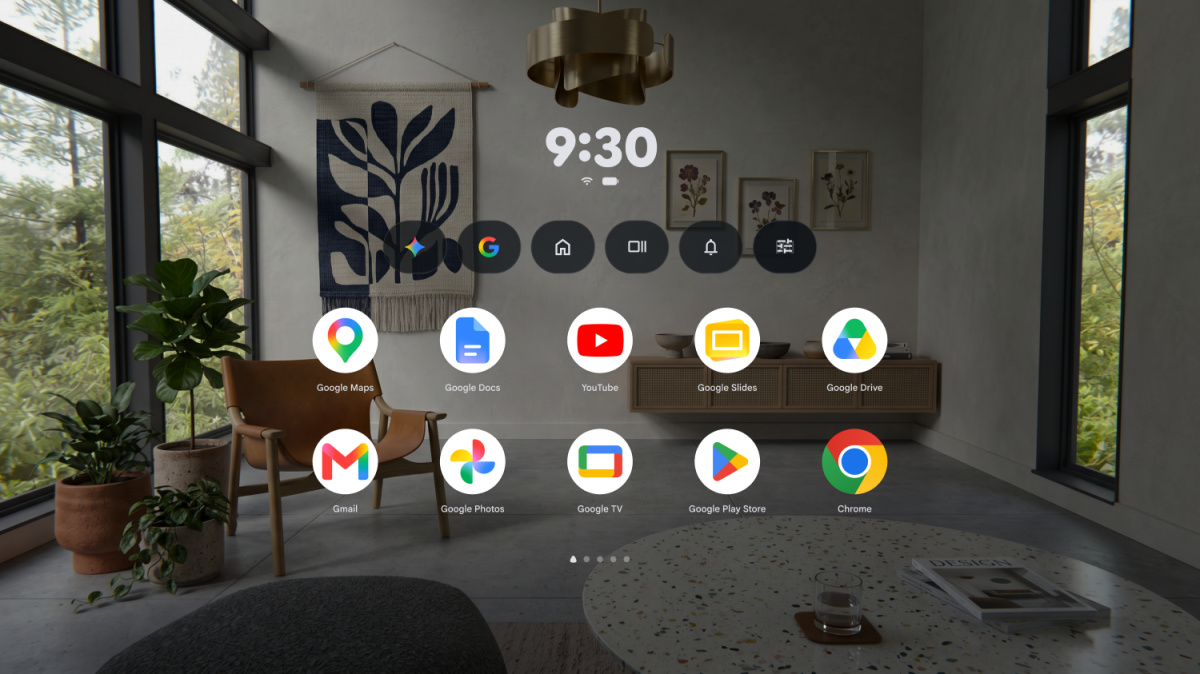
The Xreal Aura is built to leverage the expansive Android ecosystem from its initial launch. A central feature of this integration is the inclusion of Gemini, Google’s AI assistant. Users can summon the AI to analyze their surroundings, retrieve information, or automate tasks across multiple applications simultaneously. This creates a functional bridge between digital data and the physical workspace.
Beyond productivity, the device emphasizes immersive media consumption. Users can access Google Photos to transform standard 2D images and videos into 3D spatial experiences. Panoramas are rendered as full 360-degree environments, and Google Maps allows for exploration of terrain and urban centers in 3D. The platform also launches with a curated library of over 150 applications, including specialized XR titles such as the mixed-reality adventure “Project Hail Mary: Journey Among the Stars” and various sports applications from the NBA and NASCAR.
Impact on the Spatial Computing Market
The introduction of the Xreal Aura places it in direct competition with emerging devices in the spatial computing sector. While companies like Meta and Snap have announced their own ventures into smart glasses and virtual reality hardware, the Xreal Aura is notable for being one of the first to implement the Google-backed Android XR platform on a mass-consumer scale.
The strategy behind these glasses is to provide the utility associated with the Apple Vision Pro—namely, the ability to anchor apps and media to physical space—within a device that preserves the user’s peripheral vision. By focusing on a lighter, glass-like form factor, Xreal is attempting to prove that high-end spatial computing does not necessarily require a bulky headset. As more developers begin to build for the Android XR ecosystem, the versatility of the Aura is expected to grow, potentially establishing a new standard for how users interact with digital interfaces in their daily environments. Whether the market is ready for a $1,279 pair of tethered glasses remains to be seen, but the underlying technology represents a significant leap forward in the miniaturization of high-performance augmented reality.
Disclaimer: This content is auto-generated for informational purposes only.
Source: Read Original News