









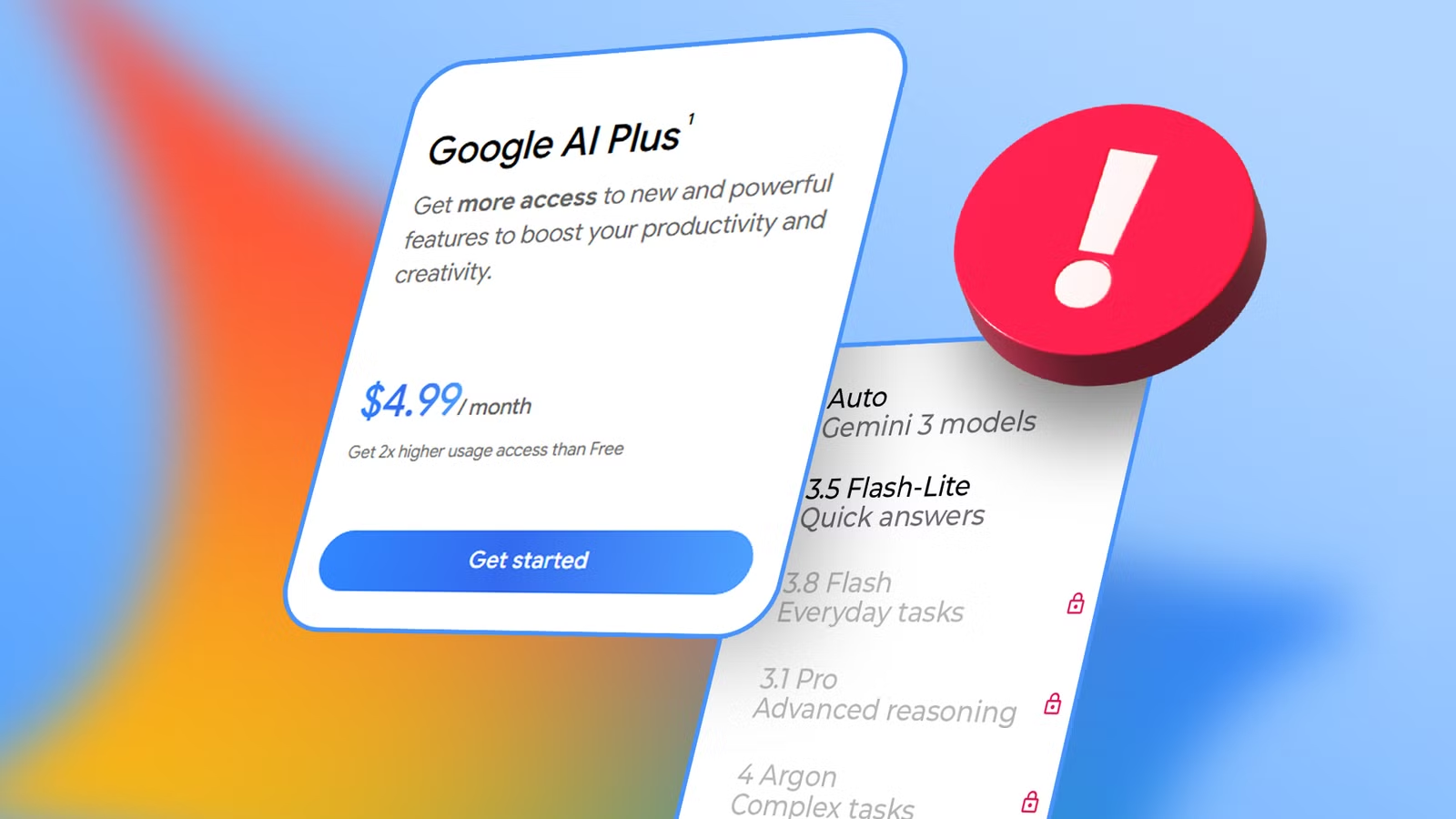
Google AI Plus was the sweet spot for budget-conscious users
For many, Google AI Plus represented the ideal compromise between a basic free service and a premium enterprise-grade subscription. At a price point of $5 per month, it provided users with access to some of the most advanced language models available without the steep barrier to entry presented by the $20-per-month Google AI Pro tier.
The primary draw for this subscription was the ability to toggle into Pro-level models for complex tasks, even with limited quotas. It allowed hobbyists, students, and light professional users to leverage Google’s highest-performing AI for specialized coding, deep reasoning, or nuanced creative writing. When combined with 400GB of cloud storage and advanced features like Deep Research, the service offered a value proposition that felt both fair and practical. It was the standard recommendation for anyone who felt the free version was too limited but did not require the heavy-duty infrastructure of the top-tier plan.
Google is taking away an existing benefit
The landscape of AI subscriptions is shifting as Google prepares to enact significant changes on November 13. The most impactful update is the removal of the ability for AI Plus subscribers to access Pro models within the Gemini app and the AI integration in Google Search. After this date, these users will be strictly confined to the Flash model tier.
This decision marks a notable departure from how the subscription was originally marketed. Users who opted for AI Plus did so with the expectation of a hybrid experience that included at least some exposure to the company’s flagship model capabilities. By removing this feature, Google is effectively forcing users to choose between a significant downgrade in utility or a fourfold increase in their monthly expenditure to reach the AI Pro tier. This change is particularly difficult for long-time subscribers who have built workflows around the occasional, precise reasoning of the Pro models, only to find that their access is being revoked retroactively.
AI Plus still has value, but its target audience is changing
While the loss of Pro-model access is a significant blow, the AI Plus subscription is not being rendered useless. The plan still retains its 400GB cloud storage allotment, which remains a primary utility for many Google ecosystem users. It also includes ongoing access to various Gemini Notebook features and expanded capabilities in image and video generation tools.
However, the profile of the “ideal” subscriber is shifting. Previously, the plan was a gateway to advanced artificial intelligence. Moving forward, it is becoming a storage-centric bundle with lightweight AI utility. Users who rely on AI for complex reasoning or specialized professional tasks will likely find that Flash models, while fast and efficient, cannot bridge the gap left by the absence of Pro-tier intelligence. The value of AI Plus is now tethered more to its storage and basic productivity integration than to its status as a high-performance AI tool.
Google is creating a fragmented Gemini experience
One of the growing criticisms of Google’s strategy is the increasing fragmentation of its AI ecosystem. Even before the upcoming changes, navigating the differences between various subscription tiers and model versions was a complex task for the average consumer. The distinction between “Flash” and “Pro” versions is not static; for instance, the Gemini app currently serves an older iteration of Flash (3.6) to AI Plus subscribers, while newer versions (3.8) are locked behind higher-tier plans.
This creates a “subscription maze” that hinders user trust. When consumers cannot easily ascertain which model they are paying for—or why they lack access to specific new releases like Gemini Argon—the perceived value of the ecosystem declines. Having to consult support documentation or comparison charts just to understand the baseline functionality of a paid service is a hurdle that complicates the user experience. By tightening access controls and segmenting model versions so aggressively, Google risks alienating the power users who were most engaged with their technology.
The impact of the shift to Flash-only
It is worth noting that Google’s Flash models are technically impressive. Gemini 3.8 Flash is capable of performing, coding, and reasoning at a level that far exceeds the capabilities of chatbots from only a year ago. For the vast majority of standard consumer queries, it is more than adequate.
The core concern, however, lies in the future of the product. As Google continues to push the boundaries of “reasoning” models and advanced agents, the divide between the Pro and Flash tiers will inevitably grow wider. By restricting AI Plus users to the Flash ecosystem, Google is essentially creating a second-class tier that will fall further behind every time a new, more powerful Pro model is introduced. The flexibility to test and utilize these advancements was what gave AI Plus its identity. Without that, users are left with a subscription that offers a great deal of storage, but an increasingly stagnant window into the future of artificial intelligence.
Disclaimer: This content is auto-generated for informational purposes only.
Source: Read Original News