









The Critical Intersection of Civil and Defence Aviation
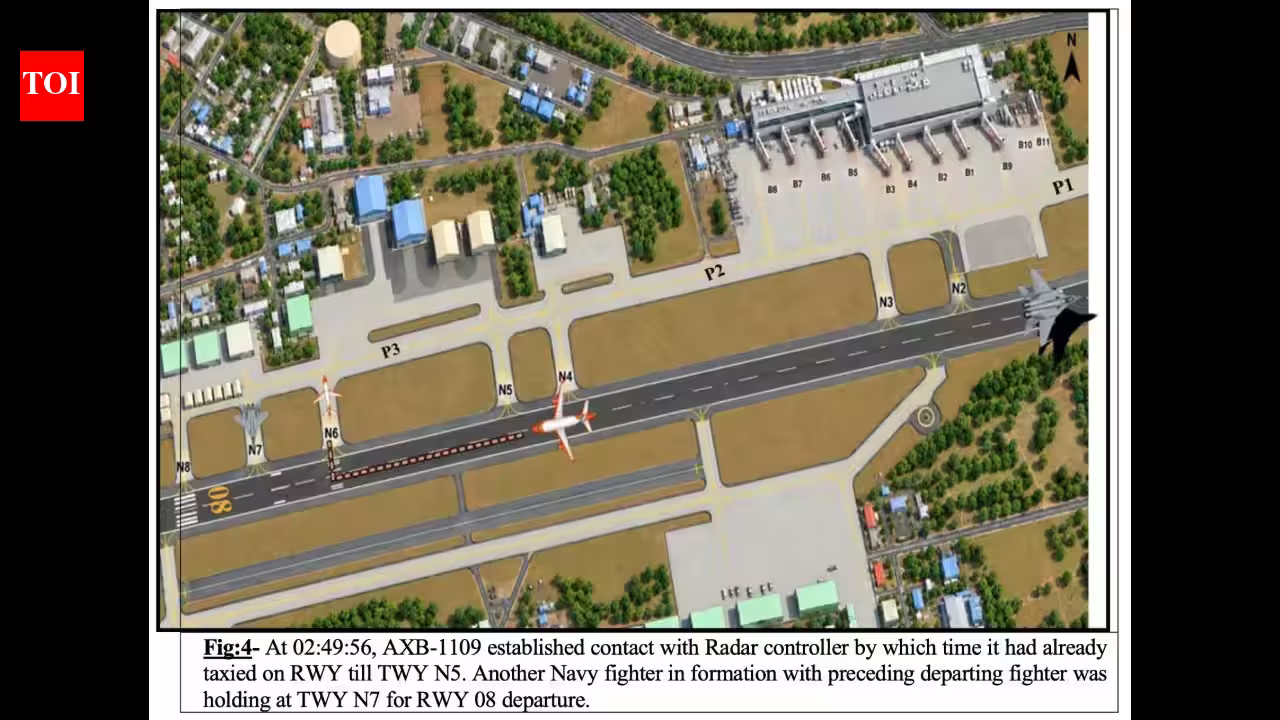
The recent incident at Goa’s Dabolim Airport, involving a near-collision between an Air India Express commercial flight and a Navy fighter jet, has brought a long-standing structural challenge in Indian aviation into sharp focus. With several of India’s busiest airports functioning as “civil enclaves” within larger military airfields, the operational synergy between the Directorate General of Civil Aviation (DGCA) and the Ministry of Defence is no longer a matter of convenience; it is a fundamental safety imperative. The Aircraft Accident Investigation Bureau (AAIB) has now formally advocated for a robust, formal framework to bridge the gap between these two distinct governing bodies.
In the Indian context, the sharing of airspace and runways between military and civilian aircraft is a product of historical development and geographical necessity. Airports like Dabolim, Pune, Srinagar, and Visakhapatnam handle both tactical fighter operations and high-density commercial passenger traffic. While this dual-use model maximizes the utility of national infrastructure, it creates unique complexities in Air Traffic Control (ATC) protocols, communication standards, and emergency response procedures. The AAIB’s recommendation for a structured information-sharing mechanism highlights the need to move away from ad-hoc coordination and toward an integrated safety oversight system that transcends the organizational silos of the armed forces and civil aviation regulators.
Anatomy of a Runway Incursion: Communication and Clarity
The near-miss at Dabolim underscores the fragility of verbal communication in high-pressure aviation environments. The investigation revealed that a misinterpretation of standard phraseology—specifically the confusion between “expect backtrack” and “enter backtrack”—precipitated the runway incursion. This specific incident serves as a sobering reminder that terminology that seems clear to an air traffic controller can be misinterpreted by a flight crew during the high-workload phases of taxiing and takeoff.
The AAIB’s directive to the Airports Authority of India (AAI) to re-sensitize controllers on phraseology is an essential corrective measure. However, the industry-wide lesson is that standard operating procedures (SOPs) must be resilient enough to account for human error. In mixed-use airfields, the pressure on ATCOs is amplified by the presence of high-performance military aircraft that operate under different performance profiles and priority constraints than commercial jets. The recommendation to review the usage of specific phrases is not merely a linguistic exercise; it is an attempt to standardize the “language of safety” across the civil-military divide, ensuring that every command is unequivocal and devoid of potential for misinterpretation.
Redefining Infrastructure Safety at Dual-Use Airports
Beyond the human element, the AAIB report identifies specific physical infrastructure concerns that contribute to the risk profile of dual-use airports. By designating a specific taxiway at Dabolim as a “hotspot” due to its proximity to civil aprons, the investigation highlights the need for modernized ground control infrastructure. The recommendation to install and utilize “stop bars”—light-based signals used to control aircraft movement on taxiways—is a critical infrastructure upgrade that would provide a visual barrier against runway incursions.
For the Indian aviation sector, which is currently undergoing a massive expansion in terms of fleet size and passenger throughput, the retrofitting of older airfields is a financial and operational challenge. However, the cost of implementing modern runway safety systems is negligible compared to the potential consequences of a major accident. The integration of advanced surface movement guidance and control systems (SMGCS) across all civil-military enclaves would provide an automated safety net that reduces reliance on manual coordination. As India continues to develop new regional airports and upgrade existing ones, the inclusion of these safety features must be a non-negotiable component of initial airport planning rather than an afterthought post-incident.
The Necessity of Formal Collaboration Frameworks
One of the most significant takeaways from the AAIB report is the call for a “formal framework for collaboration” between civil aviation regulators and defence authorities. Currently, investigations into incidents at dual-use airports can be hampered by the compartmentalized nature of military data and the distinct regulatory mandates of the DGCA. A formal framework would allow for the seamless exchange of unclassified information, flight data, and cockpit recordings, which is vital for performing a root-cause analysis of any incident.
This collaboration is also required at the procedural level. The recommendation for the Navy to consider standardizing the frequency change-over process for civil traffic transitioning from ground to tower frequency is a practical step toward reducing cognitive load on pilots. In a busy airfield, a pilot moving from a ground controller to a tower controller must manage multiple radios and frequencies. If the procedure is not identical across all aircraft types or if the timing of the hand-off is ambiguous, the risk of a “communication black hole” increases. Standardizing these protocols ensures that transitions are seamless, regardless of whether the aircraft is a commercial Airbus or a naval fighter.
Addressing the Human Factor and Organizational Culture
The AAIB’s directives extend beyond technical and procedural recommendations to include the human element within the airlines themselves. Requiring the Air India Express crew to undergo counseling and specific training on safety lapses highlights the shift toward a “Just Culture” in Indian aviation. This approach acknowledges that while systems should prevent errors, individual accountability remains a crucial pillar of safety. By addressing the lack of operational clarity at an individual level, the regulator is sending a strong signal that safety is a shared responsibility between the airline management, the individual flight crew, and the airport operators.
However, training alone cannot compensate for flawed systemic architecture. The airline’s responsibility to issue circulars and update training modules is a reactive step that must be complemented by the proactive regulatory oversight of the DGCA. The overarching goal for the Indian aviation industry must be the development of an integrated safety management system (SMS) that accounts for the unique complexities of civil-military cooperation. As passenger traffic continues to grow, the frequency of aircraft movements at these dual-use airports will only rise, making the current model of fragmented communication unsustainable.
Charting the Future of Indian Aviation Safety
The lessons from the Dabolim incident provide a blueprint for how Indian aviation can mature into a more safety-conscious, technologically driven ecosystem. The transition toward greater transparency between the defence and civil sectors is not just about avoiding accidents; it is about building a foundation for sustained growth. As India pursues its vision of becoming a global aviation hub, the reliability and safety of its dual-use infrastructure will be evaluated by international stakeholders.
The proactive recommendations made by the AAIB represent a significant stride in modernizing oversight. By addressing the nuances of phraseology, investing in modern infrastructure like stop bars, and creating a mandate for inter-agency information sharing, the Indian aviation sector can mitigate the risks associated with its unique operational environment. Achieving this will require continuous engagement between the Ministry of Civil Aviation and the Ministry of Defence, ensuring that safety protocols evolve as rapidly as the industry itself. In the coming years, the success of these reforms will be measured by the ability of these two distinct sectors to function as a unified, safe, and efficient system for all airspace users.
Disclaimer: This content is auto-generated for informational purposes only.
Source: Read Original News