







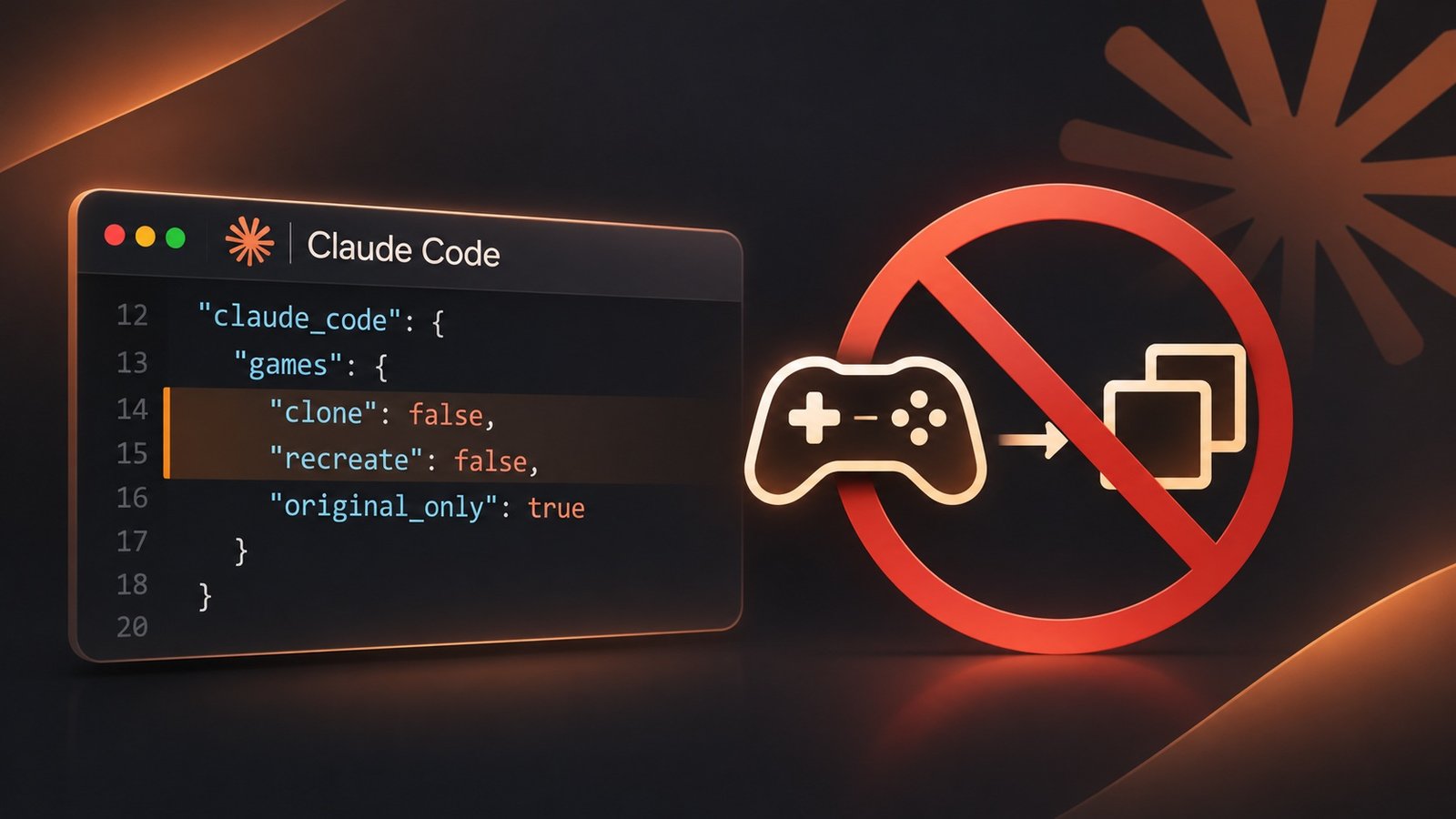
Anthropic has implemented new constraints within its Claude Code AI assistant aimed at preventing the unauthorized reproduction of existing video games. This update, which arrived as a server-side configuration change identified as “tengu_heron_brook,” marks a significant shift in how the developer tool handles requests related to established gaming intellectual property. While the objective is to mitigate copyright infringement, the deployment has triggered immediate friction among the developer community, who report that the guardrails are inadvertently blocking legitimate software projects.
The Mechanics of the New Restrictions
The restriction is explicit: Claude Code is now instructed not to build a recreation of a specific, existing game, even if that project is rebranded or presented as an original creation. The configuration directive clarifies that while the AI should continue to assist in building original games, projects within established genres, or software utilizing a user’s proprietary designs and assets, it must refuse tasks that involve cloning existing titles.
Addy Osmani, representing Anthropic, confirmed the modification, noting that the update was integrated into the prompt for the Opus 5.5 model. The company framed this as a necessary step to align AI assistance with existing usage policies that prohibit copyright infringement. By embedding these instructions directly into the system prompt, Anthropic aims to automate the enforcement of intellectual property boundaries that were previously handled through broader, more manual policy compliance checks.
Impact on Independent Developers
Despite the intent to protect intellectual property, the implementation has led to unexpected operational hurdles for professional developers. A notable case involves Conflict Simulations LLC, a firm that specializes in digital board-wargame modules. The developer reported that their professional workflow—which involves writing original code to create digital adaptations for customers who own the physical board games—was halted by the AI.
The issue highlights a persistent technical hurdle: AI models often struggle to distinguish between a “clone” of a game and a “derivative work” or “adaptation” that may be legally permissible or requested by a client. Because the tool is now primed to be hyper-vigilant regarding game-like structures, it has begun to trigger false positives, refusing to execute code for projects that do not technically infringe on protected assets but share structural similarities with existing tabletop or video game systems.
Reverse Engineering and Modding Challenges
The broader developer community, particularly those involved in PC modding and reverse engineering, is watching these developments closely. In the gaming space, AI tools have become essential for optimization and game preservation. For instance, recent performance-enhancing mods for classic titles have demonstrated significant frame-rate improvements and stutter reduction by using AI to analyze and suggest code refactoring.
While the new Claude Code policy does not explicitly forbid modding, the ambiguity of the directive leaves developers in a state of uncertainty. If an AI assistant cannot reliably differentiate between a malicious clone and a legitimate performance mod or a reverse-engineered patch, developers may find their productivity stifled. The fear is that as AI tools become more restrictive to avoid legal liability, they may inadvertently lose their utility for the very hobbyist and professional communities that have championed their use in software maintenance and improvement.
Balancing Compliance and Utility
Anthropic is currently navigating the difficult intersection of copyright law and open-ended generative AI utility. For the company, the “tengu_heron_brook” update is a mechanism to shield its platform from being utilized as a tool for widespread piracy or asset theft. However, as evidenced by the growing number of complaints on platforms like GitHub, the current implementation lacks the nuance required to handle the complexities of software development.
The company has encouraged users to report instances where their legitimate work is wrongly blocked. This suggests that the current mechanism is a work-in-progress, likely subject to continuous tuning. As Anthropic refines the system, the challenge will be to create a filter that is precise enough to catch direct code-cloning efforts without overreaching into the legitimate, creative, and transformative work that defines the modern software development lifecycle.
Future Outlook for AI Development Tools
This situation underscores a growing trend in the AI industry: the transition from permissive general-purpose tools to specialized, policy-governed environments. As AI becomes deeply integrated into IDEs (Integrated Development Environments), users should expect more frequent updates to these system-level constraints.
For developers, the lesson is clear: reliance on cloud-based AI tools for complex projects carries the risk of sudden, externally imposed constraints. Moving forward, providers like Anthropic will need to provide better transparency regarding how these constraints are triggered and offer clear pathways for developers to contest incorrect flagging. Without such mechanisms, the utility of AI assistants in specialized domains will remain perpetually at odds with the providers’ need to mitigate legal risk. Whether through improved prompt engineering or more sophisticated classification models, the industry must find a way to maintain the guardrails without obstructing the legitimate technical progress of the software community.
Disclaimer: This content is auto-generated for informational purposes only.
Source: Read Original News