







Seasonal monsoon rains in India turn crops lush and fill essential water reservoirs. They can also cause roads to flood and bring train travel to a standstill, impacting the economic heartbeat of cities and towns.
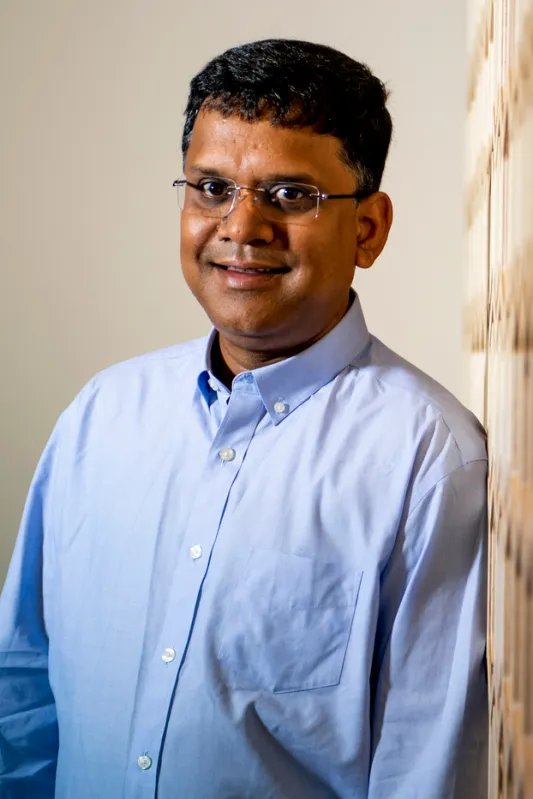
Udit Bhatia, a scientist trained at Northeastern, has a new startup that looks to AI to not only better predict rainfall amounts but also to prescribe best responses to urban flooding in India.
From rerouting traffic and evacuating residents to using pumps at strategic locations along railroad lines, the new program, called AIResQ, aims to release the bottlenecks that keep India’s streets clogged during the rainy season that runs June through September.
AIResQ “is not just about predicting floods but also about doing it in real time,” said Bhatia, an associate professor of civil engineering at the Indian Institute of Technology, who co-founded AIResQ with Northeastern’s College of Engineering Distinguished Professor Auroop Ganguly.
“One of the products we develop for cities is where they get to foresee in real time or near-real time (what) traffic would look like if it starts raining at a particular time in the day,” said Bhatia, who received his Ph.D from Northeastern in 2018.
AIResQ models can show that it’s going to start raining at 3 p.m., and then the program can also indicate which areas are going to be a hotspot for traffic by 6 p.m. or 7 p.m., when most people are leaving the office, Bhatia explained.
From there AIResQ helps come up with solutions depending on the depth of water, as well as the velocity, direction of flow and total volume of water in particular locations, he said.
Bhatia’s development integrates physics and AI to solve problems in urban hydrology, Ganguly said, who calls his former student an innovator.
AIResQ is already in demand.


Two cities using the program are Gurugram, which is just outside India’s capital city of New Delhi, and Changodar, an industrial part of the city of Ahmedabad in the western state of Gujarat. Those cities are working with Bhatia’s startup on seasonal flooding issues, said AIResQ board member Vivek P. Kapadia.
“What is especially important in the AIResQ approach is that it goes beyond flood prediction alone,” Kapadia said. “The objective is not merely to know where water will accumulate but to understand what that means for infrastructure and what can be done about it in time.”
The information Bhatia’s model provides is especially important for transportation agencies like Indian Railways, which has expanded greatly over the past decade, said Nikhil Srivastava, a senior divisional engineer for the railway.
The data generated can help identify vulnerable stretches, flag areas for monitoring in extreme rainfall and target where to send resources, Srivastava said, adding that over time, such tools could also help with creating more resilient design, planning better drainage and prioritizing maintenance efforts.
AIResQ is also in the pilot stage of installing low-cost sensors on streets to continuously stream real-time water depth during rainfall and flood events, Bhatia said.
He said satellite-based sensors capture the extent of flooding over large areas but not water depth and flow velocity, which have a major impact on infrastructure and mobility.
In addition to high-tech data, Bhatia’s startup also has designed a platform where people can report how high flooding is where they are located. The portal is live on the Gurugram city website as an example of what Ganguly calls urban citizen science.
Bhatia said the sensors and citizen science platform provide two data streams that “build high-resolution, real-time flood maps” during extreme events.
Bhatia said his time at Northeastern helped him “connect the dots” between teaching, research and translating research into action. In addition to working as a teaching assistant and co-instructor in Dialogues of Civilization in Singapore and Indonesia, India, Peru and Brazil, he worked with Ganguly’s Sustainability and Data Sciences Laboratory on resilience planning for Climate Ready Boston and Brookline’s heat action plan.
He also co-authored a textbook, Critical Infrastructures, Resilience Policy and Engineering Principles, with Ganguly and Northeastern professor Stephen Flynn.
Kapadia, who is retired from a position as secretary of the government of Gujarat, said the “ultimate beneficiaries” are the people in cities that employ AIResQ. “Better prediction, better preparedness and better response together improve resilience for all stakeholders,” he said.