






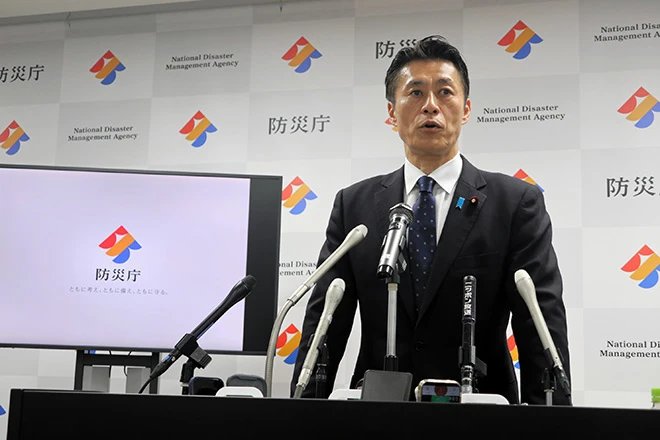
TOKYO — In a move aimed at fortifying the nation against seismic and volcanic threats, the Japanese government officially launched the National Disaster Management Agency on Nov. 2. The new body will serve as the country’s central command hub, overseeing the full spectrum of disaster management, from prevention and emergency response to long-term reconstruction efforts.
Goshi Hosono, the minister of state for disaster management who will lead the new agency, stated during a press conference that the goal is to position Japan as the global leader in disaster preparedness. The agency arrives at a critical juncture, tasked specifically with safeguarding the public against high-probability, high-impact events, including a projected major Tokyo metropolitan earthquake, a Nankai Trough megaquake, and a potential eruption of Mount Fuji.
The launch was accompanied by a series of “emergency requests” issued by Hosono to the public, local governments, and central ministries. Citing data that places the probability of a Nankai Trough megaquake at 60 to 90 percent within the next 30 years—and a 70 percent chance of a significant Tokyo quake—Hosono emphasized the urgency of the situation.
“A disaster can happen at any time,” Hosono said, urging citizens to treat disaster risk as a personal responsibility. “The government will do its best to respond, but each person must protect his or her own life in the event of a disaster on the scale of a national crisis.”
The minister’s call to action included specific directives for residents, such as upgrading the seismic resistance of homes built before 1981 and maintaining a stockpile of emergency food and water for at least three days, with a preference for a one-week supply. He further encouraged the public to study local hazard maps, identify evacuation routes, and actively participate in community disaster drills.
At the bureaucratic level, the agency is wasting no time. Hosono has challenged government ministries and agencies to accelerate 106 specific measures outlined in the basic plan for Nankai Trough preparedness. These initiatives include hardening the seismic resilience of schools and medical facilities, as well as upgrading the living conditions of evacuation centers with better sanitation, bedding, and climate control. Local governments have been similarly instructed to begin designating temporary housing sites and training specialized disaster management personnel.
To ensure accountability, the agency will require progress reports from all ministries, agencies, and prefectures by the end of the year. Hosono warned that the agency is prepared to issue formal recommendations and demand corrective action if objectives are not met.
The agency’s leadership team includes Vice Minister for Disaster Management Michihito Kaneko, a member of the Japan Innovation Party, and Parliamentary Secretary Yohei Onishi of the Liberal Democratic Party. Former land ministry official Kazuhisa Nagahashi has been appointed as the administrative vice minister, signaling a commitment to integrating professional technical expertise with political oversight.
Disclaimer: This content is auto-generated for informational purposes only.
Source: Read Original News