








The Resurrection of an Abandoned Architecture
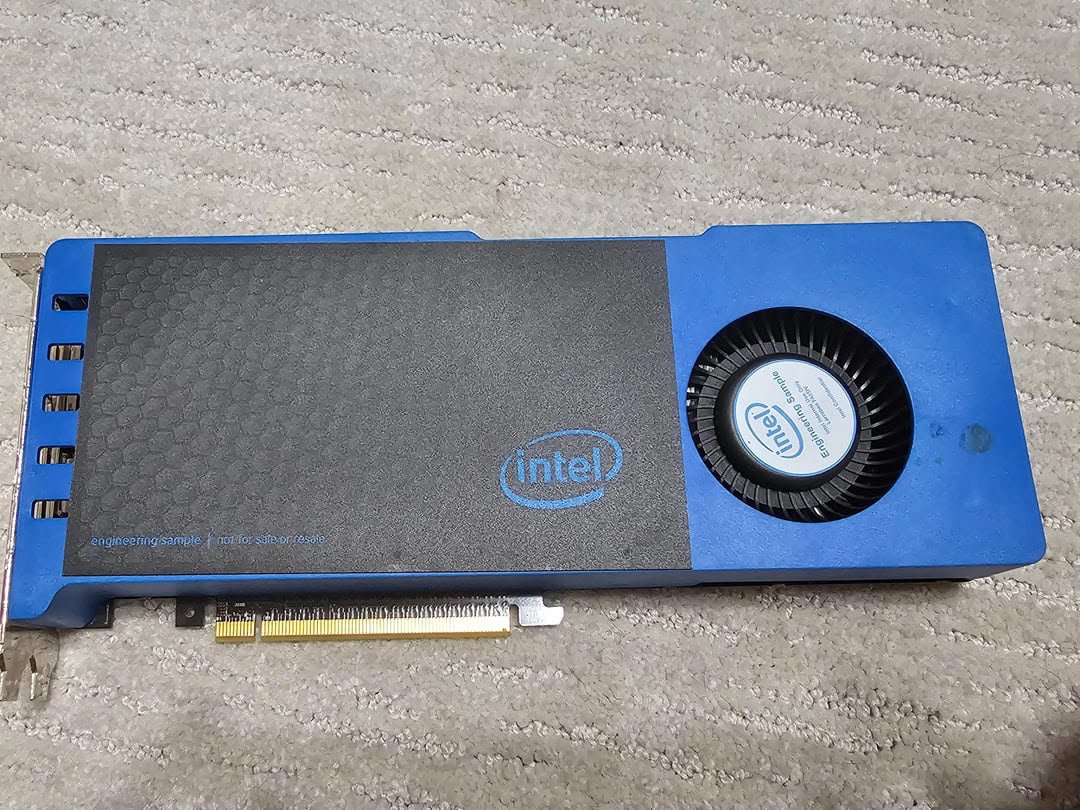
In a remarkable convergence of hardware archaeology and digital preservation, a rare Intel Larrabee prototype has been brought back to life. The Larrabee project, which represented Intel’s most ambitious attempt to enter the dedicated high-performance graphics market during the late 2000s, was officially abandoned for consumer release in 2009. However, the recent discovery of a complete development kit—formally titled the “Intel Visual Adrenaline” system—has provided the hardware enthusiast community with a functional look at what might have been.
The system was unearthed by a Reddit user who acquired it during a storage unit auction. Beyond the core hardware, which includes a DX58SO motherboard and a C0 stepping Larrabee silicon sample, the find included two USB drives containing critical development software, internal documentation, and VBIOS instructions. This discovery offers more than just historical intrigue; it provides a tangible look at the unique x86-based compute philosophy that Intel once bet its graphics future on.
Technical Hurdles and System Configuration
Restoring a prototype that has been dormant for over a decade is rarely a plug-and-play experience. To bring the Larrabee system to a bootable state, the user had to navigate significant compatibility challenges. The hardware, which relies on legacy firmware and pre-production diagnostic boards, required precise configuration to function with modern peripheral expectations.
Key adjustments included bypassing standard HDMI outputs in favor of DVI, which was more reliable during the board’s initial initialization phase. Furthermore, the storage controller settings within the motherboard’s BIOS had to be manually reconfigured to ensure stability under a Windows 7 environment. Given the custom nature of the Larrabee drivers, the operating system served primarily as a host for the specialized software stack included on the recovered USB drives. These archives, totaling approximately 810 MB of data, contained the essential headers and binary files required to map the device to the system bus, allowing the operating system to recognize the Larrabee as a functional graphics adapter.
The Larrabee Philosophy: x86 Graphics
The core architecture of Larrabee was fundamentally different from the fixed-function pipeline hardware produced by NVIDIA or AMD at the time. Intel’s design strategy favored a software-defined approach, utilizing an array of simple, in-order x86 processor cores equipped with wide vector units. These cores were tasked with performing traditional graphics operations—such as vertex shading and pixel processing—via software algorithms rather than dedicated, hard-wired silicon logic.
This approach was intended to provide unparalleled flexibility for developers. By shifting the graphics workload to general-purpose x86 cores, Intel hoped to leverage its dominant expertise in CPU manufacturing to dominate the GPU market. While the design included some fixed-function hardware for texture mapping, the heavy lifting was meant to be handled by the programmable cores. Although the project was cancelled as a consumer gaming product, the architectural lessons learned from Larrabee were not lost; the core design principles were eventually pivoted to create the Xeon Phi line of co-processors, which targeted high-performance computing and supercomputing workloads instead of gaming.
Performance Benchmarks and Real-World Tests
To evaluate the capabilities of the hardware, the revived prototype was subjected to standardized gaming tests, specifically using the title Crysis. Running at a resolution of 1280x720p with medium settings and antialiasing disabled, the system initially performed at 17 frames per second using the first set of recovered drivers.
After further optimization and the deployment of a secondary driver set found within the archives, performance improved to approximately 36 frames per second. While these numbers seem modest by modern standards, they represent a monumental achievement for a development board that was never intended for final commercial release. The ability to render a complex, graphics-intensive environment like Crysis confirms that the Larrabee design, while conceptually challenging to scale, was fundamentally sound in its execution of 3D acceleration.
Preservation and Future Exploration
The archival of these files on the Internet Archive is a significant event for those interested in the history of computer architecture. By providing open access to the drivers, utilities, and internal documentation, the discoverers have invited the global tech community to conduct further analysis. The presence of these files allows for potential reverse engineering of the Larrabee command buffer and the underlying software stack.
Moving forward, the community is looking toward two primary areas of interest. The first involves the potential to further optimize the existing drivers to stabilize performance. The second, more speculative goal, is the investigation of whether Xeon Phi hardware—the commercial successor to Larrabee—could be forced to run these graphics drivers. While the silicon architectures between the two differ, the architectural lineage suggests that there may be shared instruction sets that could permit experimental gaming scenarios on server-grade hardware.
The Legacy of the Visual Adrenaline System
The story of the Intel Larrabee prototype serves as a reminder of the iterative nature of technological innovation. Even when a product line is cancelled, the intellectual capital invested in its development often finds a second life in other sectors. In this instance, Larrabee’s failure in the gaming market arguably paved the way for Intel’s later success in parallel processing and compute-heavy silicon design. Through the dedication of enthusiasts and the availability of recovered development archives, this abandoned chapter of Intel’s history has finally become a public record, allowing us to better understand the technical path the industry nearly took.
Disclaimer: This content is auto-generated for informational purposes only.
Source: Read Original News