








Last week, the Central Board of Secondary Education (CBSE) introduced a set of changes as part of a new curriculum aligned with the National Education Policy (NEP) 2020.
The new curriculum provides for math and science to be offered at two levels in class 9 from the ongoing academic session onwards, with the advanced level having additional content for students. It also makes art education, vocational education, physical education, and computational thinking and AI mandatory subjects in classes 9 and 10 in the coming years.
Of the announcements made in the new curriculum, the three-language formula has kicked up a storm yet again, with Tamil Nadu Chief Minister MK Stalin calling it an “attempt at linguistic imposition”, and Union Education Minister Dharmendra Pradhan retorting that it is an effort to “promote all languages equally”.
Here’s what CBSE’s new curriculum proposes for languages, and the opposition to parts of it.
What does CBSE’s new curriculum say about languages?
The curriculum released last week for classes 9 and 10 introduces changes that the NEP and the National Curriculum Framework for School Education (NCFSE) 2023 recommend.
The NCFSE asks that school students learn three languages from class 6 all the way up to class 10: R1, R2, and R3. It also prescribes the competencies that students are expected to develop in these languages. This is different from the previous system where the third language was only taught from classes 6 to 8.
With the new curriculum, CBSE has made the third language compulsory in class 6 from the ongoing 2026-27 academic session onwards. This will be “R3”, and the teaching and learning of the third language in schools will now be as per the curricular goals that NCFSE 2023 specifies. Going by the NCFSE, at the middle stage (classes 6 to 8), students will be expected to develop effective communication skills in the third language for day-to-day interactions, express ideas by describing and narrating events and situations, develop fluency and the ability to comprehend what they read, and express their experiences, feelings and ideas in writing instructions, invitations, and letters.
Story continues below this ad
In line with these proficiencies that the NCFSE specifies, the Board will release learning material for R3 languages for class 6 online this month, according to an official.
The Board has said in its curriculum that as per the NCFSE, at least two of the three languages must be Indian languages. Official sources told The Indian Express earlier that this means that if a foreign language is taught as the third language in class 6, it will have to be accompanied by two Indian languages.
Making the third language compulsory in class 6 sets the stage for the Board to eventually make R3 compulsory in class 10. Students who are in class 6 in the ongoing academic session will be the first cohort that will have a third language when they are in class 10 in 2030-31. Going by the curriculum, the third language will involve a school-based internal assessment in 2031, and not a board exam. For the higher classes, books for the third language will have to be made available.
Why has the new curriculum sparked a controversy?
A few days after the CBSE’s curriculum was released, Tamil Nadu CM Stalin reiterated the State’s opposition to the three-language formula, stating that the curriculum “is not an innocent academic reform — it is a calculated and deeply concerning attempt at linguistic imposition that vindicates our long-standing apprehensions”.
Story continues below this ad
Both the ruling DMK and the opposition AIADMK in Tamil Nadu have opposed the three-language formula. Schools under the state board in Tamil Nadu are required to teach only two languages up to class 10: Tamil and English. Stalin’s argument is that “this framework effectively translates into compulsory Hindi learning”, and that the three-language system is a “covert mechanism to expand Hindi into non-Hindi speaking regions”.
Responding to Stalin, Pradhan stated that “by misrepresenting a flexible policy as ‘compulsory Hindi’, you are not defending Tamil; you are creating barriers that deny our youth the opportunity to become multilingual global leaders.”
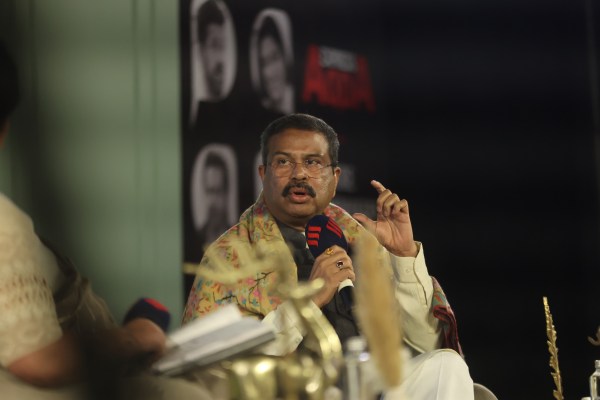 Union Education Minister Dharmendra Pradhan. Photo: Tashi Tobgyal
Referring to the NEP as a manifesto for linguistic liberation, Pradhan said, “Portraying multilingualism as a threat is misplaced. Tamil is not weakened by the learning of additional languages…NEP upholds constitutional principles by promoting all languages equally and also addresses the limitations of the existing two-language system.”
While the education policies of 1968 and 1986 proposed a three-language formula with “Hindi along with the regional language and English in non-Hindi speaking States”, NEP 2020 does not specify which three languages are to be taught. It states that three languages will be the choices of the States, regions, and students, as long as at least two of the three are native to India.
Story continues below this ad
CBSE’s three-language system will apply to CBSE-affiliated schools in Tamil Nadu, which have already been offering a third language to students.
According to data presented in response to a question in the Lok Sabha last year, 3.2% of the schools in Tamil Nadu (a total of 1,905 schools in the State) teach three languages. CBSE’s list of affiliated schools lists over 1800 schools in Tamil Nadu.
The Tamil Nadu Tamil Learning Act, 2006, provides for the phased implementation of Tamil as a compulsory subject for classes 1 to 10 in all schools of the State, including private ones.
Is Tamil Nadu the only State that opposes the three-language formula?
It has a companion in neighbouring Karnataka, where the Congress government in its state education policy has recommended a two-language policy. The State board in Karnataka has three languages in class 10.
Story continues below this ad
A separate row is playing out in the State. The Karnataka government has recently announced that only grades will be given for the third language in the state board class 10 exam, in what it said was an effort to reduce the academic burden on students, particularly in the context of students being unable to clear their third language paper.
Karnataka Governor Thaawarchand Gehlot has written to the state Chief Secretary asking the government to re-examine this switch from marks to grades for the third language. Referring to concerns raised in a representation received from an association in Bengaluru, the communication from the Governor’s office notes that “it has been pointed out that the proposed system of awarding only grades, in place of marks, may inadvertently diminish the academic importance of the subject and affect students’ motivation to engage seriously with it”.
After he asked for the decision to be reviewed, pro-Kannada groups have called for the Governor’s removal, stating that it was part of a “conspiracy” to “impose” Hindi in Karnataka.