








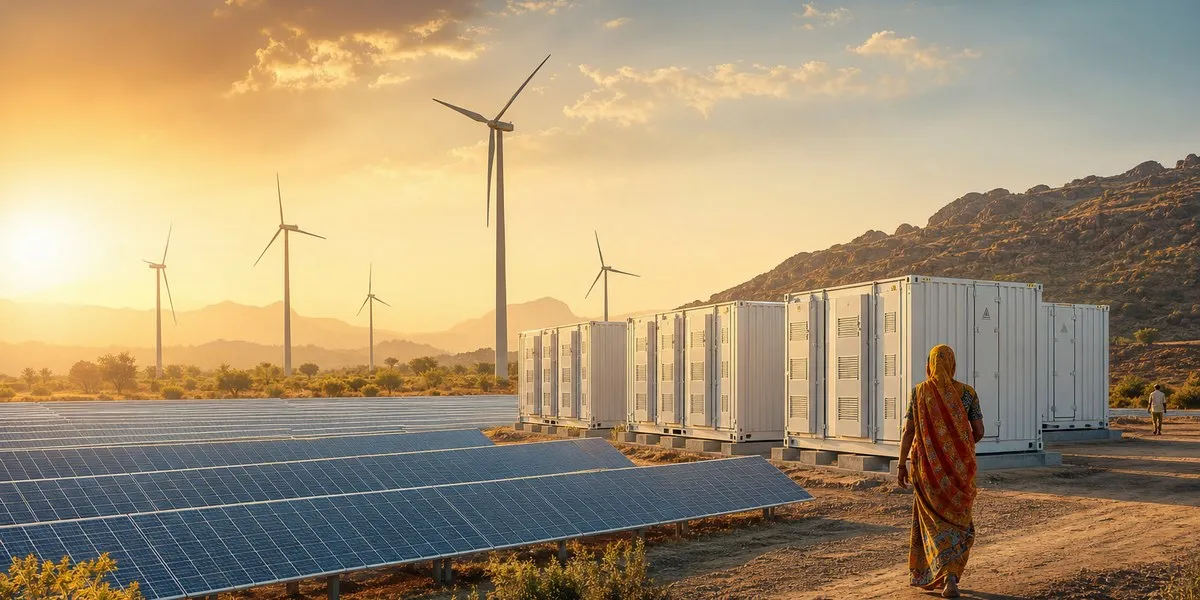
India Mandates Energy Storage for State Utilities to Tackle Renewables Curtailment
India is set to overhaul its renewable energy integration strategy by mandating that state-owned energy companies incorporate energy storage capacity into their infrastructure. The move, announced by Power Ministry Secretary Pankaj Agarwal during the recent Bharat Renewable Energy Summit, aims to address the growing crisis of wasted clean energy and grid instability.
As the nation aggressively scales up its solar and wind power footprint, it has faced a paradoxical challenge: significant quantities of green energy are being curtailed—or discarded—because the current power grid lacks the flexibility and storage capacity to manage intermittent supply.
Addressing the Curtailment Crisis
The scale of the problem is significant. Data from JMK Research & Analytics reveals that in September alone, India was forced to curtail approximately 118.6 GW of wind and solar capacity. This waste occurs despite the country frequently facing electricity shortages, highlighting a critical disconnect between energy generation and grid absorption.
Analysts point to several factors driving this inefficiency, including archaic transmission infrastructure, a misalignment between peak demand hours and peak renewable production, and a near-total absence of utility-scale battery systems. When solar and wind farms produce energy during periods of moderate demand, the grid is often unable to handle the influx, leading to forced shutdowns of these assets to prevent system-wide instability.
Strategic Shift Toward Storage
To resolve these bottlenecks, the federal government is launching a dual-pronged approach. Beyond the new requirements for state utilities to integrate storage, authorities are preparing to roll out new clean energy tenders that specifically mandate the inclusion of storage systems. By linking future generation projects to storage requirements, the government hopes to create a more resilient, “round-the-clock” renewable energy supply.
Looking ahead to July 2027, the Ministry of Power plans to enforce a landmark regulation requiring developers of all new solar and wind projects to install battery storage systems directly at the generation sites. This shift is designed to ensure that renewable energy can be banked during times of low demand and dispatched precisely when the grid needs it most.
Government Backing and Future Investment
The transition to a storage-backed grid is being supported by a substantial financial commitment from the federal government. To incentivize the industry, India has approved a funding program worth 145 billion Indian rupees (approximately $1.54 billion).
This capital is earmarked for the development of grid-scale energy storage systems, targeting the commissioning of 92 GWh of new capacity. The plan includes a strategic mix of technologies: 30 GWh dedicated to battery energy storage systems (BESS), 60 GWh allocated for pumped-hydro storage projects, and 2 GWh reserved for emerging energy storage innovations.
By diversifying its storage portfolio, India aims to stabilize its energy grid, reduce its reliance on fossil fuel peaking plants, and ensure that every megawatt of renewable energy produced contributes to the nation’s ambitious decarbonization goals. Through these regulatory and financial measures, the government is signaling that the era of passive renewable energy generation is coming to an end, giving way to a more sophisticated, storage-integrated power sector.
Disclaimer: This content is auto-generated for informational purposes only.
Source: Read Original News