







Scotch Price Wars: Indian Distillers Face Heat as Import Duties Plummet
Bengaluru: The landscape of India’s burgeoning spirits market is undergoing a seismic shift. As import duties on Scotch whisky continue to trend downward, a stark paradox has emerged: imported labels are increasingly undercutting domestic, craft-made spirits, leaving small-scale Indian distillers struggling to justify their price tags in a hyper-competitive environment.
The Price Inversion
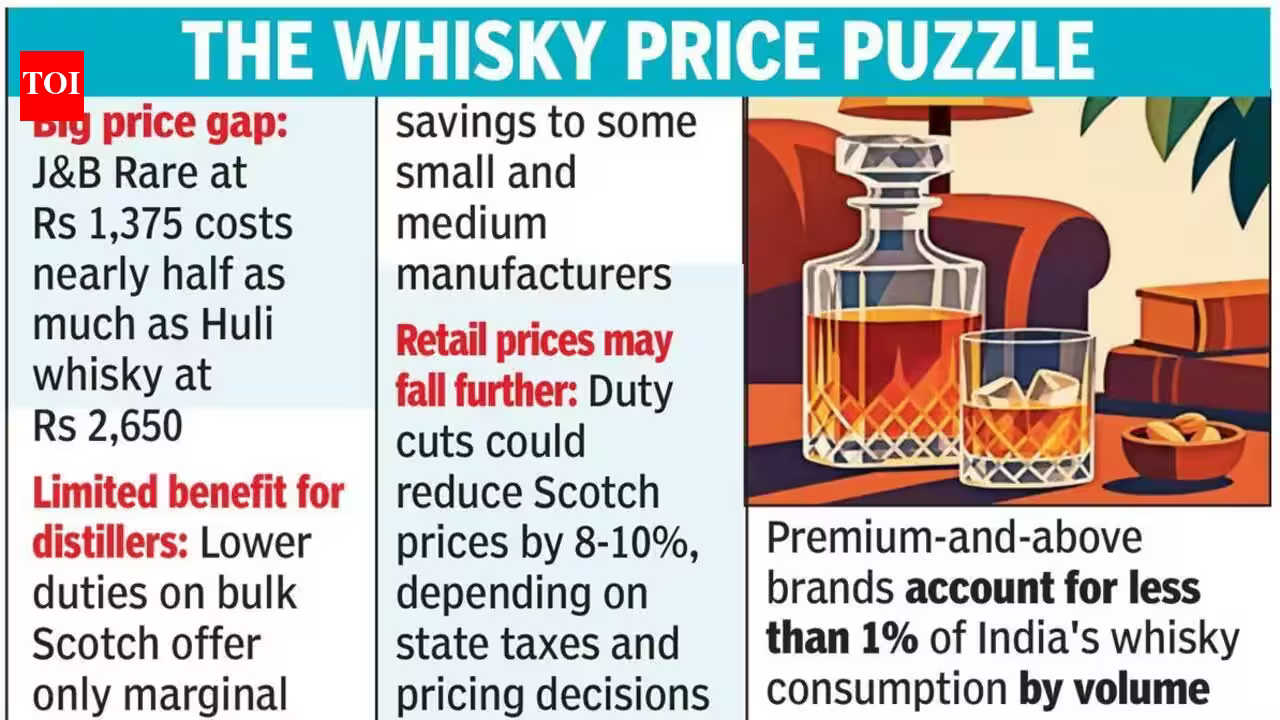
The disparity is becoming impossible to ignore. In premium markets like Bengaluru, the cost of an established imported label can now be significantly lower than a high-quality, locally crafted alternative. For instance, Huli’s rice malt whisky was introduced in Karnataka at a price point of Rs 2,650 for a 750ml bottle. Meanwhile, some imported blended Scotches—such as J&B Rare—have seen their retail prices slashed to nearly half that amount.
This drop is largely attributed to the rise of “bottled-in-India” operations, where bulk Scotch is imported in large containers and packaged domestically, bypassing the steeper costs associated with importing finished, bottled spirits.
Survival of the Smallest
For entrepreneurs who eschew imports in favor of indigenous ingredients, the situation is dire. Aruna Urs, founder of Huli Spirits, which utilizes locally sourced paddy and jaggery in its Mysuru distillery, warns that the market is becoming untenable for boutique players. “The smaller players will not be able to survive,” she noted, pointing to the structural disadvantage faced by those who cannot leverage the economies of scale offered by global supply chains.
Arun Kumar Parasa of Unistil Alcoblends echoes these concerns, noting that the broader Indian single malt industry is facing significant headwinds. While some medium-sized distilleries might gain marginal relief from lower duties on bulk Scotch imports, those benefits rarely trickle down to independent craft distillers who rely on original, local production methods.
Policy Shifts and Market Realities
The current volatility stems from a bilateral trade pivot that saw Scotch import duties slashed from 150% to 75%. While the move was designed to liberalize trade, it triggered confusion regarding the classification of bulk versus bottled shipments. Commerce Secretary Rajesh Agrawal recently moved to reassure the industry that duty benefits would be protected, promising inter-departmental coordination to iron out the classification hurdles that have plagued importers.
However, industry insiders suggest that duty cuts are only half the story. Indian importers are reportedly leveraging their buying power to secure more favorable purchase agreements directly from Scottish distilleries. Experts estimate that these combined factors could lead to an 8-10% reduction in retail prices across the board, contingent upon state-level tax structures.
Despite the excitement surrounding premium spirits, market data remains sobering. According to Jason Holway, a senior consultant at the research firm IWSR, the “premium-and-above” segment—bottles priced over Rs 2,899—represents a fraction of the total volume of whisky consumed in India. As the price gap between imported blends and domestic offerings continues to narrow, the pressure on homegrown brands to maintain visibility and market share amidst restricted advertising and logistical hurdles will only intensify. For India’s craft distillers, the quest for a competitive edge has become a battle for survival.
Disclaimer: This content is auto-generated for informational purposes only.
Source: Read Original News