









For decades, Tommy Lee Jones has been the quintessential Hollywood enigma. With his granite-hewn face and a delivery that could make a single word sound like a tectonic shift, he became one of the most bankable stars in cinema history. From the frantic pursuit of Harrison Ford in The Fugitive to the existential dread of No Country for Old Men, Jones mastered the art of playing men who didn’t want to be bothered. As it turns out, that wasn’t just good acting—it was his life’s philosophy.
At 80 years old, Jones has largely traded the red carpets of Los Angeles for the rugged, dusty expanse of San Saba, Texas. It is a world away from the “industry,” and by all accounts, exactly where he belongs. In a recent, rare glimpse into his life, the actor reflected on a career that took him from the oil fields of his youth to the Ivy League halls of Harvard, only to bring him right back to the Texas Hill Country. “There came a time when I became aware that I could live anywhere I wanted to,” he said. “So, in my wisdom, I went home.”
The Architect of His Own Sanctuary
The centerpiece of this retreat is a stunning, two-story limestone structure dating back to 1856. To call it a “home” feels like an understatement; it is a monument to history, a fortress built in the era of Sam Houston. While most stars fill their mansions with minimalist white furniture and neon signs, Jones’ taste is decidedly more textured.
The house serves as a living museum, featuring everything from Frank Lloyd Wright slate-top tables to a 120-year-old Gustav Stickley settle sofa. His walls hold a curated collision of cultures—Native American artifacts unearthed on his own land sit comfortably near an aluminum Donald Judd box and a painting by Texas legend Kermit Oliver. It is a space designed for a man who treasures depth and provenance over the disposable glitz of contemporary trends. For a man who has lived so much of his life under the bright lights of a film set, this home is his anchor.
Life Between the Goalposts
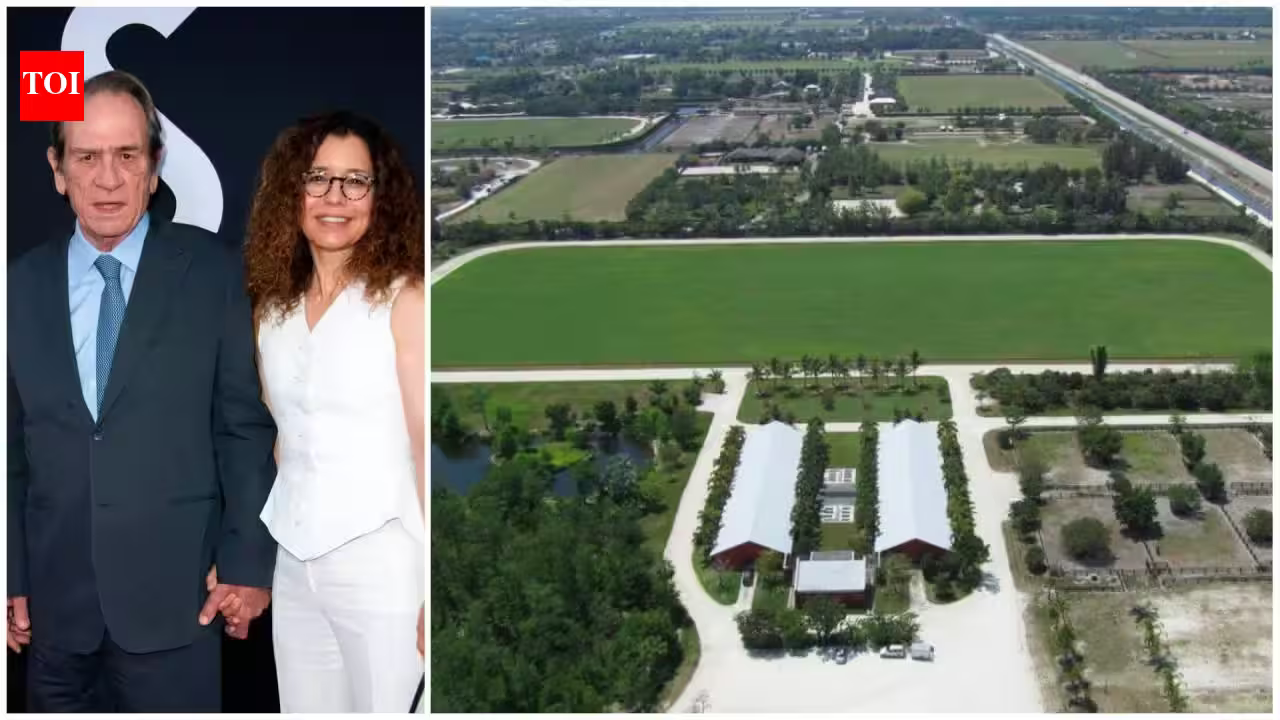
If the house is his anchor, his horses are his soul. Jones, an avid polo player since the 1970s, isn’t just playing at ranch life; he is living it. His sprawling 6,000-acre estate features two regulation polo fields and a herd of 25 horses, a passion he shares with his wife of 25 years, Dawn Laurel-Jones.
The couple, who first met on the set of the 1995 film Good Old Boys, maintain a life that feels intentionally insulated from the noise of Tinseltown. They spend their days breeding polo foals and managing the estate, a labor-intensive endeavor that Jones clearly prefers over press junkets. However, even in paradise, the reality of ranch life sets in. Currently, he is engaged in an ongoing skirmish with local feral hogs that have been wreaking havoc on his lawn. It’s a domestic nuisance that he handles with the same stoic, no-nonsense determination that defines his most iconic characters—though he refuses to surround his historic home with a perimeter fence, insisting that the house deserves to be seen in all its architectural glory.
The Alienation of the Public Eye
Why does a man of his stature retreat so deeply into the brush? His wife, Dawn, offers a candid answer that strikes at the heart of why so many icons eventually burn out. She describes the experience of being a movie star as “objectification,” noting that it is profoundly alienating to have one’s life viewed through a microscope.
For Jones, who has navigated fame for nearly half a century, the ability to be a person rather than a “personality” is a luxury. Their marriage has been built on this mutual understanding—a quiet partnership shielded from the gossip columns and the relentless demands of a career that rarely lets its subjects breathe. In the silence of San Saba, they have found a life that doesn’t require performance.
A Legacy Marked by Resilience
While the allure of the ranch is constant, Jones hasn’t entirely retired his craft. His recent appearance in FX’s The Lowdown alongside Ethan Hawke proves that the fire for acting hasn’t gone out. Yet, these projects are chosen with the discerning eye of a man who knows his time is better spent in the saddle than on a stage.
This focus on the personal has become even more vital in the wake of tragedy. The family is still processing the devastating loss of his daughter, Victoria Jones, who passed away in January 2026 at the age of 34. Following that heartbreaking chapter, Jones has kept an even lower profile, leaning into the comfort of his home and the support of his immediate family. It is a testament to the resilience of a man who has seen both the pinnacle of global fame and the deepest valleys of personal grief.
The Final Curtain, Written in Texas
As Jones settles into his eighth decade, his perspective seems clear. He is a man who recognized early on that fame is a temporary state, but the land—the physical, rugged reality of the Texas earth—is permanent.
He didn’t just stumble into his ranch life; he curated it. He returned to his roots, not to retreat from the world, but to finally live in it on his own terms. When asked about his journey from a roughneck’s son to an Oscar-winning titan of cinema and finally to a rancher in San Saba, his answer is as simple as a Texas horizon: “I knew that God loved me,” he says. “Because he put me on the ground in Texas.”
For Tommy Lee Jones, the spotlight was never the goal. The goal was always the quiet, the horses, and the house built of limestone and history. In the end, he didn’t just find a place to live; he found his way home.
Disclaimer: This content is auto-generated for informational purposes only.
Source: Read Original News