








NEW DELHI: India’s recent Under-19 Asia Cup triumph over Pakistan wasn’t just a victory; it was a masterclass in psychological resilience, a white-knuckle thriller that culminated in a last-ball boundary from Mohit Ulva. While the scorecard will reflect a hard-fought chase of a daunting 338-run target, the story behind the scenes is one of grit, unwavering faith, and the physical endurance of a young squad pushed to their absolute limits.
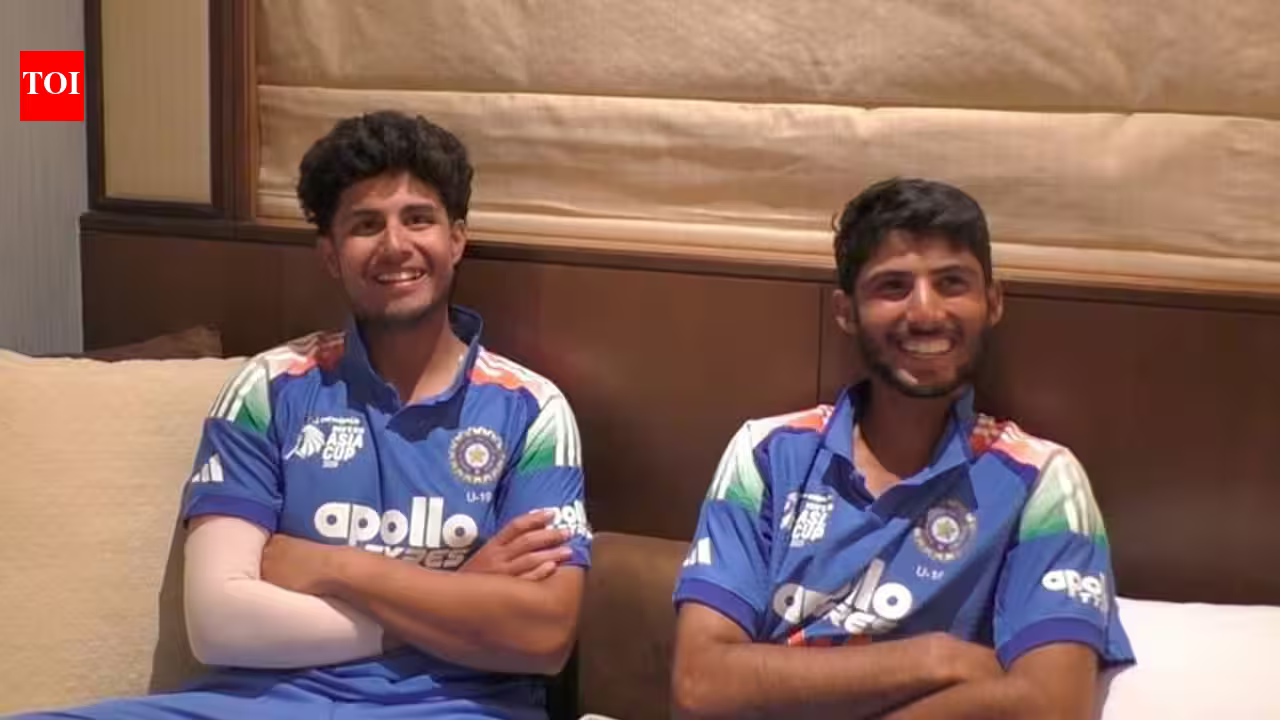
In an intimate look back at the campaign, Player of the Tournament Aaryavir Sehwag and captain Lakshya Raichandani sat down with the BCCI to pull back the curtain on the emotions that fueled their title-winning run in Oman.
‘I might not get the chance for India-Pakistan again’
For Aaryavir Sehwag, the final was a test of physical agony. Struck on the arm by a venomous delivery, the opener felt his limb go numb as the pain radiated through his body. With the team in the midst of a high-stakes chase, the decision to continue wasn’t just tactical—it was visceral.
“When I got hit, my arm went numb and it was paining a lot,” Sehwag recalled. “When Suresh sir came and saw the swelling, he was concerned. But I was just thinking that I might not get the chance for an India-Pakistan match like this again, and certainly not in a final. I couldn’t leave my team in the lurch. I had to fight it out.”
Fighting through the pain, Sehwag produced a quintessential knock of 58 off 61 balls. As the pressure intensified in the later stages of the chase, he turned to a personal mantra to center himself. Starting from the 32nd over, Sehwag began chanting “Sitaram, Sitaram,” a rhythmic invocation that he credits with keeping his focus steady while the dugout remained frozen in collective, nervous anticipation.
Sehwag’s performance throughout the tournament was nothing short of extraordinary. He finished the competition with 361 runs across five matches at a staggering average of 90.25, complemented by 16 massive sixes—the most by any batter in the tournament. Yet, for all his personal accolades, the young standout remains humble, emphasizing that the trophy was the only milestone that truly mattered.
‘The atmosphere was very tense’: Raichandani’s leadership
If Sehwag provided the spark, captain Lakshya Raichandani provided the steady hand at the tiller. Tasked with managing a team on an emotional roller coaster, Raichandani admitted that the atmosphere in the dressing room during the final was thick with tension.
“It was an emotional roller coaster,” Raichandani said. “The atmosphere was very tense, but everyone had the belief that the boys would pull it off. The tournament was a masterclass in learning how to handle your emotions in a pressure-cooker environment—knowing when to speak, what to say, and how to keep the group grounded.”
Raichandani’s personal form was a highlight of the tournament, reflecting the very resilience he demanded from his squad. After a sluggish start—managing only 70 runs in his first three innings—he rediscovered his rhythm just when it mattered most. A sublime 93 in the semifinals was followed by a crucial 80 off 101 balls in the final, cementing his status as one of the tournament’s most reliable batters. He finished with 243 runs at an average of 60.75, proving that his leadership was matched by his technical proficiency.
A Final Act of Defiance
The match itself was a pendulum of momentum. Pakistan, opting to bat first, set an imposing target of 337/9, driven by Usman Khan’s century (107 off 111) and vital contributions from Abdul Qadir and Farhan Yousaf.
India’s reply began with a promising 95-run opening stand between Raichandani and Sehwag, but the middle order faced a stern examination from the Pakistani bowlers. With India teetering at 252/8, the dream of an Asia Cup title appeared to be slipping away. Enter Manal Chauhan, whose blistering 47 off 32 balls turned the tide, forging a 67-run partnership with Mohit Ulva that kept the chase alive.
When the dust finally settled, it was Ulva—the cool-headed hero of the hour—who took the responsibility of closing the show. Facing the final ball with the weight of a nation on his shoulders, Ulva found the boundary, clinching a victory that will be etched in the annals of junior cricket.
For Sehwag, Raichandani, and the rest of the squad, the victory in Oman represents more than just a trophy. It is a testament to the belief, resilience, and composure that characterizes the next generation of Indian cricket. As they head back to the nets, these youngsters carry with them the lessons of an unforgettable final: that when the pressure peaks, the only way forward is to keep your eyes on the ball and your mind at peace.
Disclaimer: This content is auto-generated for informational purposes only.
Source: Read Original News