








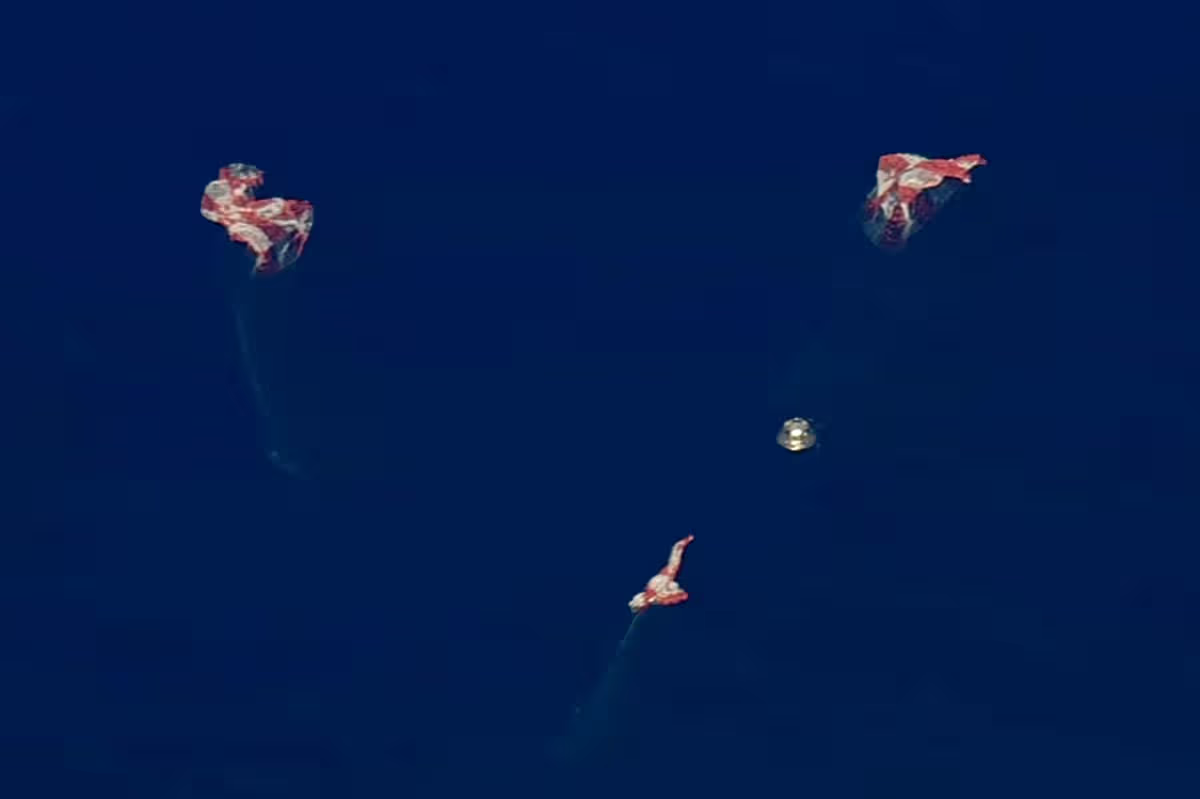
The Artemis mission travelled close to 700,000 miles

Splashdown for Artemis 2
NASA’s Artemis II mission has returned safely to Earth on Saturday (April 11), splashing down in the Pacific Ocean after a landmark 10‑day voyage that carried four astronauts around the Moon for the first time in more than half a century.
The Orion capsule, named Integrity, drifted beneath its parachutes into waters near San Diego after 1am UK time. The landing marked the end of a journey that stretched nearly 700,000 miles and saw Commander Reid Wiseman, Pilot Victor Glover, Mission Specialist Christina Koch and Mission Specialist Jeremy Hansen set a new human distance record.
The landing was called a ‘perfect bullseye splashdown’ and went off seemingly without a hitch.
For 16 tense minutes before landing, Mission Control and millions watching around the world via video link were met with silence as the spacecraft fell through the atmosphere with its heat shield enduring temperatures close to 5,000°F.
A sheath of superheated plasma caused the communications blackout, posing the final test of a mission designed to prove NASA can once again send humans safely into deep space. Further missions are slated to take place across the next five years, including landing astronauts on the Moon’s surface once again and building a permanent lunar base.
“We are back in the business of sending astronauts to the moon, bringing them back safely and to set up for a series more,” NASA Administrator Jared Isaacman said Friday from the recovery ship. “This is just the beginning.”
NASA’s Artemis program schedule is below:
- Artemis I – Uncrewed test flight that successfully orbited the moon and returned to Earth (completed in 2022)
- Artemis II – First crewed mission, flying astronauts around the moon (completed 2026)
- Artemis III – Planned mission to test docking with SpaceX/Blue Origin lunar lander in Earth orbit ahead of a lunar landing (expected 2027)
- Artemis IV – Expected to deliver astronauts to the moon’s surface, targeting the south pole (expected 2028–2029)
- Artemis V – A follow-up mission aimed at expanding lunar exploration capabilities (expected 2029–2030)
After splashdown, an hours-long recovery mission was launched with U.S. Navy teams set to secure the Orion capsule and assist the crew aboard the USS John P. Murtha, which departed San Diego on Monday (April 6).
The crew, who trained together for three years, return as record‑breakers, having travelled farther from Earth than any humans before them and capturing extraordinary images of the Moon, Earth and deep space during their travels.