









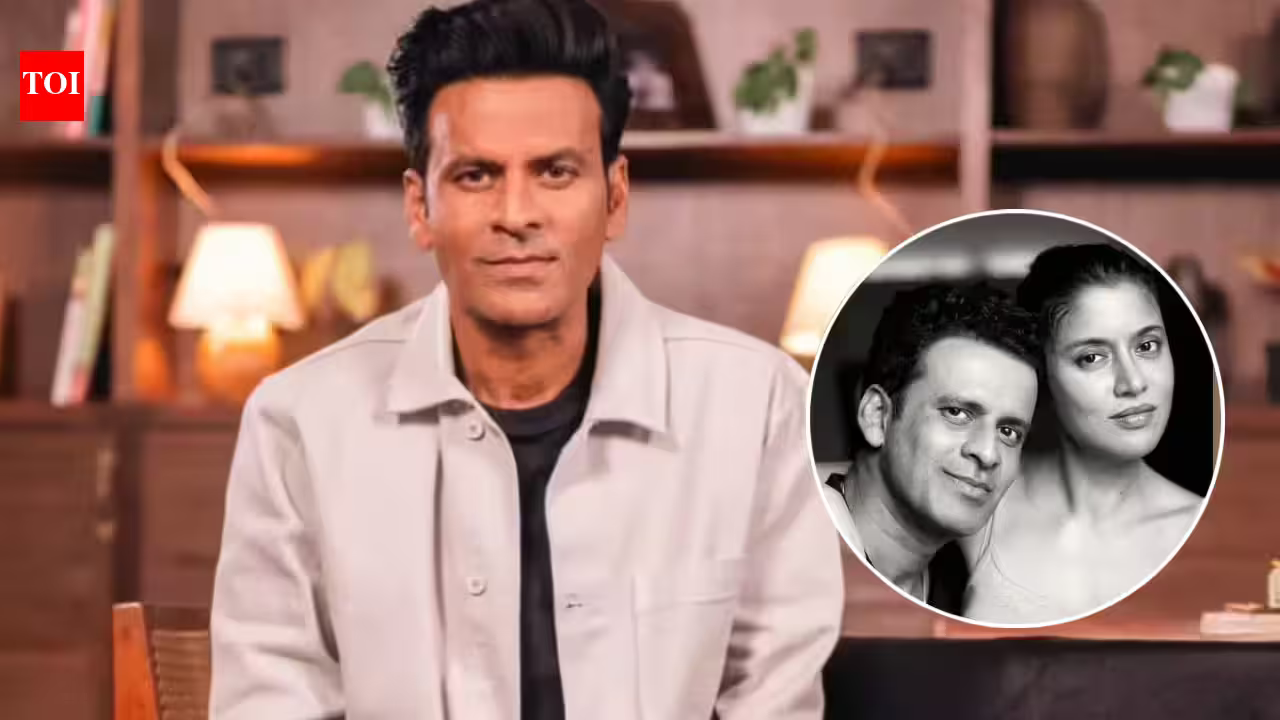
The theater of the mind is a demanding stage, and for Manoj Bajpayee, the curtain rarely falls when the director yells, “Cut.” In an industry that often celebrates the technical precision of acting, Bajpayee stands as a relic of a dying breed—a performer who doesn’t just inhabit a role; he lets it occupy his consciousness, rearranging the furniture of his psyche until the lines between the actor and the man become dangerously blurred.
In a recent, startlingly honest conversation with India Today, the veteran actor opened up about the psychological toll of his craft. He revealed that the process of shedding a persona isn’t just a simple act of changing costumes; it is a prolonged, often painful period of emotional labor that spills over into his private life. So deep is his immersion that his wife, Shabana Raza, has occasionally stepped in with a dose of reality that is as humorous as it is concerning.
The Cost of Total Immersion
When you look at the filmography of Manoj Bajpayee, you aren’t just looking at a list of credits; you are looking at a gallery of tortured souls, desperate men, and morally gray enigmas. From the terrifyingly grounded Bhiku Mhatre in Satya to the weary, burdened Srikant Tiwari of The Family Man, Bajpayee has built a career on the back of intensity.
However, that intensity comes with a price tag. When asked about his ability to transition from the set to his living room, Bajpayee admitted, “Sometimes my wife says that you need to meet a psychiatrist, not even a psychologist. But she is right in a way. Because you really don’t know which is the real part of your life. The playing of different roles or complex roles, or the part where your wife and your child live.”
This confession touches on a phenomenon known as the “post-character hangover,” something many method actors fear but few admit to with such transparency. For Bajpayee, the home is supposed to be his sanctuary, yet it often becomes a confusing landscape where his family is forced to navigate the residual temperaments of his latest fictional iteration.
The Myth of the Midnight Wrap-up
There is a common misconception among audiences that acting is a “job” that ends when the clock hits 6:00 PM. Bajpayee is quick to dismantle this fantasy. To him, the human mind is not a light switch that can be flipped off simply because a technical milestone—the “wrap-up”—has been achieved.
“It’s not that easy that it is going to leave your mind the moment there is a sound of wrap-up,” he explains. “It plays out for a very long time.” This is the reality of the internal actor. When one spends twelve to fourteen hours a day ruminating on the traumas, motivations, and insecurities of a character, those neural pathways remain activated long after the makeup is scrubbed away. The character becomes a roommate—uninvited, persistent, and increasingly difficult to evict.
A Magnet for the Complicated
Why does he keep doing it? Why keep choosing roles that require such a massive sacrifice of his mental peace? The answer lies in Bajpayee’s artistic DNA. He has an almost allergic reaction to the superficial. If a character is simple, if it is “clean” or easily categorized, it holds no interest for him.
“The kinds of roles I take up are very complex,” he notes, citing his recent performance in the film adaptation of Aravind Adiga’s Last Man in Tower. In this project, Bajpayee portrays a man clinging to his home against a tide of redevelopment. The character isn’t a hero, nor is he a villain—he is a human being anchored by grief and a stubborn refusal to let go of the past.
“He himself doesn’t know why he wants to hold on to this house,” Bajpayee shares. “He sometimes comes across as a very stubborn guy, or sometimes he comes across as somebody who is very vulnerable. And also because of the memories of his wife, he doesn’t want to vacate or sign the papers for redevelopment.”
It is this precise contradiction—the stubbornness masking the vulnerability—that likely keeps Bajpayee tethered to the role. He isn’t interested in the easy path. He is interested in the human condition, and he is clearly willing to be the vessel for that exploration, even if it leaves him feeling a little out of sorts at the dinner table.
Balancing Art and Reality
The irony of Bajpayee’s life is that his greatest strength—his ability to mirror human complexity—is also the thing that makes his domestic life feel so precarious. When your profession requires you to possess a deep empathy for “stubborn” and “vulnerable” men, it is natural that you might start seeing the world through those same lenses.
While his wife’s suggestion of a psychiatrist might be spoken with the exasperated love of a partner who just wants her husband to “be home” in every sense of the word, it also highlights the lack of resources and support systems available to actors who operate at this level of intensity. The industry celebrates the performance, but the human behind the performance is often left to decompress in isolation.
As Bajpayee continues to push boundaries, one thing remains clear: he isn’t playing games. He is participating in an artistic struggle that is as exhausting as it is essential to the medium of film. For audiences, it results in some of the most compelling work in Indian cinema. For Bajpayee, it’s a long, winding road home—a road that currently looks a lot like the one his character in Last Man in Tower is walking.
For those eager to witness this latest display of psychological endurance, Last Man in Tower is currently available to stream on ZEE5. It is a masterclass in nuance, anchored by an actor who, even when the cameras stop rolling, is still fighting to figure out exactly who he is.
Disclaimer: This content is auto-generated for informational purposes only.
Source: Read Original News