









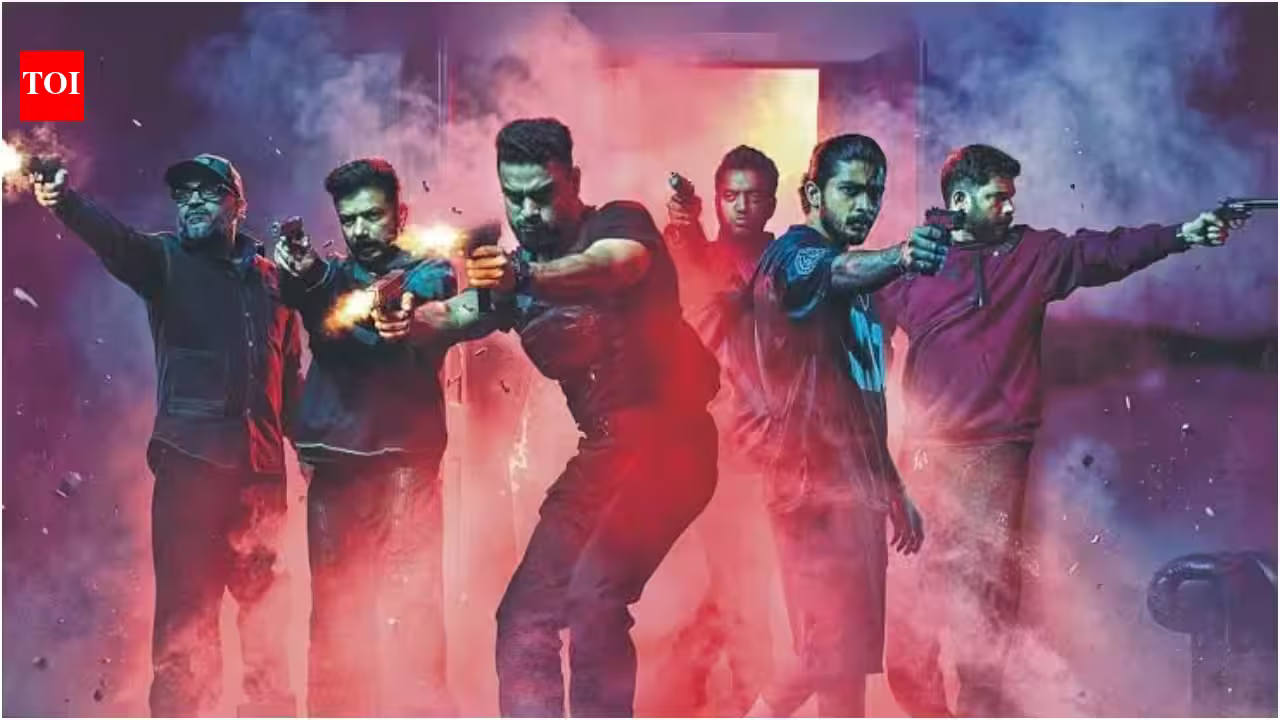
The Malayalam film industry has always possessed a unique gravitational pull, often turning regional releases into national talking points. With Amal Neerad—a director synonymous with slick visuals and high-octane storytelling—at the helm, the arrival of Bachelor Party D’eux was always going to be an event. Billed as a spiritual successor to the 2012 cult hit Bachelor Party, this latest venture has officially entered the fray, clocking in a solid opening day that speaks volumes about the current appetite for Malayalam action cinema.
As the dust settles on the first 24 hours of release, the numbers suggest a classic case of home-turf dominance. With a debut India net collection of Rs 2.55 crore, Bachelor Party D’eux has marked its territory. While these figures might seem modest compared to pan-Indian mega-blockbusters, they represent a focused, deliberate start for a film that leans heavily into the nuanced sensibilities of the Kerala audience.
The Numbers Game: A Deep Dive into Day One
The breakdown of the opening day provides a fascinating look at where the audience’s heart—and ticket money—truly lies. According to industry tracking data, the film managed to pull off its debut through 1,516 shows across the country. The lion’s share of the success came from the Malayalam version, which raked in Rs 2.52 crore.
When you look at the percentage breakdown, the picture becomes clear: 98.8% of the total domestic net earnings were derived from the Malayalam screenings. In contrast, the Telugu release, while an ambitious expansion, contributed only about 1.2% of the net total, amounting to Rs 3 lakh from 234 shows. This disparity isn’t necessarily a failure, but rather a reflection of the film’s specific cultural resonance. For a director like Amal Neerad, whose visual grammar is deeply rooted in the aesthetic of Kerala, this “hometown advantage” is the foundation upon which the film’s long-term sustainability will be built.
Occupancy Trends: The Kerala Pulse
The theatre occupancy reports for the opening day tell a story of anticipation. The Malayalam version boasted an impressive 46% overall occupancy, a testament to the drawing power of a cast that includes heavyweights like Kunchacko Boban, Tovino Thomas, Soubin Shahir, and the ever-rising star, Naslen K. Gafoor.
Perhaps the most telling metric is the timing. Night screenings for the Malayalam version hit an occupancy peak of 49.50%, suggesting that word-of-mouth began to circulate throughout the day, prompting last-minute theater runs. In contrast, the Telugu and Tamil versions saw lower, albeit expected, occupancy levels. With a 7% occupancy rate for the Telugu 2D version and roughly 10% for the Tamil version, it’s evident that the film’s primary identity remains firmly anchored in its Malayalam-speaking markets. The strategy moving forward will likely focus on whether these secondary language markets can catch fire as reviews continue to trickle in over the weekend.
Kerala as the Engine Room
When dissecting the gross collection, one state stands head and shoulders above the rest: Kerala. Generating a staggering Rs 2.60 crore in gross collections, the state accounted for roughly 86.7% of the film’s entire national footprint. This underscores a perennial truth in the Indian film industry—if you want to succeed in the South, you must first master your home base.
Other markets, including Karnataka (Rs 22 lakh) and Tamil Nadu (Rs 8 lakh), played their parts, but the film’s heartbeat is undisputedly in God’s Own Country. The contribution from Andhra Pradesh and Telangana, while relatively small at Rs 5 lakh, highlights the industry’s push to expand the horizons of Malayalam cinema, even if the “pan-Indian” appeal is still finding its legs outside the traditional belt.
The Ensemble Effect: Star Power and Legacy
Beyond the ledger sheets, there is the matter of the film’s DNA. Bachelor Party D’eux carries the heavy mantle of being a spiritual successor to the 2012 hit. In an era where franchises are the currency of Hollywood and Bollywood, Malayalam cinema is testing the waters with this brand of thematic continuity.
The casting choice is a calculated masterpiece of ensemble dynamics. By pairing seasoned veterans like Kunchacko Boban and Soubin Shahir with the modern, frantic energy of Naslen and the sheer screen presence of Tovino Thomas, the film aims to capture a multi-generational audience. Supported by a stellar cast including Sharafudheen, Sreenath Bhasi, Shine Tom Chacko, and Nadhiya, the movie is less of a solo vehicle and more of a symphony of talent. For fans of the original Bachelor Party, this film offers the familiar “Neerad” aesthetic—moody lighting, sharp editing, and an underlying sense of cool—that has become the director’s trademark.
The Road Ahead: Can the Momentum Hold?
A Rs 2.55 crore net opening is a respectable starting point, but the real test for Bachelor Party D’eux begins now. The initial rush of the superfans is over; the weekend will determine if the movie has the legs to transition into a sustained box office run.
Currently, the industry is watching closely to see if the film can maintain its foothold. The reliance on the Kerala market is both a strength and a constraint. If the film earns favorable critical reviews and strong “audience chatter,” we can expect the occupancy rates in secondary markets to climb. However, if the buzz remains limited to the hardcore fans, the film may see a sharp trajectory toward its natural ceiling.
Regardless of the final tally, Bachelor Party D’eux has already succeeded in doing one thing: it has reminded us that the Malayalam film industry remains the most experimental and distinct voice in Indian cinema today. Amal Neerad has delivered a product that isn’t chasing a generic pan-Indian formula, but is instead doubling down on the specific flavor that made the original 2012 film a milestone. As we wait for the first weekend results, one thing is certain—the party is just getting started.
Disclaimer: This content is auto-generated for informational purposes only.
Source: Read Original News