







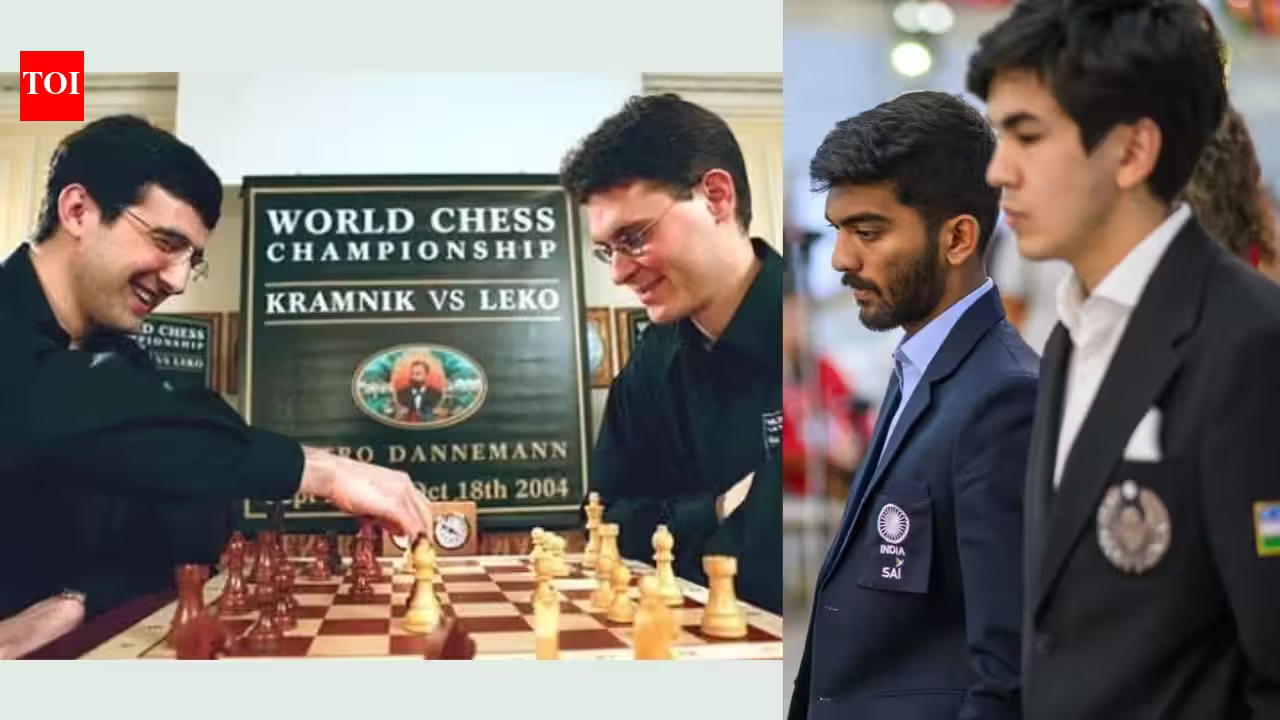
Switzerland is poised to reclaim its place in the annals of chess history, but the journey back to the Alpine nation is paved with the echoes of a dramatic past. For over two decades, the lakeside village of Brissago held the title of the last Swiss host of the World Chess Championship. That 2004 encounter, which saw Russian legend Vladimir Kramnik narrowly hold off challenger Peter Leko, remains a touchstone for the sport. Now, as the chess world pivots toward Geneva for the impending Gukesh Dommaraju versus Javokhir Sindarov showdown, the ghost of 2004 serves as both a roadmap and a cautionary tale for the modern generation.
The Legacy of Brissago
The year 2004 was a watershed moment for the digital age—a period marked by the birth of Facebook and the rapid expansion of global connectivity. Yet, while the world was busy navigating the nascent social media landscape, the chess elite were locked in a grueling, high-stakes battle at the Centro Dannemann in Brissago.
For Peter Leko, the 2004 match wasn’t just a tournament; it was a test of psychological fortitude. Leko, who will serve as an official FIDE commentator for the upcoming Geneva match, looks back on the Swiss setting as the perfect crucible for elite competition. “Switzerland is an amazing place to play a World Championship match because it’s very quiet and peaceful,” Leko reflected in an exclusive interview. “It lets the players focus fully on the championship without any disruptions.”
The Kramnik Factor: A Different Era
To understand the weight of the upcoming Gukesh-Sindarov clash, one must appreciate the sheer dominance of the 2004 landscape. Kramnik was the man who had famously dethroned Garry Kasparov, a feat accomplished without losing a single game. In that era, the preparation gap was a formidable barrier. Before the dominance of ultra-strong chess engines, a player’s preparation—and their team’s ability to decode openings—was the ultimate currency.
“Those were the times before the computer era,” Leko noted. “Kramnik had been a top-10 player since 1993, when I was still a child. He was way ahead in opening preparation, and that was a big handicap.” The psychological toll was immediate when Leko lost the opening game of the series. Under the draconian rules of the time—the final match to employ “draw-odds,” where a tie meant the reigning champion retained his title—a single loss felt catastrophic.
Resilience and the Art of the Comeback
Leko’s path to nearly claiming the crown was a masterclass in mental compartmentalization. Faced with external criticism and the “invincible” aura of his opponent, he had to force himself into a state of total isolation. “I realised that I had to forget about what people were thinking or saying,” Leko said. “I had to focus only on myself, my game, and my team.”
The match saw a stunning strategic shift in Game 5. Recognizing that his prepared lines were being systematically dismantled by Kramnik, Leko took the bold risk of switching from 1.e4 to 1.d4—a move that pushed him into his opponent’s preferred territory but ultimately yielded a crucial win. That victory leveled the playing field, setting the stage for a dramatic 7-7 stalemate. Though Kramnik retained the title on draw-odds, Leko walked away with the hard-earned pride of having pushed an “untouchable” champion to his absolute limit.
The Road to Geneva: Gukesh vs. Sindarov
Two decades later, the psychological architecture of the World Championship remains largely unchanged. As reigning champion Gukesh Dommaraju prepares to defend his title against the rising force of Javokhir Sindarov, the lessons from the Brissago match resonate more than ever.
Modern commentators note that while engines have leveled the technical playing field, the “hidden preparation” and the crushing weight of public expectation remain the decisive factors. Much like Leko in 2004, Gukesh must navigate the noise of a digital era that is far more invasive than the one Leko encountered. The ability to shut out the commentary, the pressure, and the historical comparisons will be the primary difference between the challenger and the champion in Geneva.
As the boards are set in Switzerland once more, the atmosphere is electric. Leko, now watching from the commentary booth, knows exactly what is going through the minds of Gukesh and Sindarov. They are entering a world of deep, silent contemplation where the only thing that matters is the next move. Switzerland, once again, is set to be the stage where history is written—not through digital trophies or friend lists, but through the singular, uncompromising pursuit of chess perfection.
Disclaimer: This content is auto-generated for informational purposes only.
Source: Read Original News