







Intel Nova Lake-H Architecture Emerges in Industrial Applications
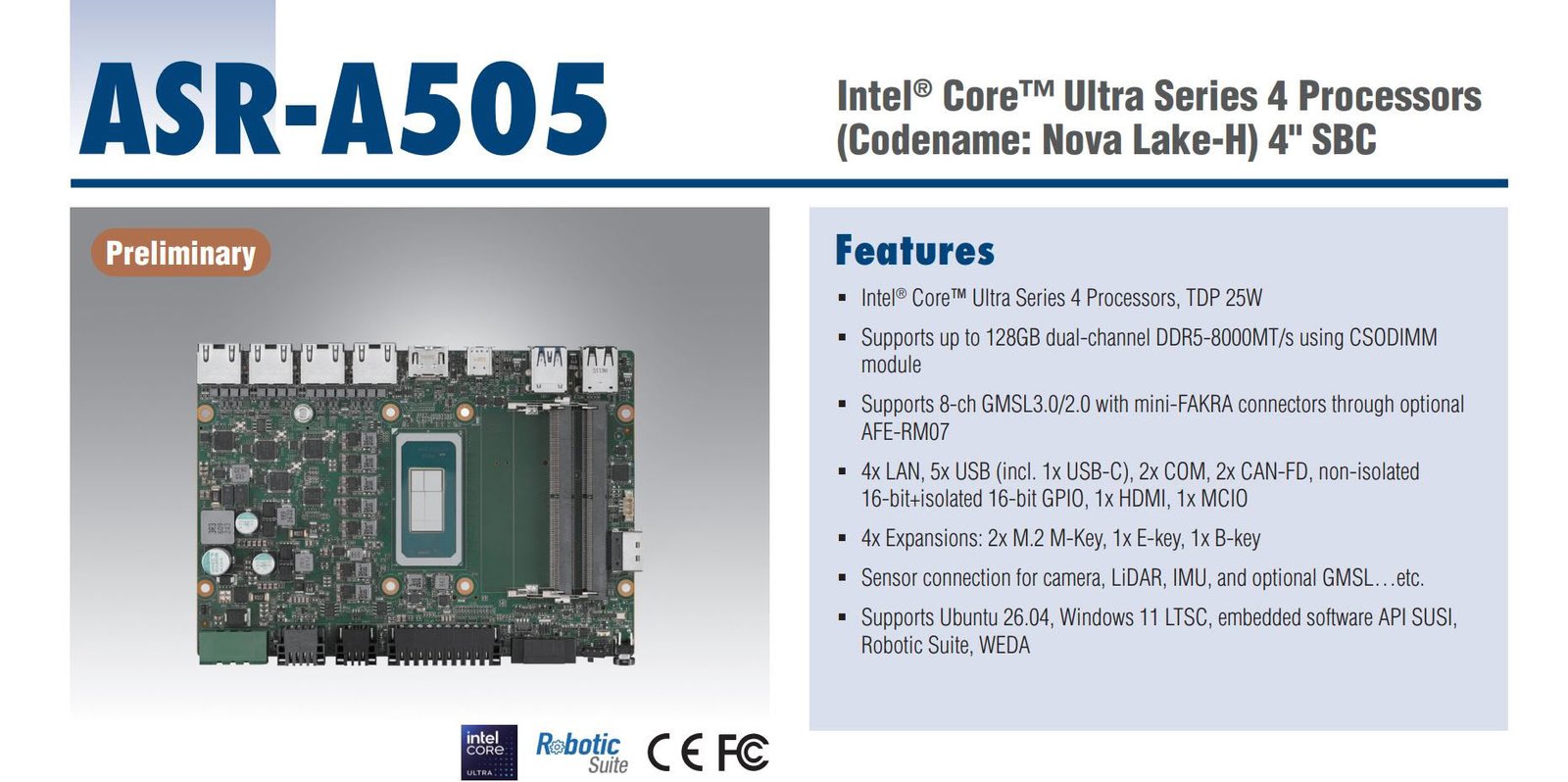
The landscape of next-generation computing is shifting as technical details regarding Intel’s upcoming Nova Lake platform begin to coalesce. While early focus centered on the high-performance desktop iterations, recent documentation from hardware manufacturer Advantech provides a rare glimpse into the Nova Lake-H lineup. Specifically, the emergence of the ASR-A505, a single-board computer designed for autonomous mobile robots, highlights the industrial trajectory of the Core Ultra Series 4 chips. This integration suggests that Intel is prioritizing a balance of high-efficiency compute and graphical throughput for edge-based robotics and automation.
The datasheet for the ASR-A505 offers a tangible data point for what users can expect from these mobile-focused SoCs. The listed configuration features a 16-core architecture capable of reaching a 4.8 GHz boost clock, while maintaining a 2.0 GHz base clock for its primary performance cores. Power efficiency appears to be a critical design pillar, with the system carrying a 25 W thermal design power (TDP), which documentation indicates is configurable between 15 W and 25 W. This adaptability is essential for the robotics sector, where battery life and thermal management are often the limiting factors in hardware deployment.
Decoding the Core Configuration Discrepancy
One of the most intriguing aspects of the Advantech disclosure is the reported core count distribution. The document lists the chip as an “8P+4E+4LE” part, a configuration that contradicts previous leaks and expert industry analysis. Historically, reputable hardware leakers such as Jaykihn and momomo_us have suggested that the Nova Lake-H 16-core model would feature a 4P+8E+4LPE structure. This architectural arrangement was further supported by photographic evidence of the Nova Lake-H package, which appeared to confirm the 4+8+4 count.
The discrepancy in the Advantech documentation likely stems from an internal typo, potentially caused by the accidental inversion of the Performance (P) and Efficiency (E) core values. Given the preliminary nature of the datasheet, such labeling errors are common during the early phases of industrial product testing. The inclusion of “4LE” or “4LPE”—referring to Low-Power Efficiency cores—remains consistent across all sources, indicating that the foundational hybrid architecture is indeed a multi-tiered design intended to segment tasks by power demand. Whether the final silicon adheres to the 4P+8E configuration or shifts toward the 8P+4E profile remains a point of speculation that will likely be clarified as the hardware nears mass production.
Advanced Memory and Graphical Capabilities
Beyond the CPU core debate, the technical specifications for the Nova Lake-H platform underscore a significant leap in memory bandwidth and graphical capabilities. The Advantech board confirms support for DDR5 memory clocked up to 8000 MT/s, accessible via two CSODIMM slots that support a total capacity of 128 GB. The transition to higher memory speeds is critical for the intended use-case of autonomous robotics, which requires real-time data processing and high-speed communication between the CPU and onboard sensors.
The graphical subsystem, powered by Intel’s Arc architecture, is equally notable for its flexibility. While the exact count of execution units remains marked as “TBD” in the preliminary data, the operating clock speed is confirmed at up to 2.3 GHz. The internal block diagrams for the ASR-A505 suggest the platform is designed to accommodate both 4 Xe and 12 Xe graphical configurations. This modularity confirms that Nova Lake-H will be available in various silicon tiers, allowing manufacturers to scale graphical performance based on the specific needs of the deployment, whether that involves basic visual processing or more complex computer vision tasks.
Industrial Use-Cases and Autonomous Systems
The choice of an industrial-grade single-board computer for this reveal offers insight into how Intel envisions the Nova Lake-H series. Autonomous mobile robots require a unique blend of high-thread counts to handle pathfinding and obstacle avoidance algorithms, alongside low-power cores to manage standby modes and peripheral connectivity. The Nova Lake-H architecture, with its focus on a flexible TDP and integrated Arc graphics, is positioned to serve as the “brain” for these systems.
By offloading sensor fusion and navigation tasks to the Arc-based GPU and reserving the P-cores for time-sensitive decision-making, the platform aims to provide a reliable framework for industrial automation. The 4-inch board form factor indicates that the physical footprint of the computing unit is being minimized, allowing for integration into smaller, more agile robotic platforms that operate in warehouse, medical, or manufacturing environments.
The Road Ahead for Nova Lake
As the industry looks toward the eventual launch of the Core Ultra Series 4, the data provided by Advantech acts as a preview of the platform’s versatility. While the specific core arrangements on the ASR-A505 are currently under scrutiny due to documentation inconsistencies, the underlying technologies—such as the high-speed DDR5 support and scalable Xe graphics—represent a clear advancement over the current generation.
Intel is expected to provide a comprehensive overview of the Nova Lake ecosystem at CES 2027. At that time, consumers and enterprise partners will likely receive final confirmation regarding the SKU lineups, thermal envelopes, and the exact distribution of cores across the H-series. Until then, these preliminary industrial datasheets serve as a primary window into the future of Intel’s mobile and edge-computing roadmap, illustrating a platform that is as focused on the requirements of heavy-duty robotics as it is on the high-performance computing needs of standard laptop users.
Disclaimer: This content is auto-generated for informational purposes only.
Source: Read Original News