








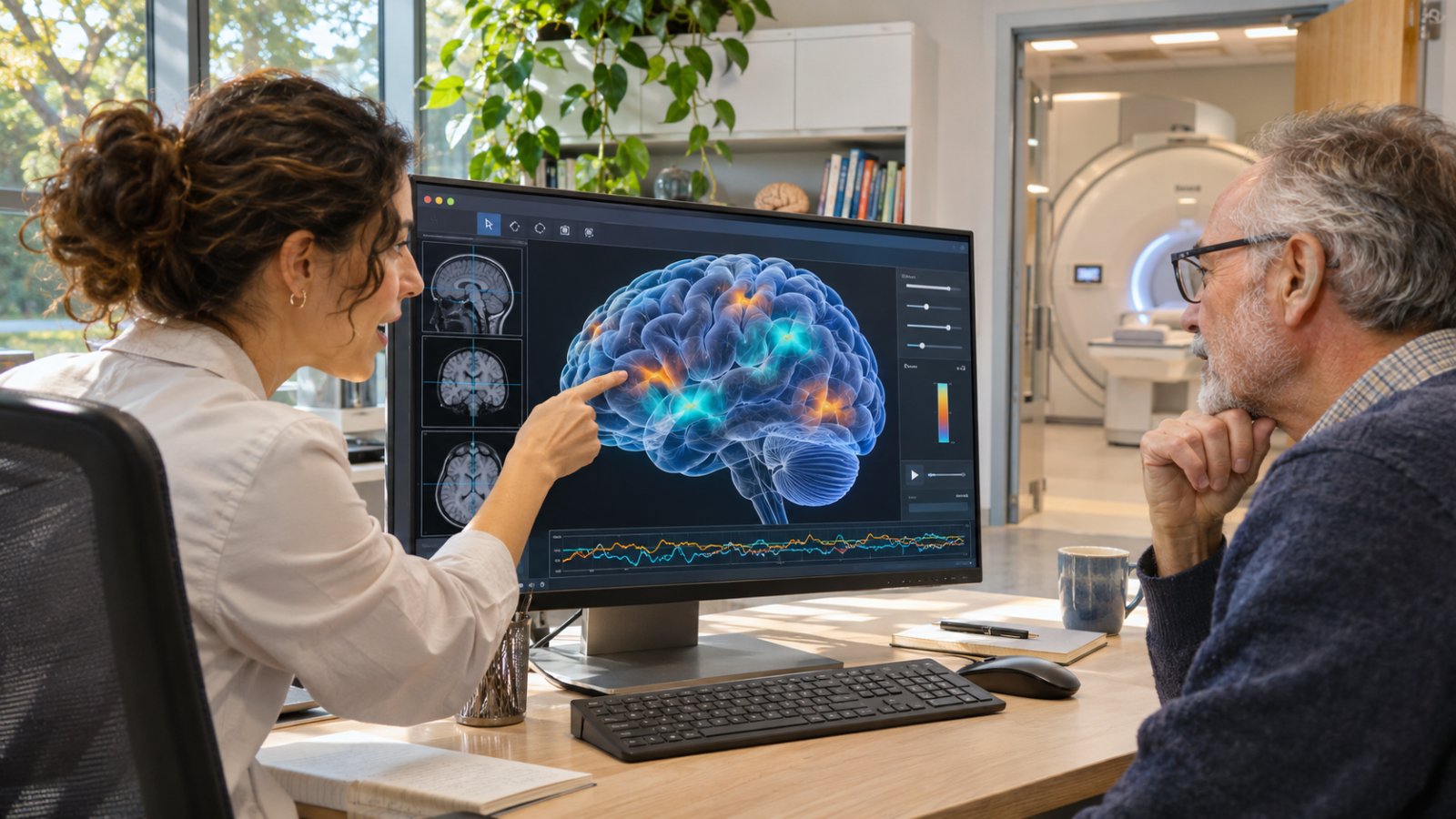
A groundbreaking study involving nearly 7,000 participants has successfully utilized digital brain simulations to bridge the gap between abstract neural activity and the tangible influence of environmental and social conditions. By generating “digital twins” of individual brain activity, researchers are now able to investigate the biological mechanisms underlying brain aging and neurodegeneration in ways previously inaccessible through standard imaging alone.
The research project, which spanned 16 countries, analyzed a diverse cohort ranging in age from 18 to 100. This group included 5,063 healthy individuals alongside 1,923 participants diagnosed with Alzheimer’s disease, mild cognitive impairment, or frontotemporal lobar degeneration. Using resting-state functional magnetic resonance imaging (fMRI), the team constructed personalized models consisting of 90 interconnected brain regions. These models simulated the complex interplay between excitatory and inhibitory neural populations, allowing scientists to move beyond static snapshots of the brain to examine the dynamic rhythm and balance of neural firing.
A key innovation of the study is the distinction between observational scans and biological mechanisms. While a conventional fMRI provides an indirect look at neural patterns, the personalized twins act as a controlled environment where researchers can hypothesize which combinations of biological processes—such as altered neurotransmitter activity or cellular communication—might drive those patterns. When compared to group-based models, the personalized simulations showed an average improvement of 12% in capturing individual neural activity, suggesting that individual adjustments are essential for accounting for data that would otherwise be lost in population averages.
Perhaps most significant for the field of environmental health is the study’s attempt to link these virtual brain models with external living conditions. The team examined 68 environmental and social indicators, finding that factors such as air quality, soil and water quality, and democratic governance were strongly associated with variations in simulated brain dynamics.
While the researchers caution that these findings are observational and represent national-level conditions rather than localized individual exposure, they offer a compelling framework for understanding how external environments may penetrate the biological architecture of the human brain. Further analysis of 952 participants showed that personal socioeconomic factors, such as access to healthcare and childhood experiences, also correlated with specific neural activity profiles.
Despite these advancements, the study does not claim to provide a clinical diagnostic tool. Instead, the models serve as a sophisticated laboratory for virtual experiments. Scientists can now manipulate parameters within these digital twins to observe how changes in neural communication might influence global brain patterns. This approach provides a roadmap for future research, such as mapping neurotransmitter receptors to see if simulated interventions might shift an aging or diseased brain toward a healthier, more youthful state of activity.
The next critical hurdle for the team is to demonstrate that these models can accurately predict changes in an individual’s brain over time or in response to specific environmental interventions. To encourage rigorous testing and development, the researchers have made their code and model parameters available to the scientific community. As these digital twins evolve, they may eventually allow for a new level of precision in public health, helping to clarify the long-term impact of environmental stressors on the aging human brain and potentially identifying the specific, modifiable risks that drive neurodegenerative disease.
Disclaimer: This content is auto-generated for informational purposes only.
Source: Read Original News