









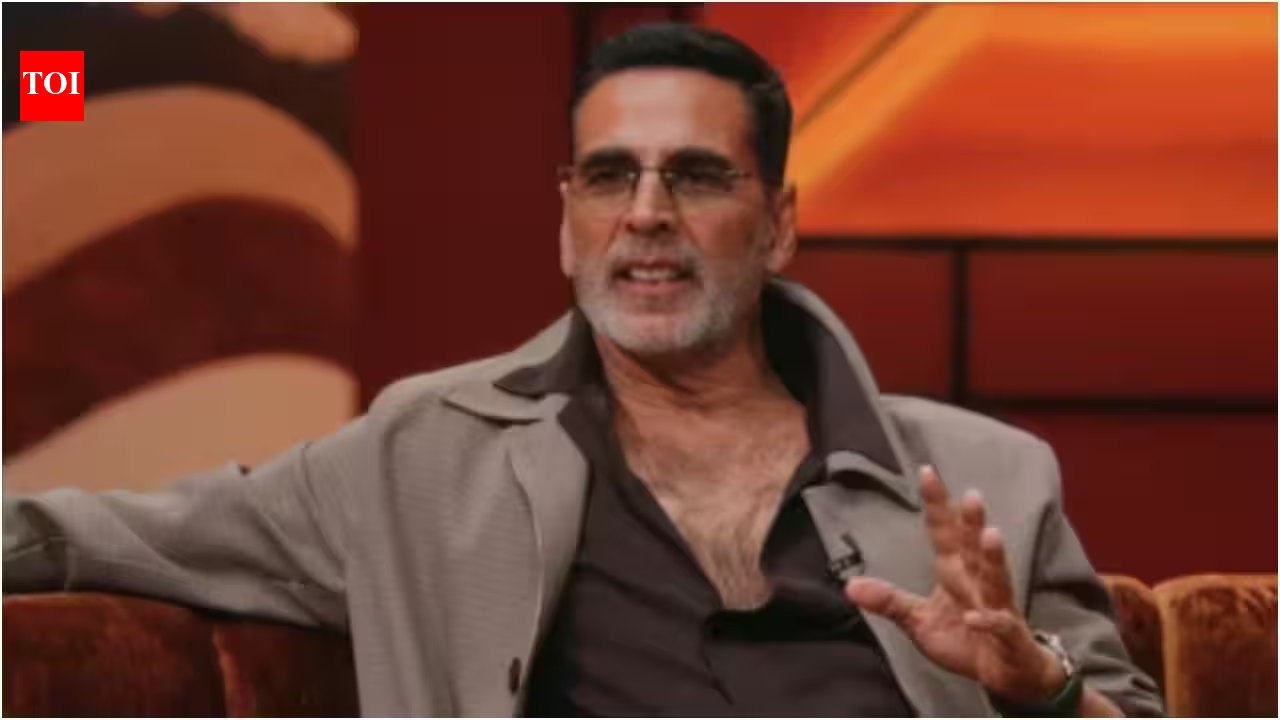
In an industry where the “12-hour shift” is often worn as a badge of honor, Akshay Kumar is turning the tables. On the latest season of Koffee With Karan 9, the Bollywood superstar—joined by actor-politician Ravi Kishan—didn’t just defend his disciplined, eight-hour workday; he effectively told the industry’s elite that if they can’t appreciate efficiency, they’re missing out on a gold standard of professionalism.
It was a candid, slightly defiant revelation. While Karan Johar praised the Khiladi for his uncanny ability to mentor first-time directors and his reputation as a “producer’s actor,” Kumar dropped a truth bomb that sent ripples through the studio audience: the industry’s heavyweights aren’t lining up to cast him. Why? Because the rumor mill suggests he’s “lazy” for refusing to work past an eight-hour clock.
Challenging the Myth of the “Overworked Hero”
“A lot of big people don’t want to cast me,” Akshay admitted, leaning into the controversy with a smirk. “There are rumours that I only work eight hours.”
For many, an eight-hour day sounds like a dream, but in the chaotic, often unorganized world of Indian film production, it’s viewed as a radical departure from the norm. However, Kumar countered the criticism with surgical precision. He pointed out that while some actors might spend those extra hours lounging in vanity vans, he is committed to being present, focused, and—most importantly—energetic.
“They forget that I don’t even go to my vanity van for those eight hours,” Kumar explained. “Our work is to be in front of the camera, and people want to see you beautiful, not tired. So, I thought I would work eight hours, sleep for eight hours, spend two hours on my physique, and dedicate a few hours to my family.”
For Akshay, this isn’t about cutting corners; it’s about sustainable performance. He argues that the industry’s obsession with endless hours leads to burnout, lackluster performances, and inflated budgets—none of which he is interested in facilitating.
The Hollywood Parallel: Nolan and Cruise
The highlight of the conversation came when Ravi Kishan jumped in to defend his co-star’s pace, noting that Kumar’s efficiency is a boon for the entire unit. By wrapping films in roughly 55 to 60 days, Kumar ensures that the 300 to 400-member crew stays employed and that the producer’s capital isn’t hemorrhaged on unnecessary delays.
To silence the critics who view this speed as a sign of lack of “artistic depth,” Akshay invoked the names of the industry’s most revered icons. “I recently read an interview with Christopher Nolan, and apparently he doesn’t take more than 90 days to complete a film. Tom Cruise completed Mission: Impossible in 55 days.”
By placing his own work ethic alongside a visionary auteur like Nolan and a perfectionist like Cruise, Kumar is rebranding his “eight-hour rule.” He is reframing it not as a limitation, but as a deliberate choice made by the most successful, disciplined figures in global cinema. If Cruise can perform death-defying stunts and lead a global blockbuster in under two months, why is it considered a liability when a Bollywood star does the same?
The Gendered Conversation of Boundaries
The discourse around the “eight-hour shift” gained significant national traction in 2025 following the highly publicized exit of Deepika Padukone from the project Spirit. Reports claimed that Padukone had requested a shift cap, only to be met with skepticism and public scrutiny.
The backlash was swift and, according to many, unfairly gendered. Padukone eventually addressed the double standard in a candid interview with CNBC-TV18, noting that male superstars have enjoyed similar boundaries for decades without the “difficult” label being slapped onto their careers. The support she received from peers like Alia Bhatt and Karan Johar highlighted a shifting tide in the industry—one that finally began to question why prioritizing mental health and personal time is seen as “pushy” for women, yet “disciplined” for men.
By bringing this topic back to the forefront on his show, Karan Johar is acknowledging that the industry is at an inflection point. The old guard of “suffering for your art” is being replaced by a modern, corporate-adjacent standard where time is considered the most valuable asset of all.
What’s Next: The Golmaal Phenomenon
While he defends his schedule, Akshay Kumar shows no signs of slowing down his professional output. He is currently deep in production for Golmaal 5, the latest iteration of Rohit Shetty’s juggernaut comedy franchise.
The cast list reads like a who’s-who of Bollywood comedy legends: Ajay Devgn, Arshad Warsi, Kunal Kemmu, Sharman Joshi, Shreyas Talpade, and Tusshar Kapoor. The sheer scale of the ensemble, combined with Shetty’s signature high-octane directing style, makes it one of the most anticipated releases of 2027. Fans are already buzzing about the chemistry between Kumar and Devgn—two titans who have long defined their own paths to superstardom.
With a theatrical release set for January 8, 2027, the film is poised to be a box-office giant. And if history is any indication, Akshay will likely walk onto the set, deliver his lines with razor-sharp focus, clock out after eight hours, and leave with a finished product that keeps the wheels of the industry turning—without needing to spend all night in a vanity van to prove he’s working.
In a world that loves to idolize the “struggle,” Akshay Kumar is choosing to idolize the “strategy.” And given the current state of his career, it’s hard to argue with the results.
Disclaimer: This content is auto-generated for informational purposes only.
Source: Read Original News