






Every day Katy Brill looks to the skies above her farm café in the Chiltern Hills and scans for the winged menace terrorising her customers.
In recent months visitors to Peterley Manor Farm, near Great Missenden in Buckinghamshire, have lost sandwiches, crisps and slices of cake to the daring raids of a raptor that has a top speed of 113mph and can span more than 6ft: the red kite. “They’re a pest. They’ll swoop and literally take food off people’s tables or out of their hands,” said Brill, 38. “It’s become a problem for us. I live on the same lane as the farm and I just won’t eat outside any more.”
A bird of prey that was once on the verge of extinction in the UK, the red kite is thriving: there are an estimated 6,000 breeding pairs nationwide, the largest population in Europe. But this revival has seemingly brought trouble to the picnic-goers of Britain amid reports the birds have developed a taste for human food and are becoming increasingly brazen.
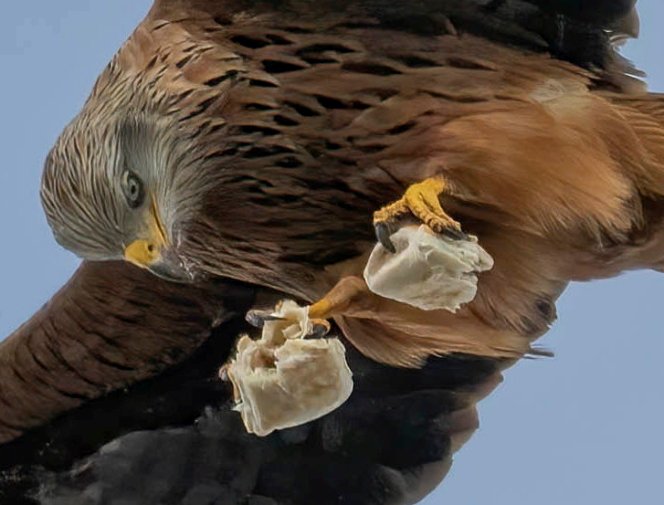
Last month a red kite was captured carrying what appeared to be a sausage roll in its talons as it soared above Banbury. On Facebook groups in the Chilterns, home to the largest concentration of red kites, residents say the birds have snatched food out of their hands. There have been stories of red kites swooping to attack small dogs.

The Royal Society for the Protection of Birds (RSPB) has urged people not to feed red kites, which typically feed on carrion, road kill and worms, saying it can encourage bad behaviour.
Such is the problem at Peterley Manor Farm that Brill has installed wiring above the outdoor seating area at her café to prevent the birds from swooping, along with warning signs.
“It’s a terrifying experience, they’re obviously a bird of prey and they’re really big,” she said.
 Joshua Bratt for The Sunday Times
 Joshua Bratt for The Sunday Times
The red kite, identified by its reddish-brown coat, deeply forked tail and distinctive mewing call, was once protected by royal decree but from the 16th century onward was deemed a threat to livestock and widely hunted.
Four decades ago the red kite had all but died out in Scotland, England and Ireland. In Wales, there were only 52 nests known to ornithologists. Then, in August 1989, five young red kites of Swedish origin were released into the Chilterns as part of a species recovery programme led by the Nature Conservancy Council, a now defunct government agency.
Over the next 20 years more red kites were released in nine sites in England and Scotland — including Yorkshire, the Derwent Valley in Derbyshire, Gateshead and Grizedale Forest in Cumbria — in an expansion of conservation efforts. Such was the success of the programme that between 1995 and 2023 the breeding population increased by 2,464 per cent, according to the RSPB.
“They are thriving,” said Dr Mike Pienkowski, who was involved with the early phases of the recovery project. “And we know now that other birds of prey are spreading, benefiting because of our work to discourage the illegal persecution of red kites,” he added, referring to the campaign to stop illegal poisoning of red kites by agricultural pesticides on baits, which were killing other birds.
In total there are an estimated 12,000 red kites in Britain, about 17 per cent of the global population. But Pienkowski doesn’t believe kite numbers will get out of hand. “If the population density becomes too high, they have a tendency to breed and feed less so the numbers won’t race up indefinitely,” he said. “They are stabilising.”

Duncan Orr-Ewing, head of species and land management at RSPB Scotland, said the birds appeared to be targeting people because they were being fed by humans and therefore associated them with food. “We don’t support the feeding of kites. It’s not necessary,” he said. “There’s plenty of food for them in the environment and feeding them is, in some places, creating problems.”
He added that it was rare for a kite to attack humans. They are more likely to grab at food in people’s hands.
Outside the Chilterns, conservation centres run dedicated feeding programmes that mimic natural scavenging and encourage the kites to sustain themselves, rather than rely on human food, which may be processed or contain salt and other products unhealthy for kites.
At the Argaty red kite feeding station near Stirling, kites are fed at about 2pm with small amounts of venison to encourage the birds to visit the area, improving rural diversification. “The kites attending the site feed naturally for most of the day,” said Orr-Ewing. “What is supplied is really just a top up.”
Chris Johnson, a falconer at SMJ Falconry, which offers experience days with birds of prey, believes that if people continue to feed red kites they could once again become a target.
“A lot of people think they are helping the kite population. Realistically all it’s doing is making history repeat,” he said. “Kites became a pest and we persecuted and killed them because they were a problem. They were stealing food from people and we killed them for it. Your best bet: leave them alone.”