






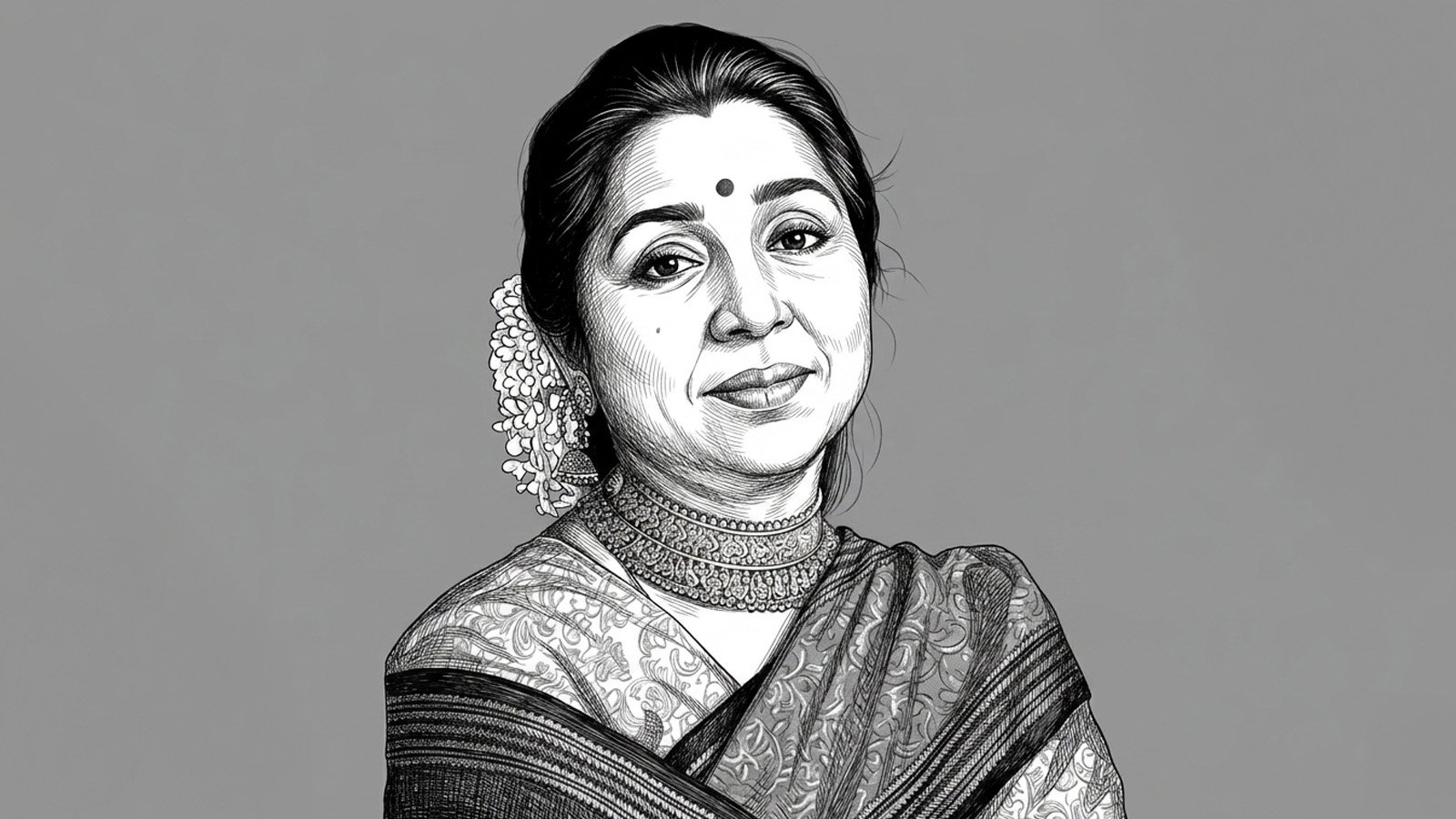
Asha Bhosle, the singular playback singer whose husky and versatile voice became the soundtrack of modern India’s love, longing, mischief and heartbreak, died early this morning at Breach Candy Hospital in South Mumbai at 92.
Even in her twilight years, Asha Tai, as she was fondly called by her fans, refused to let age write her ending. Just two years ago, at 90, she stood on the cusp of a milestone that summed up everything she was: a three-hour concert titled “Asha@90: Woh Phir Nahi Aate” at Mumbai’s Jio World Garden in Bandra Kurla Complex (BKC), a defiant celebration of eight sterling decades in playback singing.
Also read | At 90, Asha Bhosle gears up for a milestone concert in Mumbai
She had initially waved it off — “who celebrates their birthday at 90? Let’s just have a party at home” (she had shared this with The Federal in a 2024 interview) — yet her son Anand, who had managed her career with pride for years, insisted the world needed to see his mother still standing and singing for three straight hours.
Her truest home
She bowed to his wish, primarily because the stage had always been her truest home. At the concert, her granddaughter Zanai Bhosle performed Kathak alongside mentee Sudesh Bhosle, threading three generations of the family’s musical bloodline into one memorable evening.
She arrived at that concert the way she had arrived at every studio since she was 10: with a flexi throat, bubbling energy, and the stubborn conviction that she still felt no older than 40. Mumbai had protected her through poverty, long walks or crowded buses to recording booths, and every private storm.
“Mumbai has protected me amidst all of life’s challenges,” she said in the same interview, reflecting on the city that once watched a broke refugee girl from Sangli scrape by now ready to roar her name again. Before the concert, she had urged fans not to miss it. “Grab the opportunity to see artists and hear them till the time they are around,” she had said, pointing to the ghosts of Kishore Kumar and Manna Dey. “Please come and listen so that you can say: We saw Asha. We heard her sing.”
Family tragedies
That same evening, she spoke softly of ghazal singer Pankaj Udhas’s recent passing (“I was a big fan… He used to visit me at home”) and of the family tragedies that had already marked her: daughter Varsha’s suicide in 2012, son Hemant’s death from cancer in 2015, elder sister Lata Mangeshkar’s in 2022.
Also read | Asha Bhosle beyond Bollywood: When her voice crossed the Vindhyas
Grief, she believed, was not for public display. “Such tragedies have happened in my own family. Grief is not meant to be expressed. You just feel it. Happiness must be spoken about and shared with others.” This philosophy was at the core of how she had survived a first marriage that nearly broke her, single-handedly raised four children, and kept the microphone as her one unshakable anchor.
Her lasting legacy
Asha Tai had a voice she had always seen as her only lasting identity. She would often quote her sister Lata’s line from the 1977 film Kinara: “Naam gum jaaega, chehra ye badal jaaega / Meri awaaz hi pahchaan hai, gar yaad rahe.” (Name will be lost, face will change — my voice alone is the identity, if it’s remembered).
That was Asha Bhosle in a single couplet, the malleable, playful, sensual and timeless voice that had carried India through every shift of taste and temperament for 80 long years. When she stepped onto the stage for the concert in March 2024, it was proof that the woman who began as a Marathi child-artist in 1943 still believed the song was bigger than the singer, bigger than sorrow, bigger than 90 years of living during which she had turned every slight, every hardship, every “vamp song” assignment that came her way into the foundation of a career that outlasted every musical fashion, making her truly evergreen.
Early days
Born Asha Mangeshkar on September 8, 1933, into the Maharashtrian Brahmin Mangeshkar family in the village of Goar near Sangli (the turmeric city and the sugar hub) in Maharashtra, she was the middle of five children in a family that lived on music even when it was mired in debt.
Her father, Pandit Deenanath Mangeshkar, carried the blood of temple singers and the rigorous training of the Gwalior and Kirana gharanas. Deenanath had performed with the Kirloskar Natak Mandali and formed his own Balwant Mandali, favouring patriotic themes and the aggressive style of his guru Pandit Ramkrishna Buwa Vaze.
When he died suddenly in April 1942 at 41, the family was left almost penniless.
Asha, nine years old, remembered the immediate years with characteristic understatement: “Our financial position was not good, but we children were too young to be much affected,” she is quoted as saying by Ramya Sarma in Asha Bhosle: A Life in Music (Amaryllis, 2025). “We would have one cup of tea or a handful of peanuts.”
The invisible scaffolding
That genteel hunger, that theatre-bred discipline, and that refusal to complain became the invisible scaffolding beneath every note she ever sang. The family migrated to Bombay (now Mumbai) in the early 1940s. The Hindi film industry into which the young Asha arrived was itself still inventing its musical grammar.
Playback singing had only just arrived as a revolutionary convenience: New Theatres in Calcutta (Kolkata) had recorded the first song with the technique in the 1934 Bengali film Bhagya Chakra, remade the following year as the Hindi Dhoop Chhaon.
Also read | 10 eternal Asha Bhosle songs that India could never stop humming
The great studios — Imperial, Prabhat, Bombay Talkies, Ranjit — had already shifted from actors singing live on set to professional singers behind the screen. In-house orchestras under composers like Anil Biswas, Saraswati Devi, and Pankaj Mullick were experimenting with Western strings and pan-Indian rhythms while still honouring classical gharanas. The system was freelance and hungry; fans bought tickets for a single song, and music directors could now pick voices that fit the character rather than the actor’s limited range.
A ‘quantum leap’ with Pancham
The golden era that followed in the 1950s crystallised around a handful of composers who reshaped the soundtrack of a newly independent nation. OP Nayyar, in particular, refused to use Lata’s voice at all, choosing instead the younger sister whose conversational timbre suited his cabaret numbers and Westernised bounce.
Films such as Aan (1952), Albela (1951), Baiju Bawra (1952), Daag (1952), and Naya Daur (1957) gave Asha the space to develop the sly glide and erotic charge that would become her signature. While Lata’s crystal purity dominated the heroine songs, Asha inherited the vamp roles and the “other woman” tracks.
Besides OP Nayyar, the decade belonged to Madan Mohan, Roshan, Hemant Kumar, Salil Chowdhury, and later Shankar-Jaikishan, Laxmikant-Pyarelal, and the game-changing RD Burman, whose fusion of rock, jazz, and dholak rhythms would define the next generation.
Tough marriage
By her late teens, Asha was logging 200 to 300 songs a year, riding a Lambretta between Film Centre, Mehboob Studios, and tardeos with toddlers in tow. Her first marriage at 16 to Ganpatrao (Ganesh) Bhosle, a singer-choreographer 20 years her senior, was a love match against family wishes. It turned nightmarish.
In Asha Bhosle: A Life in Music, she describes the abuse with unflinching candour: “My husband had a short temper. Maybe he enjoyed causing pain, maybe he was a sadist. But no one outside ever knew. I gave him respect and never questioned him. I simply did my duty as per Hindu dharma.”
Four months pregnant with her third child, thrown out of the house, she swallowed a bottle of sleeping pills in a hospital ward. “The mental agony was unbearable,” she recounts. “I swallowed an entire bottle… but my love for my child was so strong that it didn’t let me die.”
She survived, left the marriage in 1960, and raised Hemant, Anand, Varsha, and her youngest daughter largely alone while the gossip columns kept writing random things about her. “I have brought up my kids single-handedly,” she said later. “So a strenuous routine is something I thrive on, not shy away from.”
Pancham’s ‘demands’
While OP Nayyar gave her the breakout Ae Dil Hai Mushkil in C.I.D. (1956), it was RD Burman — lovingly called Pancham —who understood the fire in her voice and, after Ganesh’s death, became her second husband in 1980.
In the Teesri Manzil (1966) sessions, Pancham demanded an impossible note; Asha told him, with characteristic bluntness, that if he wanted divinity he should visit a temple. The next take was the one used. She loved every song they made together.
“I instinctively felt Pancham and Gulzarbhai were meant to make music together,” she said in an interview. “I love every song that I did with Pancham and Gulzarbhai.” Till her last days, Asha had the unshakable belief that the song was always larger than the singer’s pain. “I sang my first song in 1943 and then began a long struggle,” she recalled in a 2020 interview. “I had to do something which didi (Lata) would not try.”
Shift in the industry
The 1970s opened with a shift in Hindi music industry that finally let Asha claim her territory as a singer. As the new decade dawned, Rajesh Khanna’s Kati Patang (1971) became the vehicle for her breakthrough with RD Burman and Kishore Kumar.
The bindaas vamp number “Mera naam hai Shabnam,” sung for Bindu, gave Asha an RD identification unique in the glossary of mainstream cinema. Journalist and biographer Raju Bharatan met her around that time and notes “a spring in her step” and “a new insouciance” as she spoke about music.
The change was palpable: after 12 years of creative dependence on OP Nayyar, Asha had moved on. Nayyar’s personal and professional hold had waned; Pancham had stepped in with a composing magnetism all his own. Their rapport dated back to early 1957, when a young RD, then SD Burman’s second assistant, had rehearsed Asha for the songs of Nau Do Gyarah.
Now, with RD’s stormy marriage to Rita Patel heading toward divorce in mid-1971, the two found themselves “chumming up” both personally and musically. From OP Nayyar to RD Burman was, as Bharatan writes in Asha Bhosle: A Musical Biography (Hay House, 2016), “a quantum leap for Asha.”
Away from the old order
That leap coincided with a telling moment between the Mangeshkar sisters. Bharatan was working on a Lata special for Filmfare when he asked the elder sister whether she had given Asha an inferiority complex early in her career.
Lata deftly dodged the question and suggested he put it to Asha herself. The encounter happened inside the family’s Peddar Road building, Prabhu Kunj — Lata in Flat No. 1, Asha in Flat No. 2, where the younger sister had begun sending out the unmistakable message: “I am here to stay, Lata or no Lata.”
When Bharatan relayed the question, Asha shot it down without hesitation. There could be no such complex, she insisted, because both sisters drew from the same fount: the rigorous Hindustani vocal tradition of their father, Pandit Deenanath Mangeshkar. “A pizzazz” came into Asha’s voice as she said it, Bharatan recalls.
She had gained immense self-assurance now that Nayyar was no longer a mental block and SD Burman had stopped sidelining her in favour of Lata. For the first time she felt she was her own performing person.
Asha’s own grammar
It was this Asha — liberated, rebellious, mentally young despite being nearly six years older than Pancham — who came full circle with RD Burman. He rewrote the very grammar of composition to create a slot she could call exclusively her own: the “Piyaa tuu ab toh aa jaa” style, Helenised, titillating, tuned to a new generation unshackled from the Lata-Mohammed Rafi mould.
Bharatan structures his entire biography around the three composers who defined her — OP Nayyar, SD Burman and RD Burman — because each marked a distinct phase.
Nayyar had tutored her bass voice and given her razzmatazz; SD Burman had refined her vocals before reverting her to second choice. But RD alone delivered the personality makeover and the signature sound that left Lata “tongue-tied.”
Asha asserts in Bharatan’s book that RD took her beyond OP. In doing so she outgrew almost every composer on the scene, creating a brand distinguishable from anything Lata had patented and winning an entire new young listenership that saw the Asha-RD-Kishore collaborations as a musical Esperanto moving away from the old order.
A stunning catalogue of songs
The catalogue of songs Asha Tai has left with reads like a history of desire in Indian music: the cat-in-heat yowl of Piya Tu Ab To Aaja (Caravan, 1971) that made Helen’s cabaret immortal; the rebellious cannabis haze of Dum Maro Dum (Hare Rama Hare Krishna, 1971); the stolen-heart swagger of Chura Liya Hai Tumne (Yaadon Ki Baaraat, 1973); the disco strut of Yeh Mera Dil (Don, 1978); the haunting Mera Kuch Saaman from Ijaazat; the sensual fire of In Aankhon Ki Masti (Umrao Jaan, 1981).
Asha Tai moved seamlessly into the 1990s with Zara Sa Jhoom Loon Main (Dilwale Dulhania Le Jayenge) and Rangeela Re (Rangeela, 1995), then handed a new generation the thrill in AR Rahman’s Radha Kaise Na Jale (Lagaan, 2001).
Global fame
She recorded in more than 20 languages, collaborated with America’s Kronos Quartet, and earned two Grammy nominations in her career: she became the first Indian artist to be nominated for a Grammy Award for Legacy with Ustad Ali Akbar Khan in 1997, and another in 2006 for You’ve Stolen My Heart with the Kronos Quartet
In one of her final musical outings, she lent her voice to British virtual band Gorillaz’s 2026 album The Mountain (Parvat), appearing on the track “The Shadowy Light,” a collaboration that brought together artists like Gruff Rhys, flautist Ajay Prasanna, and sarod maestros Amaan Ali Bangash and Ayaan Ali Bangash.
Recorded in India, the album, featuring names such as Anoushka Shankar and Asha Puthli, demonstrates frontman Damon Albarn’s long-standing admiration for Indian film music, particularly the work of RD Burman. For Asha Tai, it was a proof of an artist who remained restlessly open to new sounds, moving effortlessly from Hindi film classics to global experimental collaborations, with her voice retaining its charm till the very end.
The final bow
Personal setback never kept Ash Tai quiet for long. When Pancham’s death in 1994 left her shattered, she had stopped recording for months, then returned to cut Aaj Ki Raat for the Don remake because, she said, “Pancham would have hated me moping.”
Also read | Lata ‘liberated’ music directors with her stunning range
She ran restaurants, launched a music label, fought copyright battles in the Bombay High Court (winning relief as recently as October 2025 when the HC restrained various AI platforms, e-commerce websites, and social media entities from using her personality rights without authorisation), adopted stray dogs, and still took unsolicited calls from young singers offering encouragement.
“I prefer selective memories,” she once remarked. “Some songs and some co-workers are all that I want to remember, as memories are not always so pleasant.”
Voice aged with grace
The awards arrived late but in volume: Padma Vibhushan (2008), Dadasaheb Phalke (2009), multiple National Film Awards, Filmfare Lifetime Achievement, Maharashtra Bhushan (2021). They mattered less than the measurable output, songs cut while pregnant, performances given the day a husband died, comebacks engineered after every supposed “end of an era.”
The voice itself aged with grace. The upper register thinned; the lower one grew smokier, more intimate. But the moment the red light came on, something ancient and unstoppable took over. That transformation, if you think about it, was never talent alone.
It was Asha Tai’s lifelong conviction that stopping was never an option. The songs demanded it. The children needed it. India, in all its chaotic optimism and private grief, required it.
Asha Tai is survived by her children and grandchildren, by the Mangeshkar musical dynasty she helped define, and by a recorded legacy that no single obituary can contain; mine is only a small attempt.
Earthy and unbreakable
Asha Tai did not merely soundtrack Indian cinema’s golden eras, she also outlived and out-sang them all. From the black-and-white vamp numbers of the 1950s to the digital streaming playlists of 2026, her voice remained the one constant: earthy and unbreakable.
It soundtracked first loves and last heartbreaks, national triumphs, the giddy rush of liberalisation and the daily stubbornness of ordinary Indians. The woman who once told a perfectionist composer to choose between temple and studio has now taken her final bow.
The recordings, rowdy and alive, dare every new generation to keep up. Asha Tai would have liked us to believe that the songs were always bigger than her. And perhaps they always will be. But for eight decades she made them feel like they belonged to every one of us.