







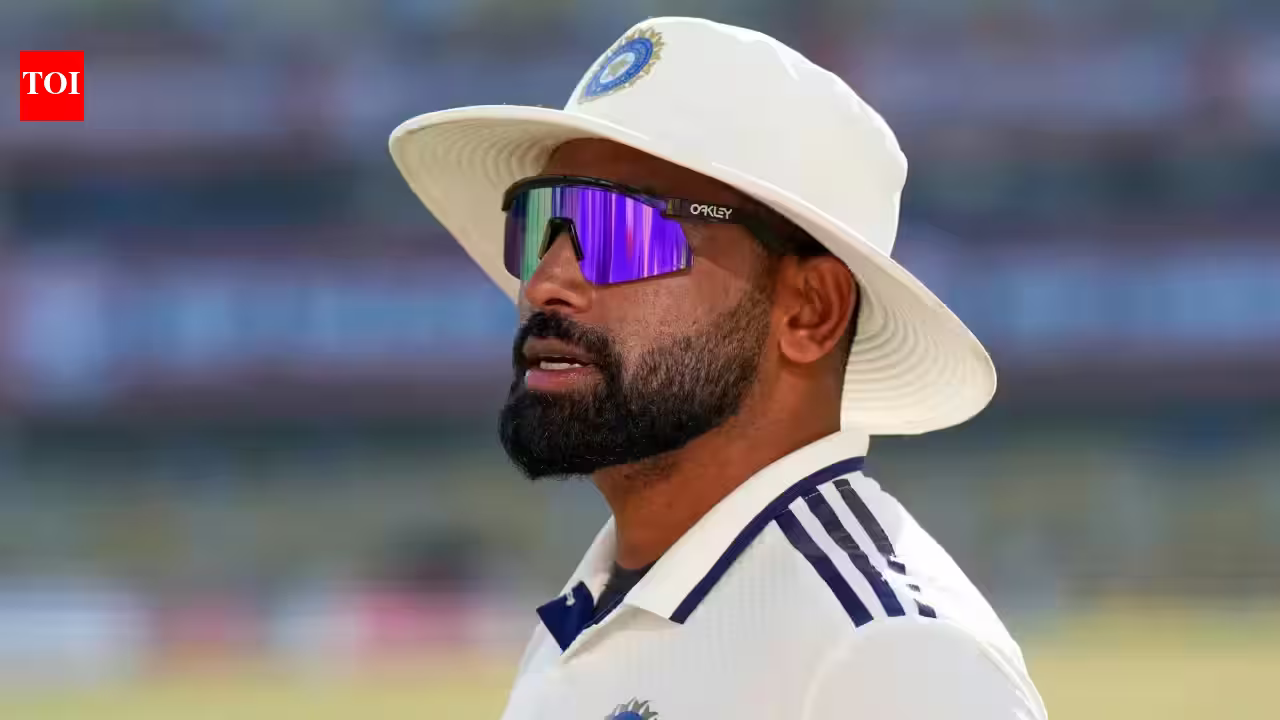
CRITICISM has erupted over the Indian team management’s selection policies as former cricketer Mohammad Kaif launched a blistering attack regarding the continued exclusion of speedster Mohammed Siraj. The controversy reached a boiling point during the ongoing second Test against New Zealand in Christchurch, where the decision to bypass Siraj in favor of Prasidh Krishna as a concussion substitute has left pundits and fans questioning the tactical coherence of the leadership group.
The incident was triggered when Indian pacer Akash Deep was ruled out of the remainder of the Christchurch Test after suffering a concussion, having been struck on the helmet twice while batting on Day 3. In a move that caught many by surprise, the management opted to draft Prasidh Krishna—who had been dropped from the starting XI for this specific match—as the replacement. The decision effectively sidelined Siraj, a cornerstone of India’s bowling attack, for the second consecutive time in the series.
A Scathing Indictment of Management Logic
Mohammad Kaif did not mince words when addressing the situation, taking to social media to call out what he perceives as a profound inconsistency in how players are handled. For Kaif, the snub is not merely a tactical preference; it is a confusing signal to a premier fast bowler who has proven his worth repeatedly on the international stage.
“Everyone is saying that Mohammed Siraj is being treated unfairly, and it is clearly visible,” Kaif remarked. “He is India’s highest wicket-taker in the ongoing World Test Championship (WTC) cycle, yet he is not getting an opportunity.”
The core of Kaif’s frustration lies in the contradiction of the management’s own narrative. Captain Shubman Gill previously justified Siraj’s absence by citing a slight dip in pace and suggesting the team was looking for him to “make a strong comeback.” Kaif dismantled this reasoning with sharp, logical precision, pointing out that match fitness and rhythm are products of competitive play, not bench duty.
“When will a player make a strong comeback? Only when you pick him in the playing XI,” Kaif argued. “How will he make a comeback sitting outside?”
The Contradiction of the Concussion Substitute
The selection of Prasidh Krishna as the concussion substitute added another layer of intrigue to the saga. Prasidh had been explicitly left out of the playing XI for the Christchurch Test, suggesting he was not in the team’s immediate plans for the match. To pivot back to him the moment an injury occurred, rather than turning to a bowler of Siraj’s pedigree, has drawn sharp criticism regarding the lack of a clear hierarchy in the pace department.
The situation becomes even more perplexing when juxtaposed with the public comments made by bowling coach Morne Morkel. The former South African fast bowler has been on record describing Siraj as a “world-class” talent and has spoken glowingly of the pacer’s dedication and performance during training sessions. Kaif expressed his bafflement at this disconnect: if the coaching staff truly believes in Siraj’s world-class ability, the rationale for keeping him on the sidelines while rotating other bowlers remains an opaque mystery.
A Proven Track Record Ignored
The frustration surrounding Siraj’s omission is backed by formidable statistics. As India pushes through the current 2025-27 World Test Championship cycle, Siraj stands tall as the nation’s leading wicket-taker. With 43 wickets in just 11 matches at a tidy average of 26.81, he has been a consistent engine for the bowling unit. Furthermore, his recent heroics in the five-Test series against England—where he finished as the top wicket-taker with 23 scalps—demonstrated a bowler at the peak of his powers.
Despite these numbers, the management’s rotation policy has seen the likes of Jasprit Bumrah, Akash Deep, and Anshul Kamboj prioritized. While India’s desire to manage workloads is understandable given the grueling international schedule, critics argue that benching a high-performer like Siraj for a full Test series against a challenging opponent like New Zealand risks damaging his morale and momentum.
The Road Ahead: Clarity or Continued Confusion?
As the Christchurch Test moves toward its conclusion, the debate surrounding the team’s selection strategy shows no signs of dissipating. The management’s reliance on “workload management” and “form assessment” is increasingly clashing with the public perception of what constitutes merit-based selection.
Kaif’s intervention serves as a reminder that the bridge between analytical selection and player management is fragile. For a team with aspirations of global dominance, the optics of sitting a premier wicket-taker while struggling for options in the face of injury creates an unnecessary narrative of instability.
Whether the management addresses these concerns or continues to follow its current internal logic remains to be seen. However, one thing is clear: the demand for transparency and a clear path forward for players of Siraj’s caliber has never been louder. As India looks toward the remainder of the WTC cycle, the question remains whether they will continue to treat their established stars as commodities to be rotated, or start viewing them as the essential, match-winning assets they have proven to be.
Disclaimer: This content is auto-generated for informational purposes only.
Source: Read Original News