







Shortly after the wellness guru Liz Earle MBE turned 60, she went to Ibiza to attend the infamous end-of-season parties with her boyfriend, who’s 17 years her junior. “I’d never been to Ibiza before,” she says. “We were leaving the clubs at 6am. My boyfriend was a DJ promoter back in the day. When we met, one of his first questions was, ‘What clubs do you like?’ I said, ‘Well, I was a member of the Groucho and I’ve been to the RAC.’ Then I realised he meant nightclub, but that whole scene had passed me by. He said, ‘We have to go.’ And it was a lot of fun.”
This new, groovy Earle, now 62, is a far cry from the frazzled Earle of 15 years ago. “Looking back at pictures of myself in my forties and early fifties, I almost don’t recognise myself. I had really lost my way. It was a time of physical perimenopause pain and ill health, weight gain, mental unease. I was looking after everyone else but I really didn’t know how to look after myself properly,” she says.
‘I’m proof you can move the needle’
There was a lot going on. A mother of five, the youngest of whom was born when she was 47, Earle had built a huge eponymous skincare business, then sold it — with all the stresses such negotiations entail. She was going through a “difficult” divorce from her second husband of 20 years and one of her children was seriously ill. “[And] I suffered severe financial pressures due to the actions of others.”
Now, facing the prospect of being “fat and 50, I realised I could be doing so much better”. So Earle leant back in to what had been her previous passion — wellness. Today, she says, “I’m living proof you can move the needle. I feel better now in my sixties than in my fifties or forties.”
Earle has delved deeply into the world of biohacking, using every trick possible to slow down or even reverse the ageing process. For the past few years, her “biological age” as calculated by a test that measures inflammation in the immune system has been 39. When she ventured into the world of internet dating, she debated what age to put on her online profile. “I was 59 at the time, so I split the difference and put 49.”
She’d been seeing her much younger boyfriend for about three weeks when she sat him down. “I said, ‘I have something to tell you.’ He looked quite worried. He was probably thinking I was going to say I was still married. I told him I’d just turned 60. He said, ‘Oh, is that all? Where shall we go for dinner?’ I’d built it up as such a big thing in my mind and it was such a non-event.”
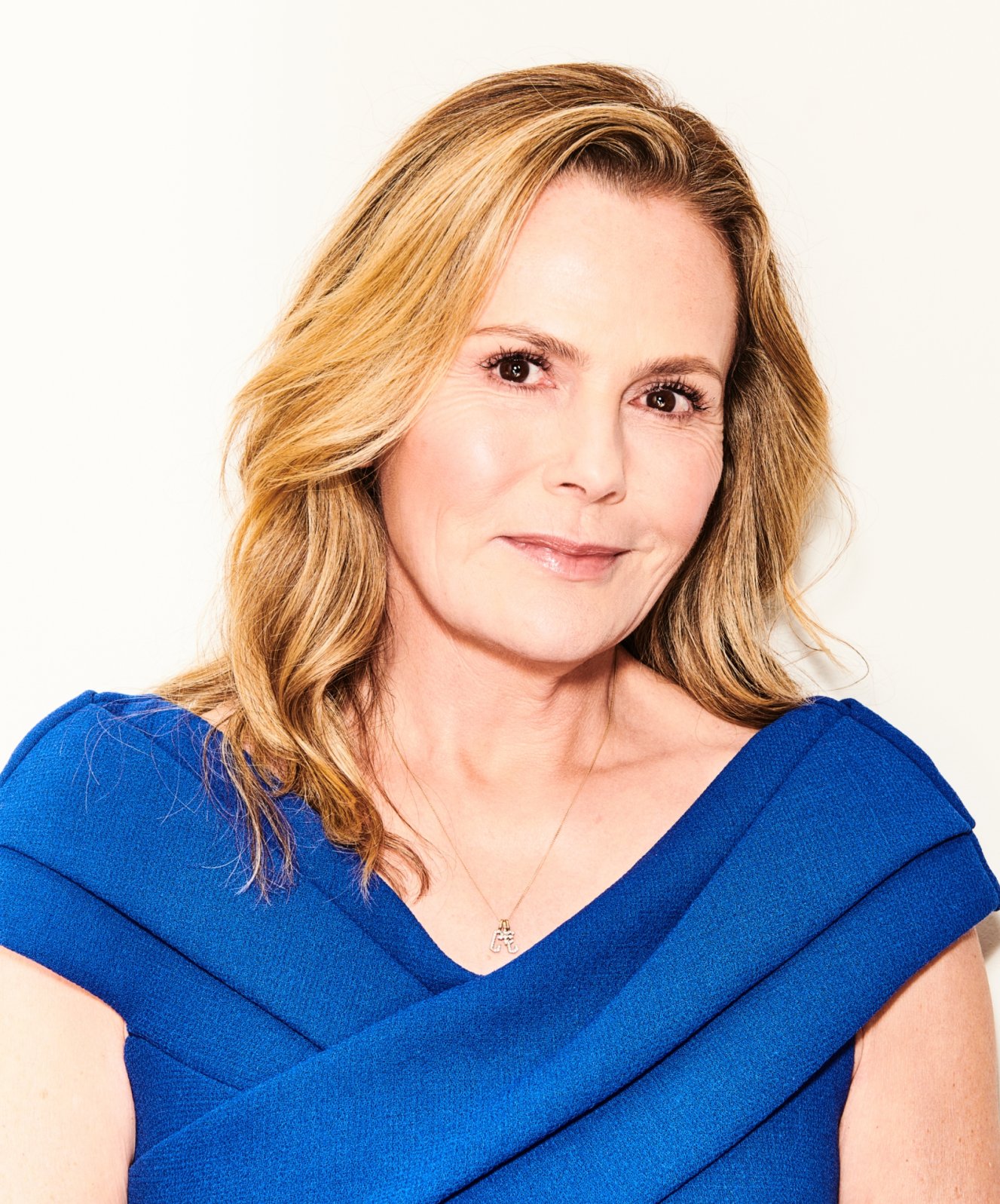
 Tom Jackson for the Times Magazine. Dress, thefoldlondon.com
Earle’s not stopping here. “Why can’t the trajectory continue? Why can’t we meet again in ten years with me saying I feel better in my seventies than in my sixties? We understand how our cells work and what the body needs to thrive. It’s not hard. It’s just knowing what you need to do and being consistent, committed to doing it.”
How long would she like to live? “I’m saying 120 with a full capacity for life. But the serious biohackers are looking at 180. They’re having stem-cell transplants and blood transfusions, but I think there are simpler things you can do — like changing your lightbulbs.”
A friend described her as ‘liquid Valium’
Earle’s not joking: one of her many tenets is that electricity — especially from flickery LED bulbs — is damaging us. “I’ve changed all my bulbs to incandescent,” she says. I make the first of many mental notes to emulate her, while already knowing I lack the consistency and commitment to make it happen.
We’re in Earle’s wellbeing HQ, a bucolic former artist’s studio tucked away behind Battersea Park in London where she films YouTube videos and records her podcast. Her main home is a pasture-fed organic dairy farm in Dorset; she also has a house near Lake Naivasha in Kenya. She opens the door looking haggard, racked with a vicious cold — no, sorry, that’s me, probably from sitting all day under LED bulbs. Earle certainly could pass for 39. She looks like a more natural version of Amanda Holden with peachy skin and shoulder-length blonde hair. Her aura is one of total calm. Her friend Jo Fairley, the co-founder of Green & Black’s chocolate, once described her presence as “liquid Valium”.

She’s wearing a beige tracksuit and grounding trainers, which feature conductive technology to replicate the effect of walking barefoot — this, according to her website, “can electrically connect us to the Earth’s energy”, with various studies claiming this can decelerate ageing.
The trainers are just some of the dozens of products listed in Earle’s latest book, How to Age, a fascinating read, if a bit daunting and potentially very expensive. Reading it, I kept filling my Amazon basket with gizmos to help me live if not to 120, then maybe 90. I started with the aforementioned trainers (£149), added a grounding bottom sheet (£129.99) “made from A-grade cotton and conductive silver thread”, which you connect to a (turned off) wall plug “to remain linked to the Earth’s potential”. Earle takes hers everywhere. Then there’s a Schumann resonance generator (a mere £14.99), which emits an electromagnetic signal that apparently mimics Earth’s pulse and which Earle says has improved her sleep quality.
It all sounds a bit wafty, but it’s basically harmless. Yet some of Earle’s takes are more controversial: for example, her views on sunscreen, which I’ve always been told to slather on whatever the weather, to prevent both wrinkles and skin cancer. “I’m not anti-sunscreen,” Earle says. “The NHS guidance is very clear that during summer, between 11am and 3pm, when the sun is strongest, you should protect your skin if you’re in the sun. But you’ve got to step back and look at this intelligently: if you’re going outside when there are no UVA [rays], let alone UVB, there’s nothing to protect yourself from. It really doesn’t make any sense.”
Other beauty gurus — take Caroline Hirons, who has 790,000 Instagram followers — are unequivocal that UVA rays are as strong in winter as in summer. But Earle points out that some huge commercial interests are involved in selling us sunscreen: “Think about who’s telling you to wear it all the time.” Sunscreen chemicals may irritate the skin. Most importantly it blocks sunlight, vital for charging our mitochondria — the organelles found in cells that manage both cell growth and death. “We have to be more nuanced about this,” she says. She’s interviewed Professor Richard Weller, the head of medical dermatology at the University of Edinburgh. “In his view, we’re going to look back and consider lack of sunlight to be as damaging to our health as smoking.”

She quotes a major Swedish study that sun avoiders had doubled the risk of death compared with those with the highest sun exposure, and another that shows higher vitamin D levels (from sunshine) correlate with less aggressive melanomas. “It makes sense when you think about it. We go outside on a sunny day and everyone’s smiling and the world is brighter. But there will probably be some defensiveness in some quarters, I think, about my views.”
Earle is the daughter of an admiral and grew up in Portsmouth. In the Eighties she became deputy beauty editor of Woman’s Journal before moving into television, presenting beauty segments on the likes of This Morning in its Richard and Judy heyday and GMTV. Wellness wasn’t even a word back then. “Instead we said ‘new age’,” she says. Through her work, Earle met people with newfangled titles such as “naturopaths and nutritionists” and was amazed to be told that what we eat affects our health: “They spoke a whole new strange language.” Still, she followed their dietary advice and her eczema cleared up. “I’d found my tribe.”

For a while she was vegan, teetotal and followed a macrobiotic diet — bringing little pots of her own food to dinner parties.
“That was no fun at all; it actually made me quite unwell. But a lot of things which at that time we thought of as woo-woo we can now prove.”
But then her friend Kim Buckland suggested they start a natural skincare brand. Earle resisted — “I thought it sounded much too commercial” — but eventually agreed. The Liz Earle Cleanse & Polish cleanser, which removed make-up with a hot muslin cloth, became the beauty sensation of the Nineties, appearing in the Vogue beauty hall of fame alongside the likes of Elnett hairspray and Crème de la Mer moisturiser.
The focus on wellbeing
In 2010, they sold the company to Avon for an undisclosed multimillion pound sum. Five years later, Avon sold it on to the owner of Boots for £140 million. Earle remained the face of the brand until 2017, but now has nothing to do with it. “Cleanse & Polish is still my baby. It still wins awards and I use it twice a day. But I spent 15 years going round the world selling face cream, and everything else I was doing basically took a back seat. I was pulled further and further away from my real interest, which was wellness.”
Finally freed from her obligations, she returned to her passion — writing books and founding her website, Liz Earle Wellbeing, sharing her opinion on everything from sound baths to practising gratitude. She tests out pretty much every piece of advice she receives.

When we meet, it’s 9am. She talks me through what she’s done so far that day, which started with getting into the sunlight as quickly as possible. “I’m not a morning person, but my resolution is to try to see as many daybreaks as I can. Now the clocks have changed it’s getting harder and harder, because it’s going to be daylight at, what, 4.30am?”
You’re going to get up at 4.30am?
“It’s my aim,” Earle says serenely. “It’s only for a short period in the summer.”
Filter your tap water
Again, I’m confused. Aren’t we meant to be sleeping as much as possible? “I’ll just have to bring bedtime earlier,” she says. “The circadian science is there — that is how we have evolved to be. Before the invention of electric light, we got up with the sun.”
Back to today’s routine. After the dawn start, Earle drank a glass of water. Hooray — again, as drilled into me by beauty editors, I chug tap water all day long on the basis that bottled water is an expensive, un-eco con. But Earle’s book tells me, “Tap water is to water what white bread is to spelt sourdough: a pale, overprocessed version of something that was once a natural source of vitality.” Aargh. “Just filter it,” she tells me.
Yet filtered water is still not good enough. Earle is intrigued by structured water — water with a hexagonal crystalline structure, typically found in natural springs, which, advocates say, has life-giving properties. You can buy a “structuring” filter to add to your water filter — from £555. More cheaply, you can swirl your glass before drinking (“I’ve tried doing it with a crystal wand,” Earle says with a smile) or leave it for a while in sunlight to alter the molecules.

Happily, all this is a bit much even for Earle. “I go through phases. When I was writing the book, I’d leave a jug of water near the window on a sunny day. But I’m not obsessive. But maybe in years to come we will discover that this is one of the secrets of longevity and we will all be doing it naturally.”
Structured or not, her water is topped up with powdered electrolytes containing trace minerals, which “make it more rehydrating”. Supplements consumed include luteolin for hay fever, vitamin D, omega 3s and magnesium L-threonate, “which crosses the blood-brain barrier”.
‘I do like to have the odd late night’
Then Earle heads outdoors for sunlight or, if that’s not possible, sticks her head out of a window. Next comes a shower ending with a short cold-water blast to give “a helpful shot of cortisol”. Afterwards, she has a cup of coffee with some shilajit. Eh? “Shilajit’s a black sap that oozes from prehistoric rock formations. Legend has it this is what fuels Sherpas as they run up mountains carrying heavy weights.” Into the basket it flies at £55.95 for 15g.
Earle is gentle when doubters like me mutter that her regime is too costly and time-consuming. “How long does it take to open a window and put your head outside?” she says, referring to the need for daylight. Negativity is very ageing, so I refrain from saying quite a long time in my case, as I’d first have to unscrew two clunky window bolts. She continues, “Little things don’t have to cost any money or take any effort. The last thing that we want to do is give women more pressure. Keep it simple.”
In comparison with many of her biohacker peers, Earle’s a lightweight. She eats red meat, albeit grass-fed. Occasionally she has a drink — mainly clear spirits such as tequila and vodka, and the odd glass of red wine, “although I don’t think it agrees with me very much”. At a recent anti-ageing conference (“That space is very competitive; people are always comparing biological ages”), she met another 62-year-old woman whose biological age was 21. “But she gets up every day at 4am and never has a glass of wine and I thought, ‘Actually, that’s possibly a little bit too extreme.’ I do like to have the odd late night and go to a party. It’s all about balance.”
Indeed, if Earle could give one piece of advice to her younger self it would be: “Lighten up. In my early years I was just so serious about everything. I’d say to her, have more fun. You’re only here once.” Albeit ideally for at least 120 years.
How to Age: Supercharge Your Health and Feel Better Than Ever by Liz Earle (Yellow Kite, £22) is published on April 23. To order, go to timesbookshop.co.uk or call 020 3176 2935. Free P&P on online orders over £25. Discount for Times+ members
Hair and make-up Kerry September using Delilah cosmetics and Innersense Organic Beauty. Opening image Shirt, hm.com. Trousers, hobbs.com