India has a population of over 140 crore people, and unlike the US, it is also a country that gives its women the right of choice. While having a child might be the dream of many, there are those who want to stay child free. But Hindi films are yet to get the memo about the growing number of women in the country who don’t see motherhood as the obvious next step, but as a punishment. Bollywood has been deifying mothers for decades, and has married itself to the thought that ‘maa’ is the centre of everyone’s universe. So when they have to deal with a woman who gets pregnant in a film, they immediately take off their shoes and fold their hands, because they have been taught ‘maa = bhagwan’. Hindi cinema, which boasts about being one of the most successful film industries in the world, is yet to make a film that gives the liberty of choice to a pregnant female character, and allows her to make her own decisions without any burden or guilt. Strangely, Bejoy Nambiar’s creature thriller Tu Yaa Main, brings up the idea of abortion and actively discusses it as a choice.
In Tu Yaa Main, Avni (Shanaya Kapoor) and Flow (Adarsh Gourav) come from different worlds. He is the boy from the streets who lives in a tiny house with his family, and she is a woman who lives in a mansion all by herself. They start dating, and eventually, she gets pregnant. Tempers flare when her sister and brother-in-law find out and push her to get an abortion because they don’t find Flow worthy of their fancy family. Flow shuts them down when they offer him some money but he too, holds the same opinion, for he feels that fatherly responsibilities are not meant for him at this moment. For a minute, you see him as a major red flag who doesn’t even pause to seek her opinion on the matter, or ask her what she really wants. And before they can have this conversation, a crocodile joins their party.

 Shanaya Kapoor and Adarsh Gourav in Tu Yaa Main.
Hindi films, for the last few decades, have equated the idea of abortion with murder, or at least something that should be seen as a sin. The concept of choice, or why that is relevant, is thrown out of the window the moment a female character gets pregnant. Films like Mimi, Good Newwz, Salaam Namaste, bring up this idea, but shoot it down just as quickly. Kya Kehna, in this subject, is truly a relic of the past where Preity Zinta’s character recites an entire monologue about her conversation with her foetus in an overtly melodramatic scene.
The only Indian film in the recent past that discusses the subject front and centre is Anna Ben-starrer Malayalam film Sara’s, where the central character wants to stay child-free by choice. It was a rare Indian film that discussed MTP (Medical Termination of Pregnancy) and tried to make the viewer comfortable by letting them know that it’s legal and safe. The film did not lecture its viewers about motherhood and constantly reminded them that this comes with a lot of sacrifices. Most importantly, it stressed upon the fact that motherhood and pregnancy are choices.
For a country that makes the most films in the world, one Sara’s is not enough to discuss something that could change the course of a person’s life.
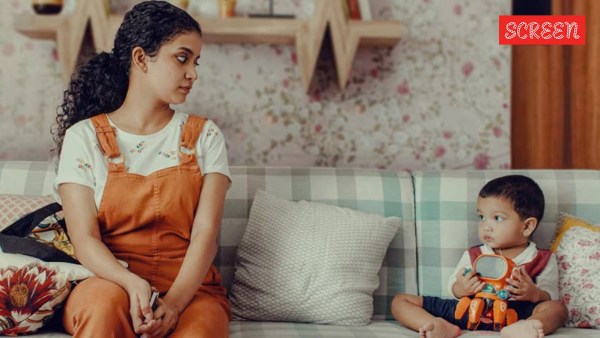 Sara’s discusses MTP, while also discussing the legality and the safety of the process.
Story continues below this ad
Tu Yaa Main, however, comes back to the subject when Avni and Flow catch a breath from fighting the crocodile. Avni lost her parents at a young age and grew up an orphan; Flow’s father was 21 when he left his family of wife and two kids, and he is starting to understand that, perhaps, it was the burden of fatherhood that made him act this way.
Flow accuses Avni that she wants to have a child to escape her “boring life.” Since they are both influencers, he puts it succinctly, “You can pretend to be famous, but you can’t pretend to be a parent. You really have to be one.” This is when she opens up and admits that she sees motherhood as an escape from her loneliness. She feels it could, perhaps, rid her of the haunting memory of her parents’ death. Her reason to be a parent, she explains, is selfish. The film holds on to that moment and lets Flow be the voice of reason. A child is not an answer to one’s loneliness, but is a person who deserves life, without an excuse. As Avni processes this moment, she calms down from her panic-ridden state and silently accepts that being a mom isn’t a solution to her problems. Moments later, the crocodile comes back, and Avni and Flow are back fighting for their lives.
Pregnancy or abortion isn’t the central idea of Tu Yaa Main and the film could have chosen to deal with it in any way, and that still wouldn’t change how the crocodile attacks its protagonists. But Bejoy Nambiar makes an active choice to discuss parenthood that must not be burdened with guilt or trauma. The crocodile here is pregnant as well, but Bejoy clearly draws your attention in differentiating between an irrational reptile and a thinking human, who has the luxury of making choices. Hindi films boast of feminism with small wins, where a female actor is billed before a male actor, or when a female character exists independently in a man’s world. They could learn a thing or two from this little creature feature.
DISCLAIMER: This article discusses cinematic portrayals of pregnancy and abortion as a matter of personal choice and includes themes of orphanhood and loneliness. It is intended for entertainment purposes and does not constitute medical, legal, or professional reproductive health advice.