





It is the largest demoracy in the world but just 14 per cent of the politicians are women.
Yet, a move to increase the number of female politicians in India, putting women’s health, gender-based violence and education more prominently on the agenda, has just been rejected.
The vote had been marred by controversy with some saying it was nothing more than “gaslighting” women.
Pratik Dattani, founder of Bridge India, believed the heart of the bill was not just about equity, but about “progress and economic development” in India and beyond.
“If you can improve the lives of women, if you can increase the employment rate of women, you will boost GDP growth,” he told the ABC.
“If the world’s largest democracy can enfranchise women and empower women in this way I think that’s a beacon for the rest of the world.
“Not just for western democracies but other parts of the world when men dominate the political landscape.”
He said several recent issues, including debate around the marital rape exemption in Indian law, had highlighted the need for more women in politics.
“If there were more women in parliament there would be a far greater drive to change what is clearly an outdated law,” Mr Dattani said.
“If you have more women in parliament, issues that male legislators have not prioritised thus far will get raised a lot more.”
Why was the bill controversial?
Boosting the number of female politicians in India’s lower house — called the Lok Sabha — actually had broad cross-party support.
A bill to reserve one third of parliamentary seats for women was unanimously supported in 2023 but has still not been implemented.
It could not be brought in until after the next census, which is currently underway, and would then have taken until after the 2029 election to come into effect.
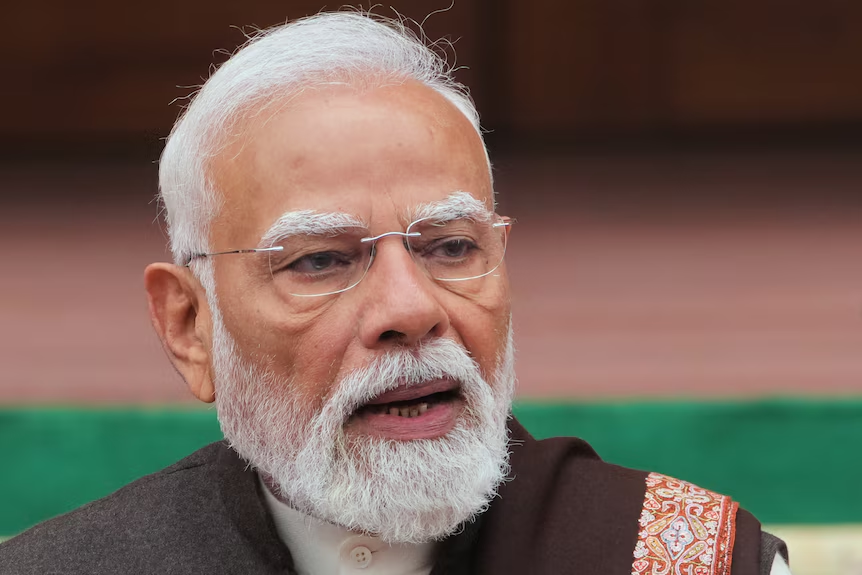
The landmark parliamentary reforms put forward by Indian Prime Minister Narendra Modi have been rejected. (AP: Manish Swarup)
Prime Minister Narendra Modi’s government convened a special sitting of parliament this week, hoping to pass several landmark bills that could overhaul India’s parliamentary system, including fast-tracking that bill.
But in order to fast-track it, the government said it planned to redraw parliamentary districts based on population, increasing the number of lower house seats from 543 to more than 800.
Critics, including India’s opposition, had argued that increasing the overall number of seats would primarily benefit Modi’s party and was merely a bid to manipulate the system and get more votes.
And so the vote was rejected on Friday.
“I think it’s slightly disingenuous of the government to say we need this in order for more women to be represented, without this women will not be represented,”
Mr Dattani said.
“A lot of the conversation around this in parliament is grandstanding on both sides.”
India’s government said it would continue to campaign for women’s quotas after the vote failed.
But Mr Dattani said both the government and opposition could have already “voluntarily” done more to increase female candidates since the initial reform was supported.
Move nothing more than ‘gaslighting’, professor says
Professor Nitasha Kaul said it was really important to improve women’s representation in politics, especially in India. (Supplied.)
But Nitasha Kaul, a politics professor and Director of the Study of Democracy Centre at the University of Westminster, said the bill was nothing more than politically-motivated “gloss”.
“It’s almost like a kind of gaslighting,” she told the ABC.
Professor Kaul said there was no doubt “India was a very patriarchal society” and it needed to improve women’s representation in politics.
But she did not believe Mr Modi’s move to fast-track the bill was ever about bringing in real change for women and was all about “political strategy”.
“This strategic silence in the face of crimes against women, rapes of women, organised violence against women, refusal to even talk about it, does not sit at all comfortably against the fact that now suddenly he’s realised that women need to be in parliament,” she said.
“This is clearly a very specious appeal to what he sees as a progressive cause that is going to help him both with the electorate and with international projection.”
She said the international community should take note of what was happening in India.
“India, as the world’s largest democracy, has been undergoing this very powerful transformation in recent years,” Professor Kaul told the ABC.
“This transformation matters to understand how democracies are eroded; the kinds of violence, anti-minority behaviours, misogynistic behaviours that get normalised.
“This is not just an India story.
“It’s a story of how attitudes to women, rhetoric on women, can be used by authoritarian types of political projects, selectively in ways that make it seem like they are promoting women’s empowerment.
“This has been used consistently by other leaders in other countries as well.”