








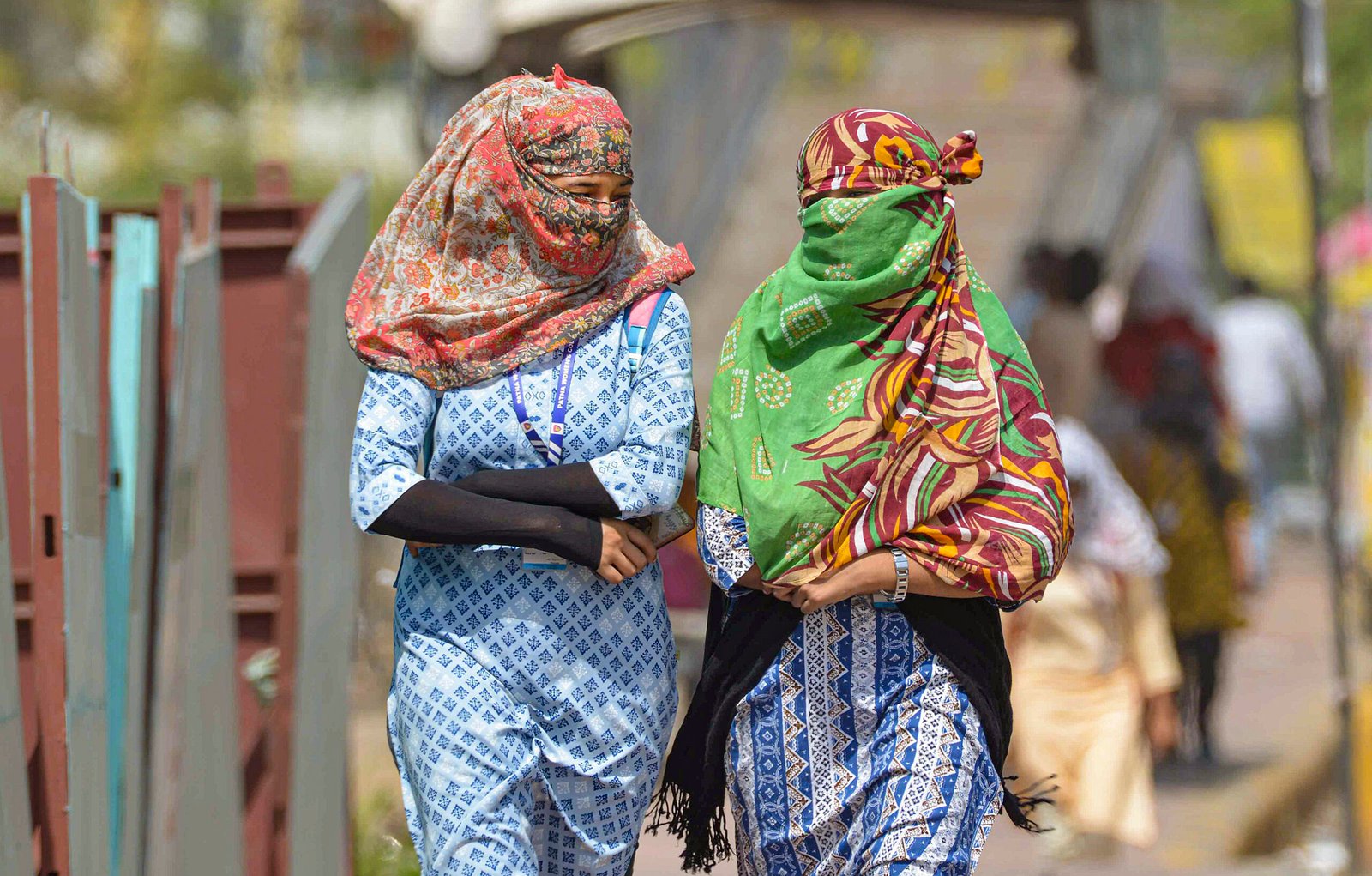
Summers in India were never kind. Even the mighty British had to find comfortable retreats when the sun started belting down on one of their most prized colonial possessions. However, as the world goes deeper into the 2020s, hot summers seem to be not just a seasonal occurrence but a structural crisis.
Or how else do you explain that in April, the country is home to 20 of the 25 hottest cities around the globe, temperatures pushing 44 degrees Celsius across several states, and the number of heatwave days easily doubling those seen in just the previous year (540 in 2024, as against 230 in 2023).
India challenging global ‘hotspots’
According to one report, India is gearing up for a severe and extended heatwave, with predictions suggesting that it may emerge as the hottest area globally in the coming two weeks, matching or even surpassing regions that are traditionally known to be global ‘hotspots’, such as those in Africa and the Arabian Peninsula.
Also read: As scientists warn of imminent desertification, can a green wall shield North Karnataka?
The India Meteorological Department (IMD) has said that temperatures in various states of the country could exceed 45 degrees Celsius during this time, with certain regions potentially reaching as high as 48 degrees.
How the states are boiling
Several parts of Maharashtra were particularly sizzling. Cities in the Vidarbha region to its east, such as Akola, Amravati, Wardha, and Nagpur, are witnessing the mercury needle rising between 43 and 44.2 degrees.
Some of India’s hottest cities as on April 18, 2026
♦ Varanasi (UP) at 45 degrees Celsius
♦ Unchahar (UP) at 44 degrees
♦ Prayagraj (UP) at 44 degrees
♦ Jaunpur (UP) at 44 degrees
♦ Mughalsarai Railway Settlement (UP) at 44 degrees
♦ Amethi (UP) at 44 degrees
♦ Azamgarh (UP) at 44 degrees
Source: AQI.in
Met officials said earlier this week that temperatures are set to rise, and heatwave conditions will prevail over most districts of Vidarbha. The maximum temperature is expected to diminish only from April 21, they cautioned.
Other places of the state, including Solapur, Malegaon (in Nashik) and Beed, also saw the mercury hovering above the 43-degree mark.
“When the temperature rises by around 4.5 degrees Celsius, it is considered a heat wave. Such a temperature rise is most likely to be recorded in 4-5 districts of Marathwada,” agrometeorologist (scientist who examines the relationship between weather/climate and agriculture) Kailas Dakhore told news agency PTI.
Anantapur in Andhra Pradesh registered 43.4 degrees on April 15, according to the IMD. Many of those top 20 hottest cities in India are from Uttar Pradesh, another state which is going through a heat spell. Banda in southern UP recorded 44.4 degrees on Friday (April 17).
Also read: As climate disasters increase in Himalayas, Himachal proposes scientific study
In the east, Odisha was seeing extreme heat conditions, compelling authorities to close schools in districts such as Bolangir, Subarnapur and Kalahandi. A Red Warning for intense heatwave conditions had been issued for Kalahandi for four days, starting Saturday (April 18). Examinations would be held between 7 and 9 am, and the examinees would be given light food, such as fruits and biscuits, officials said.
♦ A heatwave means a duration characterised by exceptionally high temperatures relative to the typical expectations for a specific area.
♦ Heatwave is declared if the maximum temperature of a station reaches at least 40 degrees or more for plains and at least 30 degrees or more for Hilly regions.
♦ Researchers associate the rising heatwaves with climate change, urban heat influences, and alterations in weather patterns.
Even Uttarakhand, which is a Himalayan state, was seeing rising temperatures and introduced “water bells” in schools to force hydration breaks for students.
Schools have also been asked to maintain adequate stocks of ORS and essential medicines. Hospitals across several states have been placed on high alert to deal with heat-caused illness.
In Rajasthan, India’s desert state, cities such as Barmer, Phalodi, Churu and Sriganganagar, and western districts such as Bikaner, Jaisalmer and Jodhpur were experiencing temperatures well above 42 degrees.
Crayons melting in Bengaluru, the ‘AC’ city
Bengaluru, the ‘air-conditioned’ weather of which is often praised, is also facing tough times. April 2026 has been as brutal for the city with the mercury frequently going past 36-37 degrees, thanks to rapid urbanisation, and loss of green cover, among other things.
One social media user recently shared a video to show the unusual heat level that Bengaluru is experiencing. In the clip, she was seen expressing shock over crayons kept in a tray in the sun melting due to the heat! “Do you think I should fry an omelette on my table?” she asked.
Overall, this is not an extreme weather anymore but a climate emergency slowly unfolding.
Nights not bringing relief, heat zones spreading
The IMD’s April-June 2026 outlook paints a sobering picture. Above-normal heatwave days are forecast across east, central, northwest, and peninsular India. Crucially, nights are no longer providing relief—minimum temperatures are rising steadily nationwide, shrinking the window during which the human body can recover from daytime heat stress.
When the body cannot cool down overnight, cumulative heat exposure becomes medically dangerous. The arrival of the heat season is also happening earlier than it has been traditionally, which means transition seasons between winter and summer, such as spring, are shrinking alarmingly. For example, this year, some parts of western India were already recording near-40 degrees in late February.
Also read: Nearly six months after flash floods wreaked havoc in Dharali, why locals are yet to move on
There is also a geographic shift underway. Extreme heat has historically been concentrated in Rajasthan, Delhi, and the central plains. Today, coastal states — Maharashtra, Andhra Pradesh, Tamil Nadu, Odisha — are experiencing a new kind of threat: humid heat. When humidity is high, sweating loses its cooling effect. A temperature of 38 degrees with 80 per cent humidity can feel, and physiologically act, like 48 degrees in dry conditions. Researchers point to rising sea surface temperatures and higher atmospheric moisture as key drivers. Even hill states are seeing warmer days now, confirming the horizontal spread of the heat islands.
The numbers confirm a decade-long trend. In 2024, India recorded 554 heatwave days — more than double the 230 logged in 2023. The IMD attributes this not only to warming average temperatures but to disrupted atmospheric circulation patterns, drier soils that heat faster, and the earlier collapse of weather systems that once delayed peak heat until late May.
A threatening ‘heat dome’
A continuous high-pressure system has established itself over the subcontinent, confining hot air in what specialists refer to as a ‘heat dome’. Furthermore, dry westerly winds and delayed pre-monsoon showers have exacerbated this scenario.
The lack of cloud cover permits direct solar radiation to quickly warm the land surface, while the absence of rainfall hinders any cooling effect. Collectively, these conditions are generating a prolonged and intense heatwave throughout a significant portion of the country.
Vulnerable sections at heat’s mercy
The human toll falls heaviest on the most vulnerable. Outdoor construction workers, farmers, children attending schools without fans or ventilation, the elderly in urban heat islands — these are the populations absorbing the worst of what the data describes as statistical anomalies.
The IMD has explicitly warned of risks to “public health, water resources, power demand, and essential services”. Power grids are under stress. Water shortages are emerging. And relief, according to forecasters, will not arrive before late April at the earliest.
Also read: 2025, the year when the weather stopped making sense in India
India is not uniquely cursed by geography. It sits at the intersection of multiple climate pressures: a vast landmass that heats rapidly, a monsoon system that is itself becoming erratic, and a population of 1.4 billion — many of them poor, many of them outdoors — that has little margin for error when the thermometer climbs past 43 degrees Celsius.
The furnace is on.
And the question is no longer whether India will face more summers like this one, but whether its cities, hospitals, schools, and power infrastructure can survive them.