









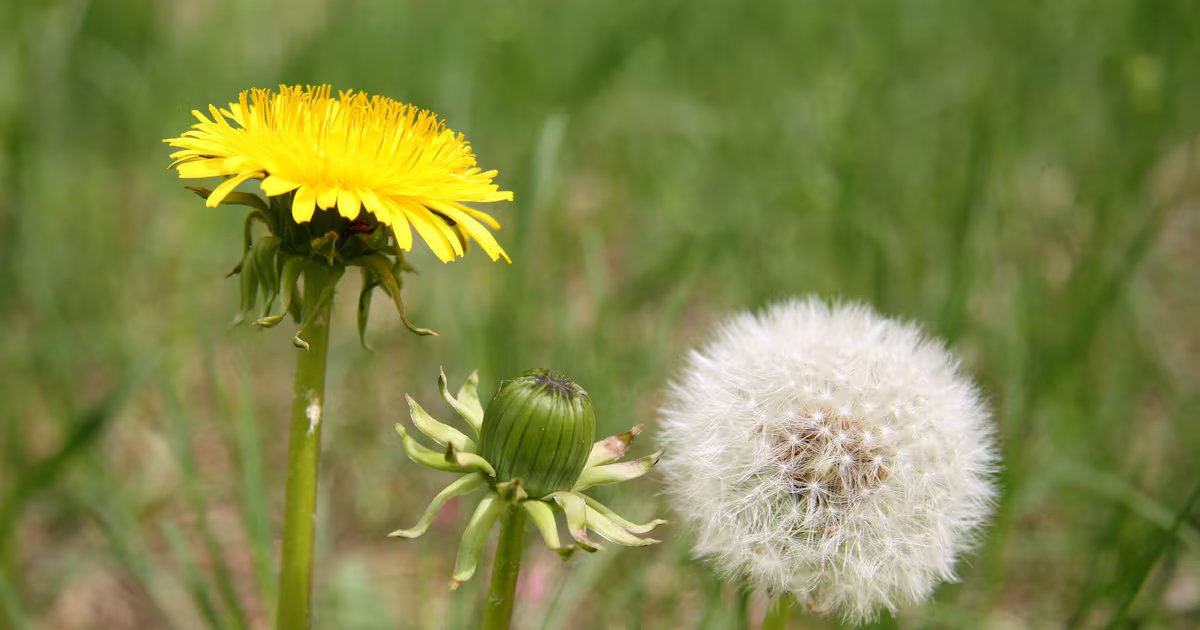
The names we give a species can reveal what we notice and what we use. The dandelion takes its English name from the Norman French dent de lion, lion’s tooth, for the jagged edges of its leaves. In Irish, caisearbhán refers to how it tastes – bitter stem – a nod to the notoriously sharp flavour of dandelion greens. The French, with blunt practicality, call it pissenlit – piss-a-bed – acknowledging its diuretic qualities. Across Europe, other names linger on its milky sap – in Denmark it’s called mælkebøtte, the milk bucket – its medicinal uses, or the pleasure children take in blowing the seeds into the air.
It’s curious that many names don’t commonly refer to its most conspicuous feature: the unmistakable, bright yellow flower that appears around this time of year in our parks, gardens, verges and fields – a stage of life that is vital for insects as a source of food. If I were to invent an Irish nickname for the dandelion, it would be something like An Bhialann Órga, the golden restaurant.
For that flare of yellow to appear, the plant must spread its seeds. In this, the dandelion’s familiar spherical seed head is a design marvel. Scientists at the University of Edinburgh used a wind tunnel and high-speed cameras to watch as air flowed through the thin bristles of the seed head, creating a ring-shaped air bubble that enhances drag, slowing the seed’s descent and helping it float much longer than would otherwise be the case. It’s far more effective at keeping the seed aloft than a solid parachute, a perfectly tuned aeronautical feat of engineering that emerged over time through evolution.
Dandelions are also, in their own way, a record of the ground they grow in. Anecdotally, horticulturalists have long suggested that they favour soils high in potassium and low in calcium, and that an abundance of them indicates compacted earth, but peer-reviewed studies confirm what is more certain: the dandelion’s long taproot is an enthusiastic accumulator of minerals, drawing nutrients and metals from deep soil layers and concentrating them in its tissues.
It makes the dandelion a useful biomonitor of environmental contamination. In 2023, Polish scientists collected dandelions from three places: a pristine mountain meadow, and two urban areas in Warsaw. They tested the plants and soil for chemicals, parasites, bacteria, and heavy metals; what they found were lead and cadmium.
The plants acted like sponges, absorbing what was in the surrounding soil. While no pesticides or industrial chemicals were found, in urban areas, they discovered numerous disease-causing bacteria and the parasite Giardia intestinalis, which causes digestive disease, likely from dog, cat, and wildlife faeces and urine, as well as contaminated water. The takeaway? If you’re tempted to harvest dandelions, wash them thoroughly before eating.
We’ve spent decades waging war on dandelions with herbicides, boiling water and garden forks. The plant is seen as an unwelcome intruder in need of erasure. In doing so, we’ve missed the abundance it offers insects, particularly at this time of the year.
The dandelion’s most important role isn’t mechanical or chemical. It’s temporal, and to do with life itself, especially where life is already thin on the ground. Imagine, for a minute, what it’s like to be an insect, like a bee, coming into spring in a city or suburb where flowers have been paved over, or in a farming landscape where wild meadows are all but gone. You’ve spent months living off fat reserves; by the time spring comes, they’re all gone. The queen, who began laying in January, is raising a brood that the colony can barely afford to feed. Temperatures rise. You and the colony need food urgently, but the trees haven’t fully bloomed yet, and the reliable nectar flows of May are weeks away. You’re in a perilous hunger gap. And then, the golden dandelion blooms.
If asked for my most memorable meal, I know the answer. It wasn’t in a fancy pub or a Michelin-star restaurant, the result of some culinary perfection. It was buttered white toast after giving birth for the first time. Depleted and exhausted, my body in deficit, the simple, delicious taste of toast was a salvation. That is what a dandelion is to a hungry insect – immediate sustenance at the point of need. A park full of dandelions is not decoration, failure or negligence. It’s a supermarket full of food; a source of nectar and pollen at the precise moment of vulnerability and hunger. The flowers are open and, if we allow them, plentiful, so insects don’t need to tire themselves out searching far and wide for food.
Thanks to the awareness-raising work of initiatives like the All-Ireland Pollinator Plan, run by the National Biodiversity Data Centre, things might be changing. In a public park last week, I watched as a council worker whizzed around on a sit-on lawnmower. In previous years, each and every blade of grass would have been cut down, but that morning, the worker adeptly circled the dense patches of dandelions, leaving them to grow in the ground like little balls of sunshine. It’s a gift to the insects in the area – a small act that can make a difference between starvation and abundance. And where we have plentiful insects, birds and bats will follow.
Life attracts life. Wherever you can, let the dandelions be.