








Sony’s rumored PlayStation 6 ray tracing performance uplift is under the microscope, with renowned leaker KeplerL2 sharing some performance insights.

VIEW GALLERY – 2 IMAGES
A post circulating on NeoGAF breaks down claims that the PS6, powered by AMD’s next-gen architecture, is slated to deliver up to 10x ray tracing (RT) performance over the PlayStation 5.
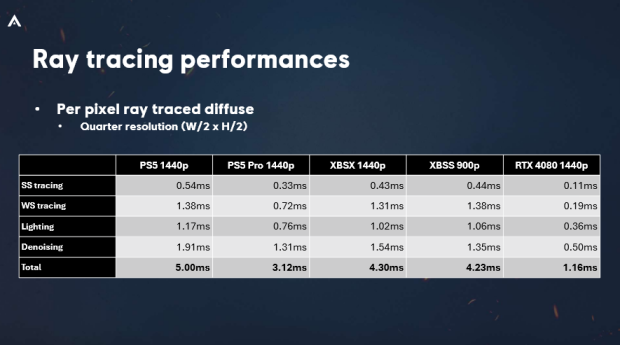
Using performance data from Assassin’s Creed Shadows, KeplerL2 shared an image that isolates RT workloads and compares them to overall frame time, arguing that RT only accounts for a fraction of the total rendering cost, which showcases that ray tracing performance is only one part of the performance equation, and gains in RT performance don’t equal proportionate in-game frame rate gains.
The analysis shows that while RT effects on PS5 can take roughly 5ms of a ~30ms frame, reducing that workload by 10x would only shave a few milliseconds off the total frame time. In practice, this translates to a roughly 3x improvement in overall performance, not 10x, as rasterization, CPU processing, and post-processing still dominate the workload. The post ultimately highlights a key limitation in modern rendering pipelines: boosting one component doesn’t scale the entire frame equally.
However, the conclusions rely on several assumptions. Future titles are expected to lean far more heavily into ray tracing and even path tracing, which could significantly increase RT’s share of frame time.
Additionally, advancements in AI-powered upscaling, de-noising, and frame generation-akin technologies can significantly assist in this process, and all of which are actively being explored by Sony and AMD. With future developments, performance dynamics can shift in ways this analysis doesn’t fully account for.