








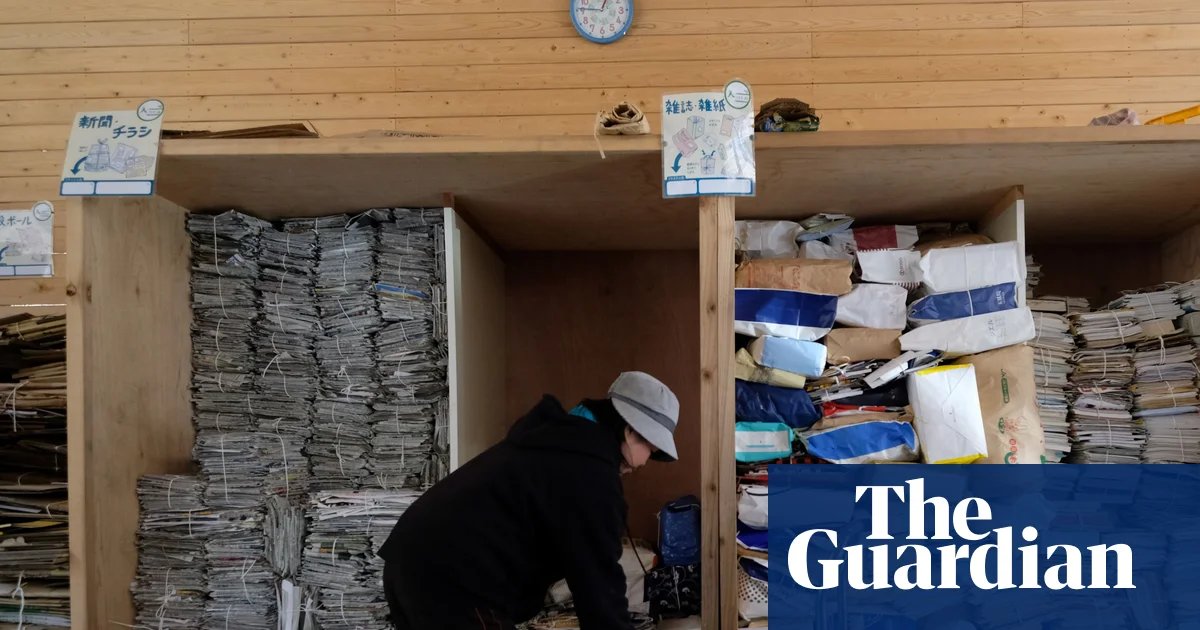
There’s no garbage truck in Kamikatsu.
Instead, the Japanese town’s 1,400 residents take their waste to the local recycling centre, or “Gomi station”, and sort it themselves into one of 40 different categories.
There are collection bins for almost everything: toothbrushes, wooden chopsticks, mirrors, mercury thermometers, button batteries, ball-point pens and disposable chopsticks. Reusable items go to the Kurukuru shop, where anyone can take them home.
The ultimate goal is “zero waste” and the meticulous sorting contributes to an 80% recycling rate.
This mountainous town on the island of Shikoku may be an outlier but as Victorians sort their waste into four kerbside bins – the most in Australia – households in some countries regularly contend with five or 10 different recycling streams.
Separating waste can improve the quality of recyclable materials and reduce contamination but are more bins better for the environment?
Kerbside wheelie bins have been used in Australia since the 1980s.
Over time, new bins with variously coloured lids have been added; they include commingled recycling (yellow), organics (green), glass in Victoria (purple), and paper and cardboard for some councils in New South Wales and South Australia (blue).
According to the latest data, local governments collect about 9.9m tonnes of waste via kerbside bins each year, made up of 6m tonnes of rubbish, 1.8m tonnes of recycling and 2m tonnes of organics.
“Many councils have a waste hotline because bin collection is something that communities really care about,” says Amelia Leavesley, who researches waste at the University of Melbourne.
Kerbside collection is one part of a complex system. For recycling to work well, materials need to be recyclable in the first place, Leavesley says, before they can be separated by households. Councils collecting the waste need access to infrastructure, like materials recovery facilities, and there needs to be market demand for the resulting recycled materials.
In addition to wheelie bins, states and territories have added container deposit schemes, drop-off points where people can claim 10 cents for each eligible drink bottle or container. South Australia was the first to do so in 1977, and Tasmania the last in 2025.
How do Australia’s kerbside bins compare globally?
Apart from Victoria, which aims to make four services standard for every household, most of Australia operates with two or three kerbside bins and a container deposit scheme.
But that pales in comparison to sorting systems elsewhere in the world.
National waste data shows recycling rates for “municipal solid waste” – waste produced by households and some small businesses – are much higher in Japan (79%) and Germany (69%) than Australia (44%).
High recycling rates in many European countries are underpinned by their longstanding use of separate collection systems, according to environmental consultants Eunomia.
In Germany, household waste is separated into five main categories – organic (or “biowaste”), paper and cardboard, glass (sorted by colour), metal and plastic, and residual waste.
Domestic collection operates alongside the “world’s largest and highest-performing deposit return system”, which has achieved a 98% return rate on single-use drink containers, according to one company that manufactures reverse vending machines.
“There’s also a really strong culture around recycling in Germany,” says Leavesley. “People are really passionate about making sure there’s clean, separated products.”
In Wales, some homes have up to 10 separate bins, according to the BBC. Policies designed to achieve the goal of zero waste by 2050, including recycling, have increased seen the country’s municipal waste recycling rate from about 5% in 1999 to 68% in 2025.
As Victorians acclimatise to four bins, residents of Cardiff, the capital of Wales, will soon be asked to sort their waste into eight different streams: plastic and cans, soft plastic, paper and cardboard, food waste, glass, garden waste, general rubbish and nappies.
Huw Irranca-Davies, the deputy first minister of Wales, says: “Recycling is now a part of who we are as a nation.”
Are more bins actually better?
There are trade-offs to having more bins, says Joe Pickin, the director of environmental consultancy Blue Environment. “I don’t think anybody’s got the perfect formula,” he says.
More stream separation might result in cleaner, higher-quality materials but also require extra collections, more trucks on the road, and higher costs.
Even in Australia, solutions that work in the city may not be cost-effective for a rural area. “We’ve got a big country, and it gets hard to do recycling in some cases, because the transport costs start getting really high,” Pickin says.
There are many other factors that influence the design of kerbside collections – like the density of neighbourhoods, demand for recycled materials, and whether any residual rubbish ends up in landfill or an incinerator. Introducing a new recycling service also takes time for people to get used to.
“It’s a generational change,” says Pickin. “It’s not something you can just do in a year.”
‘We cannot recycle our way out of a crisis’
A report by the UN environment programme estimates that more than 2bn tonnes of municipal solid waste is generated across the globe each year.
“It should be emphasised that recycling is not the ultimate goal of waste management: it is always better to reduce waste by preventing it in the first place, or reuse materials that would otherwise become waste, than to produce waste and then recycle it,” the report says.
Cip Hamilton, the plastics campaign manager at the Australian Marine Conservation Society, says the problem begins with producing too much plastic and other materials.
Plastic pollution is one of the greatest threats to Australia’s marine life, she says. “It’s important that we work on upstream measures to turn it off at the tap. Plastic pollution occurs at every stage of the life cycle, including extraction, production, transport, use and disposal.
“If we only focus on the downstream measures, then we won’t reduce the amount of plastic pollution that’s ending up in our environment.
“We cannot recycle our way out of a crisis driven by overproduction.”
People are understandably frustrated by the layers and layers of packaging they encounter when trying to navigate simple daily tasks like going to the supermarket.
“What we need is less packaging and simplified formats,” Hamilton says. “We shouldn’t have to have a degree in material science to understand what goes where.”