









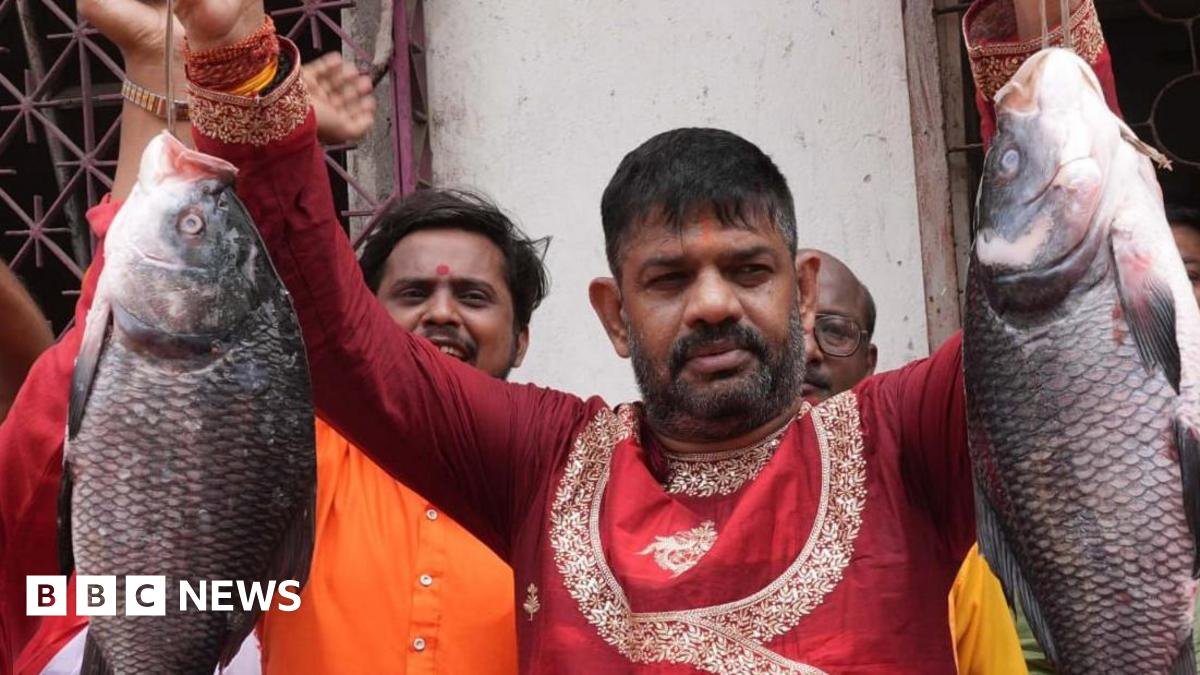
Between cultural anxiety and economic critique, fish has become more than a staple; it is now shorthand for everything the rivals say is at stake.
India is the world’s third-largest fish producer and second in aquaculture, yet ranks a low 129th globally in per capita fish consumption. But in West Bengal, fish isn’t just food – it’s near-universal.
A 2024 joint study , externalby ICAR and WorldFish found that about 65.7% of people in West Bengal consume fish weekly.
It sits alongside eastern and southern states where more than 90% of people eat fish, even as India overall sees a steady rise in fish consumption, now reaching over 70% of the population, according to the report.
In Bengal, fish has always carried meanings far beyond the plate, and its political afterlife feels almost inevitable.
In his acclaimed Bengali novel Padma Nadir Majhi (The Boatman of the Padma), Manik Bandopadhyay turns fish into fate and survival along a restless river. In The Hungry Tide, novelist Amitav Ghosh binds it to ecology and precarity in the Sundarban delta on the Bay of Bengal
The prized hilsa fish, writes Samanth Subramanian in his book Following Fish, is so central that “if Bengali cuisine were Wimbledon, the hilsa would always play on Centre Court”. To eat it properly – deboning it deftly in the mouth – is, in his telling, almost a rite of belonging.
In Bengal, fish also carries layers of meaning beyond food.
It signals geography (river systems like the Ganges River versus the Padma River), history (the legacy of Partition of India separating East and West Bengal), and class – who can afford prized varieties, who prepares them, and who has the cultural know-how to do so.
Even Bengal’s fiercest football rivalry carries fish: fans of East Bengal FC – many with roots in what is now Bangladesh – are stereotypically partial to hilsa, while Mohun Bagan Super Giant supporters are said to favour prawns. It’s a playful shorthand for deeper histories of migration, class and taste.
Sociologists believe it is possibly this dense symbolism that has made fish so politically useful. Parties aren’t just invoking it; they are folding it into the choreography of the campaign to bait opponents.