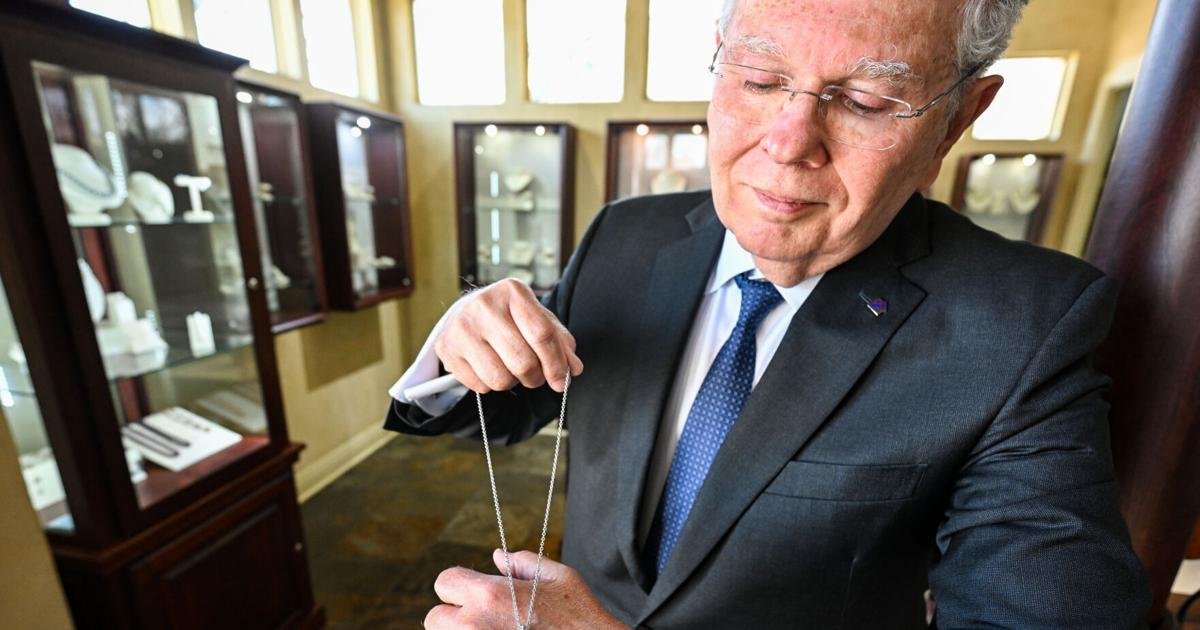
Bayardo Hannon Jirón crafts custom-made rings for weddings.
He designs rings in his Baton Rouge store, Hannon Jewelers, and gives couples a quote based on multiple factors, including the price of the metal. But recently, when it comes time to execute the custom ring, market prices for precious metals have become drastically different.
A customer purchasing a custom gold ring came into the store in January, when gold prices were about $4,400 per ounce. Jirón quoted him $4,900 for the ring, but in February, when the customer paid a deposit for the ring, gold prices had jumped to about $5,100 per ounce, making the final cost of the ring $5,780.
Jirón’s policy is to absorb half of the gold cost increases to keep prices fair amid the precious metals market volatility. Luckily, his clientele, many of them repeat customers whose family members have purchased from Hannon Jewelers before, has been understanding, he said.
“Every time that I turn and buy something new for a customer, it’s getting more and more expensive,” Jirón said.
Gold and silver prices have experienced sharp hikes and rapid falls due to a limited supply, high demand and speculative investment. The fluctuations have created an unpredictable environment for jewelry makers, even prompting Pandora, one of the most prominent jewelry brands known for their sterling silver bracelets, to start selling platinum jewelry to better manage the market.
In the past few years of volatility in the precious metals market, Louisiana jewelers have revised business practices to stem the impacts. Gold prices are about $5,000 per ounce, up from about $1,700 per ounce five years ago, and silver costs about $80 per ounce, up from about $25 per ounce five years ago.
“I always say jokingly to people here in my office, it’s like sitting down and trying to guess the future,” Jirón said.
Adjusting prices, inventory

A display of assorted silver necklaces from Hannon Jewelers pictured on Saturday, February 28, 2026. Staff photo by Javier Gallegos
Jewelry store owners have played a tricky game over the past few years, balancing the fluctuating metal prices with their typical pricing scheme and a desire to keep their products affordable for customers.
Jirón has limited the amount of metal and materials he purchases to de-risk the impact of rising metal prices on his business. About five years ago, he eliminated silver from his regular offerings, save for custom work, after prices jumped.
“Suppose that I buy the high point of gold, and suppose that the market stabilizes tomorrow, and then I lose all of that money, because the reverse problem is going to happen,” he said. “Then I have too much inventory, price too high, and nobody will buy it, because new inventory is probably going to be less expensive.”
Maghan Oroszi, CEO of New Orleans-based Mignon Faget, said she’s had to adjust prices five times since January 2025, but the company typically adjusts prices once a year or every two years. The small, incremental changes insulate the company from potentially devaluing the jewelry and protects customers from spontaneous price spikes or drops, she said.
“Our collectors really stick with us for years, and so we have a duty to them also,” Oroszi said.
Mignon Faget is looking at adding some other materials to their offerings, like beaded jewelry or leather and nylon cords, which have become increasingly trendy, in place of metal chains to manage costs. Throwing new metals into the mix isn’t on the table, Oroszi said, because other metals like platinum are more prone to tarnishing. The company also already offers alternatives like jeweler’s bronze, a copper alloy, as a more affordable option that’s easy to take care of as it ages.
Beatrix Bell Handcrafted, a New Orleans-based jewelry business, has expanded offerings to include silver-plated and gold-plated brass chains in addition to sterling silver and 14 karat gold-filled chains, so customers have more affordable options.
Depending on the chain design and source, silver- and gold-plated brass chains can range from $2 to $8 per foot, and sterling silver and 14 karat gold-filled chains can range from $3 to $13 per foot and $25 per foot, respectively.
Plated chains are cheaper due to composition — they’re made up of a cheaper base metal like copper or brass and plated with a thin layer of a precious metal. Sterling silver and gold-filled jewelry have larger amounts of silver and gold and a small percentage of other metals like copper and brass.
Owner Beatrix Bell said the changes in the precious metals market, combined with tariffs, have been a “double whammy,” with prices of sterling silver chain and sheet silver up about 40%.
“I’ve been offering such fair prices for precious metals, I really can’t do it anymore and stay in business,” Bell said.
Not the first market shake-up
In the 1980s, a mix of speculative demand, foreign conflict and inflation drove gold prices up to $800 per ounce. Jirón’s family opened Hannon Jewelers in 1980, and he said the business made similar decisions limiting inventory that he is making today.
Throughout his years in the jewelry business, the industry has also been affected by larger economic phenomena like the 2008 financial crisis, because consumers have to prioritize essentials over jewelry. Silver and gold prices also spiked in 2011 due to high demand and market speculation.
“It is not one silver bullet that affects everything,” Jirón said.
He’s optimistic that the market will stabilize in the future, but must evolve. Consumers must be willing to invest in quality, lasting jewelry rather than the jewelry with the lowest price, he said.
Jewelry makers use a variety of methods, such as casting in-house or metal choice, to insulate themselves from market fluctuations. Casting allows businesses to have more control of prices as opposed to purchasing casted metal, Madeline Ellis, owner of MIMOSA Handcrafted, said. The Baton Rouge-based business specializes in jewelry made of bronze, which prices have historically been more stable than gold and silver.
Bronze is a metal alloy primarily made of copper, which costs about $0.36 per ounce, slightly up from $0.26 per ounce five years ago.

Adri Hawkins carefully shakes silver into the molds to create new pieces of Mimosa Handcrafted jewelry on Jan. 8, 2025, in Baton Rouge.
“We do still offer sterling silver and gold options, and those pricing shifts absolutely require thoughtful adjustments behind the scenes,” Ellis said in an email. “However, our long-standing commitment to bronze has helped insulate our business from some of the more dramatic swings in the market while also giving customers a beautiful, lasting option they may not have previously considered.”
A silver lining
While the volatility of the precious metals market has squeezed jewelers’ pockets, the barriers to purchasing silver and gold have pushed some toward their goals and new designs.
Oroszi said the increased silver and gold prices have been challenging to navigate in the short term, but the market volatility is pushing the company toward its long-term goal of selling fine jewelry.
Mignon Faget sells demi-fine jewelry in a variety of metals with lab-grown diamonds and precious stones. Jewelry fineness indicates the metals used in making the products, with fine jewelry using high-quality metals, demi-fine jewelry using base metals and some precious elements and costume jewelry using nonprecious metals.
“We try to create heirloom-level jewelry that’s passed down generationally, and the base material of that having increased value helps to tell that story,” Oroszi said.

The expanded “Petit Animal Crackers” collection, available March 2017.
Bell typically solders and hammers sterling silver jewelry, which she sells in her two stores in New Orleans and sells wholesale to other retailers.
She’s experimented more with copper and brass lately, using sawing and piercing techniques to cut interior shapes out of the metal.
“I’ve just been sawing and sawing and sawing and coming up with really cool pictures and stories almost, that are going inside a shape,” she said. “And I normally wouldn’t do that.”