







People visiting one of the holiest Hindu temples in India’s Himalayan mountains must consume cow urine as a test of faith before they are allowed inside.
New entry rules for the Gangotri temple in Uttarakhand make it compulsory for every visitor to consume panchgavya, a ritual concoction made from five cow-derived products – milk, curd, ghee, honey and cow urine. The idea, according to the committee overseeing the shrine, is to keep out non-believers.
“This is to keep out non-Sanatani and non-believers from the Gangotari temple,” the committee’s chair, Dharmendra Semwal, told The Independent, referring to Sanatan Dharam, a term used to describe the traditional form of Hindu belief and practice.
“True believers will have no problem in consuming it,” he said. “Only those entering in disguise with no faith in the religion will have a problem. They won’t be allowed.”
The new measure will be implemented at the gates where temple personnel will supply the “holy water” to devotees before they enter.
“This will restore faith and spirituality in people, and those getting a chance to consume it should consider themselves fortunate,” Mr Semwal said.

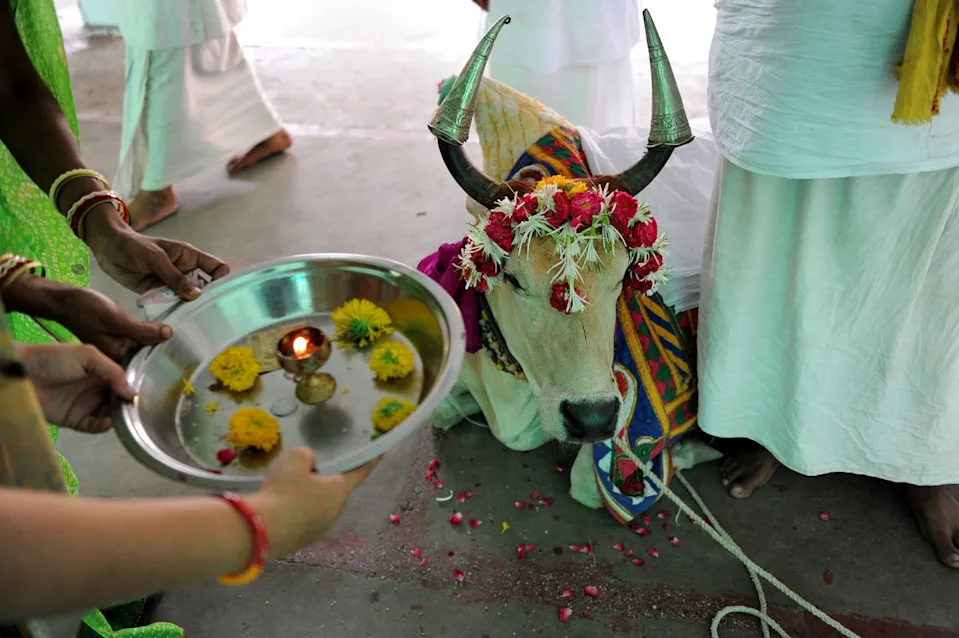
File. Indian devotees participate in a ritual as they take blessings from a holy cow known as ‘Ganga’ at the Lord Jagannath Temple in Ahmedabad (AFP/Getty)
The new rules were announced as a major annual pilgrimage for Hindus called Char Dham Yatra began on Sunday. The pilgrimage draws millions of devotees to four temples, including the Gangotri shrine, high in the Himalayas.
Pilgrims typically visit the Yamunotri temple first and then Gangotri, Kedarnath and Badrinath in that order. The journey involves long road travel and, in some cases, trekking along steep mountainous routes.
Many temples in India welcome visits by non-believers and tourists, and will explain aspects of Hindu religious practice to those who are interested. But not all are so accepting; in March the Badrinath-Kedarnath Temple Committee issued an order banning non-Hindus from entering as many as 47 temples under its management.
Mr Semwal said Char Dham pilgrims had already started arriving, and none had so far objected to drinking the “holy water” mixed with cow urine at the Gangotri temple.
While the cow is considered holy in Hinduism and its urine is used in purification rituals, mandating its consumption may offend those Hindus who don’t subscribe to or feel comfortable with the practice. The temple committee’s directive is also drawing criticism for “othering” non-Hindus and restricting traditionally inclusive religious spaces.

File. Supporters of the Hindu group Akhil Bharat Hindu Mahasabha drink tea made with cow urine as a remedy against the spread of the Covid virus (Getty)
The issue of cow urine consumption is also politically divisive as groups aligned with prime minister Narendra Modi’s Hindu nationalist BJP party routinely promote it, declaring that it possesses medicinal properties.
Baba Ramdev, a yoga guru who openly endorses the BJP, commercially supplies products containing cow urine under his Ayurvedic brand despite warnings from health experts against unverified health claims.
BJP workers often perform purification rituals using cow urine. And during the Covid pandemic the former head of the party’s West Bengal unit called on people to use cow urine to boost their immunity against the virus – prompting warnings from medical experts that there was no scientific basis for doing so.
It’s unclear how the temple committees managing the Char Dham temples will ensure the new rules are followed as the pilgrimage reaches its peak, drawing millions of people to the region.
Kedarnath alone saw a footfall of 1.77 million last year. The four temples together received 5.1 million visitors over less than seven months in 2025, according to the state tourism department.