








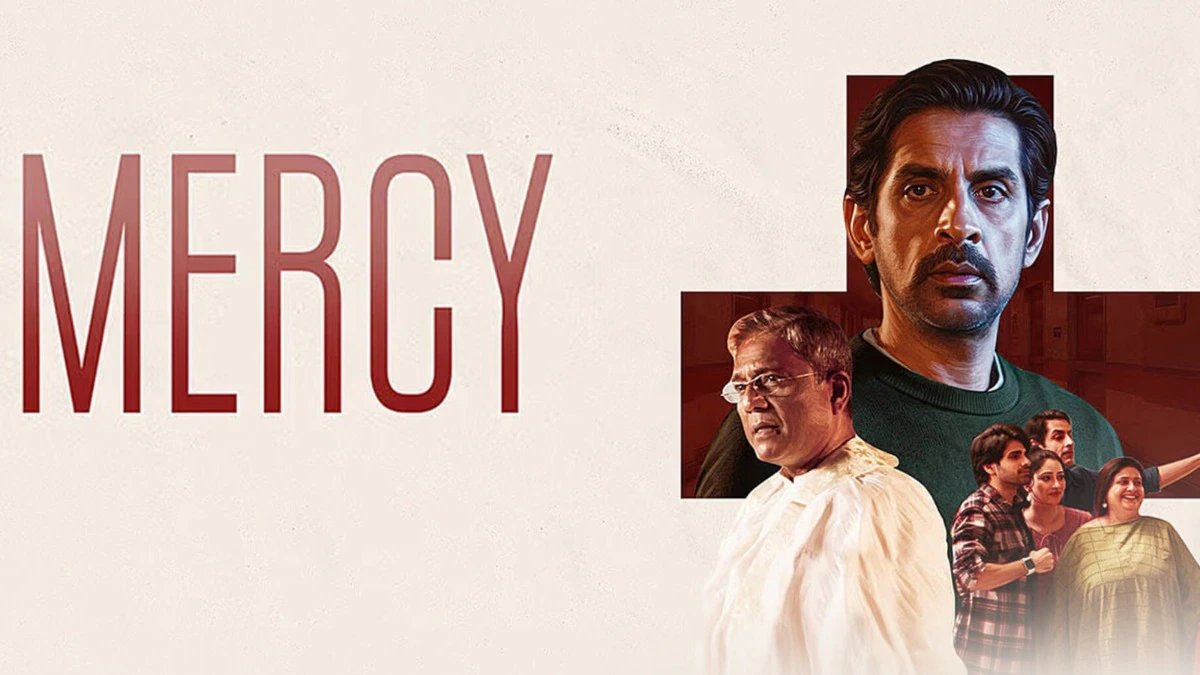
A film’s intention and its execution don’t always move in the same direction. A story can come from a place of empathy and still struggle to hold attention on screen. Mercy sits right in that space. It takes up a subject as complex as passive euthanasia, asks the right questions, but doesn’t always find the most compelling way to explore them.
Directed by debutant Mitul Patel, the film follows a family dealing with the aftermath of an accident that leaves the mother in a coma. What begins as a medical situation soon turns into an emotional and moral crossroads. The conflict builds silently, almost hesitantly, through financial strain, emotional fatigue, and the slow realisation that hope itself can become a burden.
At the centre of this dilemma is Shekhar (Raj Vasudeva), the eldest son. His internal conflict is the film’s strongest narrative. Having grown up with loss he couldn’t control, he is now forced into a position where the decision rests entirely on him. The idea of choosing between hope and acceptance is explored with sincerity, and in moments, the film comes close to something deeply affecting. You are reminded of films like Anand (1971) or even Kapoor & Sons (2016), where grief and love are not treated as opposites but as overlapping emotions. Mercy aims for that space, but doesn’t always sustain it.
Where the film falters is in its storytelling choices. Scenes often feel disconnected, as if they exist in isolation rather than building towards a larger emotional arc. Dialogues, instead of flowing naturally, sometimes sound rehearsed, like thoughts being stated first, being felt later. This takes away from the immediacy that a subject like this demands.
In films dealing with moral dilemmas – think Guzaarish (2010) or Million Dollar Baby (2004) – the writing often lets silence do as much work as words. Here, the silences don’t always land, and the spoken lines don’t fully compensate.
The pacing adds to the problem. The narrative takes its time to arrive at its central conflict, and by then, the emotional investment begins to waver. There’s a sense that the film is circling its point and not moving towards it. When it finally does confront its core question: what does it mean to let go?, the impact feels diluted.
That said, the performances keep the film grounded. Aparna Ghoshal brings strength to her role, making her presence one of the most reassuring aspects of the film. Her portrayal of Sujata, the matriarch, carries a sense of lived experience, and her scenes seem the most complete.
Adil Hussain, in a brief appearance as Father Joel, brings clarity and depth almost instantly. His maturity and his understanding of the character reflect in his acting. But there are not many such moments of restraint in the film.
Kunal Bhan and Niharica Raizada deliver sincere performances, though the writing doesn’t always give them enough to work with. The music supports the mood without overwhelming it, but like much of the film, it stays in a safe zone.
Mercy is not without value. It opens up a conversation that is rarely addressed with sensitivity in mainstream storytelling. But it looks less like a fully realised film and more like an extended discussion. It raises important points but doesn’t shape them into a cohesive cinematic experience.
Mercy leaves you with thoughts rather than feelings. And while that isn’t necessarily a flaw, you can’t help but feel that with sharper writing and tighter storytelling, it could have stayed with you longer. It appears more like an idea, not an experience.
– Ends