


There was a summer Sunday not long gone by — the kind of day where the heat continues to rise and the blue of the sky is utterly cerulean — that was perfect to spend in the sky in a friend’s four-seater Cessna 172. We flew from Gloucestershire Airport to Goodwood, West Sussex, for lunch, passing over the rolling chalkland of the South Downs and the glistening specks of cars in traffic jams, to touch down within the 1948 motor-racing circuit — the Mecca of car lovers.
Post-lunch, we took off again, continuing on to the Isle of Wight, cruising over a sea so hot that the propeller rotated through air made from an evaporated haze of salt and sun. Descending on ‘England in Miniature’, we walked to the beach; I swam in the sea, my friend read his book, children splashed around and yachts sailed past. Airborne again and full of ice cream, we tacked, in late afternoon, over the Westbury White Horse in Wiltshire, Bath’s crescents glittering in their golden hour, the pastoral perfection of Ralph Allen’s Prior Park in Somerset and, thrillingly for any equestrian, swooped low over Badminton Park in Gloucestershire, the jewel in the crown of the British eventing circuit.
That Sunday, when hours seemingly had no end and distance was no object, I could, for the first time, aged 26, see to the ends of the Earth. It was the day I realised the truth of war poet and US fighter pilot John Gillespie Magee Jnr’s 1941 sonnet High Flight: ‘Oh! I have slipped the surly bonds of Earth/ And danced the skies on laughter- silvered wings;/ Sunward I’ve climbed, and joined the tumbling mirth/ of sun-split clouds, — and done a hundred things/ You have not dreamed of — wheeled and soared and swung/ High in the sunlit silence.’
Whether soaring in a Second World War fighter or a light aircraft today, it is this ‘slipping of Earth’s bonds’, of seeing the world from above, that is the true magic of flying. Pilots have been privy to this secret since aircraft were invented, which is largely credited to the Wright brothers who, in 1903, successfully flew their fixed-wing plane in a public test that proved humans could, indeed, join the birds. Popularity grew in the 1920s and 1930s, with 21 UK flying clubs in operation by 1928.

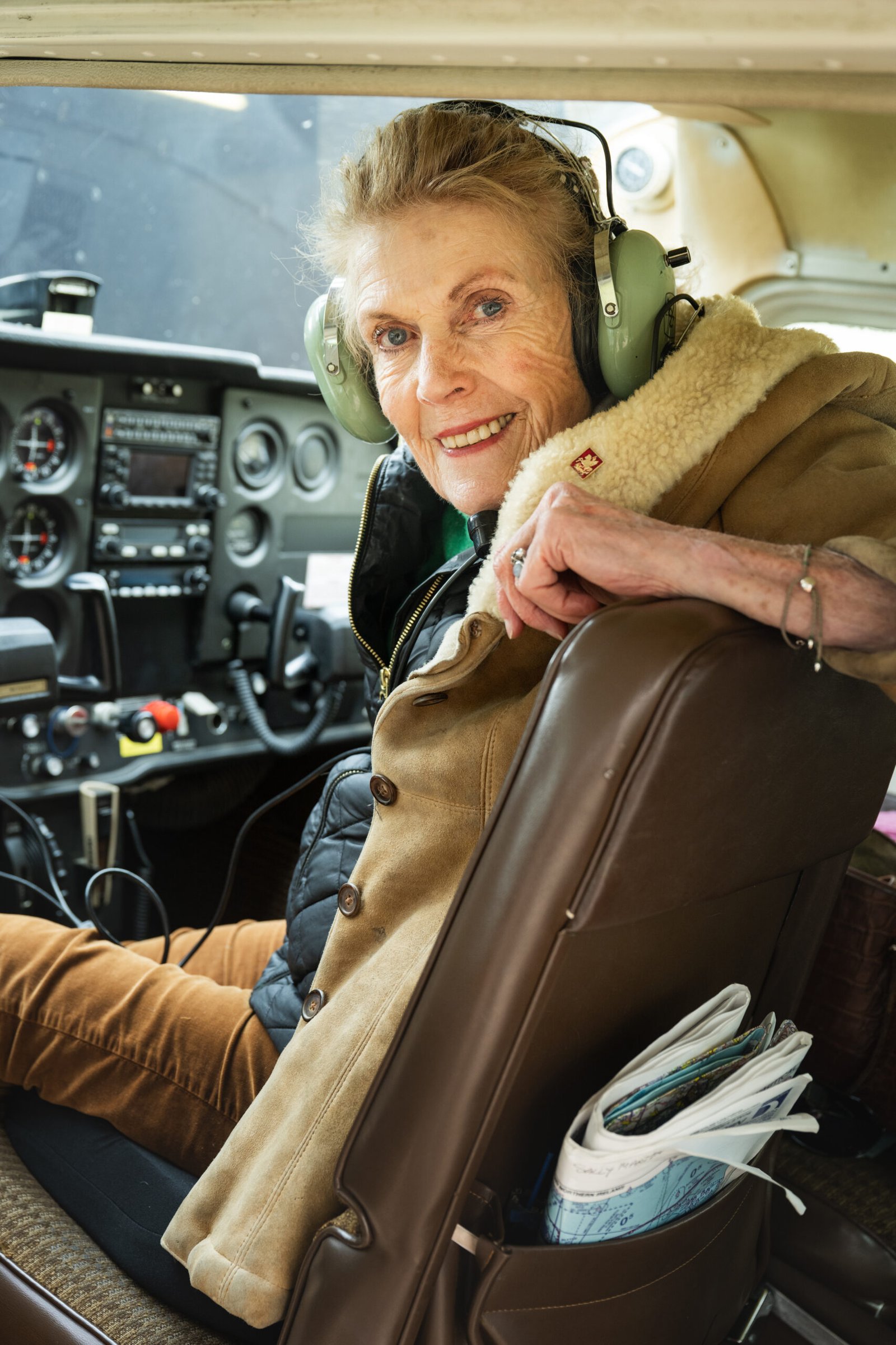
Sally Martin is a keen flyer.
(Image credit: Simon Buck for Country Life)
In the post-war years, aircraft continued to evolve, albeit for leisure and transport purposes rather than for military operations. Today, more than 25,000 people have either a Private Pilot Licence (PPL) or a Light Aircraft Pilot Licence (LAPL). Enamoured with life in the sky, I decided to sell my beloved cream Triumph Spitfire MK3 to help fund my PPL — and it seems a car for a plane is a common trade.
Sally Martin and her husband, renowned country-house conservationist Kit Martin, who reside in Gunton Park, Norfolk, and own an area of the restored parkland, swapped their white Mercedes 190 SL shortly after they married in 1980 for a Cessna 172 ‘workhorse’. ‘Bouncing around’, as Sally puts it, in her light aircraft, they primarily used her plane to journey up and down the East Coast from East Anglia to Scotland, at least once a fortnight, to ‘look at houses’ requiring restoration, when Kit was involved with various historic buildings in the North.
Sally’s lifelong interest in aviation was inspired by her father, a squadron leader in Bomber Command during the Second World War. Although he was tragically killed only two weeks before her birth flying his own aircraft after the war, Sally believes she flies to ‘live a life my father had cut short by flying’. That life has seen her fly everyone; friends, family — and even the dogs. ‘My husband calls me “the Morris Minor of the air”,’ she adds with a smile. The peace of the sky also helped her overcome a serious car accident in 1981: ‘I feel so relaxed in the air — it’s like a sigh from my body, every time I go up.’ It is a feeling echoed by French author and pioneering pilot Antoine de Saint-Exupéry who wrote: ‘I fly because it releases my mind from the tyranny of petty things.’
Charlie Lywood, owner of a Piper PA-28-181 Archer II, which shuttles between London and his family home of Shropshire, also speaks of the ‘disconnect from the day to day’ that piloting brings. ‘You’re flying the plane, you’re talking on the radio, you’re navigating where you’re going — but it’s very peaceful. You feel liberated,’ notes Charlie.

Charlie Lywood and his Piper PA-28-181 Archer II.
(Image credit: Mark Williamson for Country Life)
It’s true, you do. Up in the blustering wind, feeling the heat of the sun on the acrylic of the cockpit, hearing the thrumming of the engine, knowing that beneath the aluminium skin under your feet is nothing but air, you feel immortal. The first time I saw a sunset from a plane, I thought the whole world was lit up. Not that flying is without its hair-raising moments, of course. Even the sky-queen Beryl Markham, who, in 1936, was the first person to fly solo, non-stop, across the Atlantic from Britain to America admitted to fear in the air. She expressed in her autobiography, West With The Night (1942), that this fear isn’t ‘overcome or reasoned away’, but succeeded by ‘faith’ in the machine.
Fellow pioneering aviator Louise Thaden also recognised this feeling: ‘A pilot who says he has never been frightened in an airplane is, I’m afraid, lying.’ Charlie knows the mishaps of aviation, too, wryly recalling the day he took his father for a spin. ‘We’d done all the checks and I’d asked my dad to close the door,’ he explains. ‘We’d just taken off when the door flew open. He managed to grab it and hold it close, but you can’t shut it because of the air pressure. We had to land, close the door and take off again. That was quite close.’
You never forget the first take-off, the body running on adrenaline, your heartbeat linked to the motor and your mind grappling with the impossibility of physics. Then, miraculously, you simply ascend into the sky. Flying makes the heart race in other ways, too — and romance is still very much alive in the air. Edward Pinnegar, of East Grinstead, West Sussex, used his CT SW aircraft to woo his now-wife in a manner reminiscent of Stella Gibbons’s Cold Comfort Farm, when charmingly bossy 1930s socialite Flora is whisked away into ‘the soft blue vault of the midsummer night’ by her suitor-pilot, Charles.

Edward Pinnegar CT SW aircraft saw his romance with now wife, Sophie, soar.
(Image credit: Edward Pinnegar)
‘My wife had a family wedding in Perthshire,’ Edward recounts. ‘Her boss wouldn’t let her leave London until 5pm on Friday. I’d been going out with her for about a year and I wanted to impress. I hadn’t met the distant family and I thought right, here’s my moment.’ Unbeknownst to her family, his plane wasn’t a private jet, only a reinforced plastic microlight weighing in at about 63st. ‘We got up to Scotland in time and landed at this eccentric retired army major’s air strip at Blair Atholl — he very kindly let us store the plane in his chicken shed for the night,’ Edward recalls.
The discipline brings a camaraderie between strangers that is exceptional and, as he puts it, ‘flying is a fraternity, and it’s a fraternity in which people trust each other and throw their doors open’. Edward also stresses that flying doesn’t have to be an expensive pursuit. Many pilots rent a plane by the hour or share their aircraft as members of a syndicate. ‘Microlights are very fast and very cheap,’ he adds. ‘I fly at 110mph and the fuel is less than £50 an hour. It’s basically the same fuel economy as a VW Polo.’
Alternatively, if you’re mechanically minded, you can go down the route of journalist Colin Goodwin who, to keep costs down, built his own kit plane. ‘You build it in stages, so I could get the first bit and then worry about the money for the second bit.’ Colin now flies his aircraft in a manner reminiscent of an 18th-century aristocrat on the Grand Tour.

Reporting from the skies, journalist Colin Goodwin.
(Image credit: Colin Goodwin)
‘Every year, my wife and I go away for a couple of weeks in Europe. Last year, we flew to Bergerac in France, Corsica, Sardinia, Lausanne in Switzerland, Mannheim in Germany and back home. That’s impossible commercially and to drive that would be a fortune.’ The Grand Tour aircraft of which he speaks is a Van’s Aircraft RV-7. ‘The summer I started learning [2006], we went to a flying rally and I saw this gorgeous plane — the Porsche 911 of the sky,’ he remembers. ‘I was told it was a RV-7 kit plane and I thought: “I have to have one of those.”’
I’m yet to follow Colin’s Grand Tour, but our British Isles offer infinite opportunities to voyage around landmarks and beauty spots. You plot a course and off you blast. Do you wish to loop around Ludlow Castle in Shropshire because you loved your school trip there? Detour over nearby Brown Clee Hill and see 10 counties even through the clouds? Or have a peek at Highclere Castle in Hampshire because Downton Abbey was the theme of Sunday nights growing up? Boundaries don’t exist in flying. You are master or mistress, god or goddess — part human, part superhero. Of course, in the end, you have to come down to earth; ‘floating’ before the thump of touchdown, the wild rushing as the taxi speed is broken, a grin on your face that carries you to the end of the strip.
In the Welsh Borders, where I grew up, the chosen airfield, Abergavenny, is a little gem hidden in the shadows of the hills, among the trees. It was set up by 82-year-old pilot Frank Cavaciuti and is part of Britain’s hidden network — known only to pilots — of small airfields, stretching from Scotland’s remote island of Fair Isle, to the Isles of Scilly off the coast of Cornwall.

Awaiting pilots at Frank Cavaciuti’s airstrip is his bee observation hive and ‘duty free’ honey for sale.
(Image credit: Frank Cavaciuti)
In 1995, Frank finished treatment for spinal cancer and ticked learning to fly off his bucket list. As flying became his life, so, too, did Abergavenny Airfield. When he heard the county council was selling off property, he bought farmland and outbuildings to create the airfield and a permanent 820yd grass strip. ‘Where I live,’ Frank remarks, ‘it’s pretty much unrestricted airspace and I can pop out for a [155mph] jolly round the Black Mountains or the Brecon Beacons.’ Awaiting pilots at his airstrip is Frank’s bee observation hive and his ‘duty free’ honey for sale, including his once-every-seven-years heather variety. It’s one of life’s great surprises. That’s the thing about flying — you never know what you will discover, up in the air or on the ground. It all goes back to Gillespie Magee Jnr: ‘I have done a hundred things you have not dreamed of.’
Ready for take off: How to obtain your pilot’s licence
• You must be at least 17 and hold a Part MED Class 2 Medical Certificate
• The UK FCL PLL requires a minimum of 45 hours training. This includes 10 hours of supervised solo flight time, five hours of solo cross-country flight time and at least one cross-country flight of no less than 270km (168 miles)
• General handling exercises are followed by circuit flying and navigation
• After undertaking training and written and oral examinations, you must complete a skills test flown with an examiner before being granted your licence
• On average, it costs between £12,500 and £17,000 to achieve the licence
This feature originally appeared in the April 22 ,2026, issue of Country Life. Click here for more information on how to subscribe.