






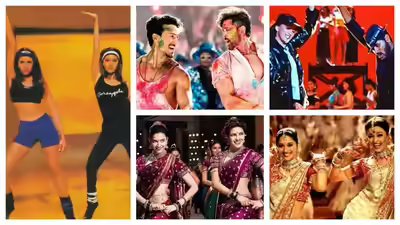
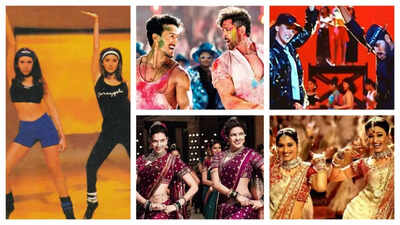
There is a particular electricity in the air when two of Bollywood’s finest step onto the same floor and let their bodies do the talking. Not a duel of words, not a clash of weapons — but a rivalry of rhythm, grace, footwork, and fire. In Bollywood dance-offs have evolved over decades into one of Hindi cinema’s most beloved traditions: part artistic showdown, part celebration, always unforgettable. World Dance Day (April 29) is, at its best, a reminder that dance is not decorative. It is confrontational, communal, healing, and defiant. In Bollywood, that magnificent, maddening, endlessly surprising cinema, the dance-off has always been one of its purest expressions of all those things at once. On this World Dance Day, we look back, at some of the most iconic moments when legends squared up, shared a stage, and gave audiences memories that still travel through generations. THE DANCE OF ENVY: MADHURI DIXIT VS KARISMA KAPOOR IN DIL TOH PAGAL HAI (1997) Long before anyone coined the phrase “iconic,” there was Madhuri Dixit and Karisma Kapoor locking eyes across a rehearsal floor in Yash Chopra’s musical Dil Toh Pagal Hai. And what followed became the gold standard for every dance face-off that came after it.The sequence, called “Dance of Envy,” is set to a pulsating instrumental track. There are no lyrics, no distractions; just two extraordinary women in all-black athleisure, their bodies telling a story of rivalry, longing, and pride. Madhuri’s character Pooja and Karisma’s Nisha are both in love with Shah Rukh Khan’s Rahul, and the dance becomes the language of that unspoken war. What made it so extraordinary was the deliberate contrast at its heart. Choreographer: Shiamak DavarChoreographer Shiamak Davar, who made his Bollywood debut with this film, later revealed that the idea was to blend Madhuri’s classic grace with Karisma’s high-octane style: modern and classic, each complementing the other. Two completely different dancers, two completely different energies, one impossibly perfect sequence. Davar recalled that the two actresses took three days to learn the moves, and even when they got hurt during rehearsals, they insisted on continuing. TRIVIA: In the late 1990s, Madhuri and Karisma were genuine box office rivals: part of an intensely competitive era of Bollywood actresses that also included Sridevi, Raveena Tandon, Kajol, and Urmila Matondkar. To see them channel that real-world rivalry into choreography was thrilling in a way audiences had rarely experienced. Decades later, the two reunited on the sets of a dance reality show and recreated the sequence — this time in black and yellow ethnic wear instead of black athleisure — they received a standing ovation. TWO QUEENS, ONE STAGE: MADHURI DIXIT AND AISHWARYA RAI IN DEVDAS (2002) If the Dance of Envy was electricity, Dola Re Dola from Sanjay Leela Bhansali’s Devdas was a thunderstorm. The song, picturised during Durga Puja, an auspicious celebration of female power, brought together the two greatest dancing heroines of the era: Aishwarya Rai as Paro and Madhuri Dixit as Chandramukhi, the two loves of Devdas’s tragic life, dancing together in an expression of shared ecstasy and unspoken heartbreak. What is so remarkable about Dola Re Dola is that Bhansali and master choreographer Saroj Khan used the dance not as an interruption to the story but as its vehicle. The dance is a narrative device, a means for the two women to acknowledge that they understand each other’s pain, that they share a love for the same man, and that there is a strange camaraderie in their tragedy. In a lesser film, this would have felt absurd. In Devdas, it feels inevitable. Choreographer: Saroj KhanSaroj Khan later spoke about how gruelling the choreography was: she had to balance the steps so that neither Madhuri nor Aishwarya felt shortchanged, and the physical demands were immense, at one point both actresses had to fall in perfect sync with the beats. Trivia: There is a detail that has passed into Bollywood legend: during the shoot, Aishwarya’s ears began bleeding from the weight of the heavy earrings she was wearing, but she said nothing and continued to shoot until the sequence was complete. The song had a production cost of ₹25 million, a staggering sum for 2002, and it shows in every frame. Cinematographer Binod Pradhan’s camera moves through pillars, around dancers, across three layers of visual depth, always finding a new angle to reveal the magic. THE GOD MEETS THE GODDESS: MADHURI DIXIT AND PRABHU DEVA IN PUKAR (2000) Every generation has its definitive “what happens when two legends share a floor” moment. For the turn of the millennium, it was the meeting of Madhuri Dixit, Bollywood’s undisputed dancing queen, and Prabhu Deva, the man who made liquid seem less fluid than his limbs. The song Kay Sera Sera from Ram Gopal Varma’s action film Pukar was not supposed to be the film’s centrepiece. It was. Set to an A.R. Rahman composition of dizzying rhythmic complexity, sung by Kavita Krishnamurthy and Shankar Mahadevan, the track required both stars to match each other move for move across a wildly eclectic mix of Latin, hip-hop and filmi styles. Choreographer Prabhu DevaPrabhu Deva, who had been choreographing for twelve years before Pukar, later said of Madhuri: “When she is dancing, it is as amazing as fire and lightning together.” He noted that the beats of the Rahman composition were particularly tricky, but that Madhuri was not moved by the challenge at all. The result was something that defied categorisation: classical grace and street-level swagger in the same frame, two virtuosos playing off each other with the casual confidence of musicians in a jazz session. Kay Sera Sera remains a masterclass in what happens when you put two transcendent talents together and simply let them go. TRIVIA:Madhuri herself has spoken about how nervous she was when she discovered that Prabhu Deva would not only be choreographing the song but actually dancing alongside her. The man who was choreographing her steps was also going to be her partner and, effectively, her competition. She took nine full days of rehearsals to master the choreography. Nine days, for a performer of Madhuri’s calibre, that speaks to the sheer complexity of what Rahman and Prabhu Deva had conceived.WIVES AT WAR, SISTERS IN DANCE: DEEPIKA PADUKONE AND PRIYANKA CHOPRA IN BAJIRAO MASTANI (2015) Sanjay Leela Bhansali’s Bajirao Mastani, a decade in the making, a film that consumed careers and created legends, had a special challenge embedded within it. Its two female leads, Deepika Padukone as the warrior-courtesan Mastani and Priyanka Chopra as the devoted first wife Kashibai, were rivals within the story and, famously, rivals in real life. Bhansali took that tension and forged it into Pinga. The song was positioned as Kashibai extending an olive branch to Mastani, a gesture of selfless generosity that created space for one of the most memorable dance numbers of the 2010s. In Nauvari saris, surrounded by diyas and torches on an open-air set, the two women danced together in the folk tradition, their characters’ complicated feelings suspended in the beauty of movement. Choreographer: Remo D’Souza The three-minute number was choreographed by Remo D’Souza over twelve days, leaving Deepika and Priyanka only ten days to rehearse. The logistics were punishing. The song was shot at night on an open-air set, and the diyas and torches would frequently snuff out mid-take. When a suggestion was made to correct these in post-production, Bhansali refused, and so more than twelve people would run around the set with candles and oil to relight them for every single take. Bhansali shot the whole sequence on a grand scale with over fifty background dancers. The sound recording was done on location, which meant that any honk of a passing car or ambient city noise could ruin a take. Trivia: Remo D’Souza, who choreographed Pinga, was known at the time primarily for contemporary and hip-hop dance numbers. Bhansali cast him specifically for a folk song, knowing he would bring a fresh eye to the material. The gamble paid off, Pinga went on to become one of Bajirao Mastani’s most celebrated sequences, and the film won nine Filmfare Awards including Best Film. TWO TITANS OF DANCE: HRITHIK ROSHAN VS TIGER SHROFF IN WAR (2019) In a film built on the premise that two of Bollywood’s most physically extraordinary performers were each other’s greatest nemesis, it was only a matter of time before the real competition arrived, not in an action sequence, but on the dance floor. This iconic dance was choreographed by the duo Bosco-Caesar (Bosco Martis and Caesar Gonsalves). Jai Jai Shiv Shankar from Siddharth Anand’s War is the definitive Bollywood male dance-off of modern cinema. Hrithik Roshan, the man who made audiences weep simply by moving his hands, against Tiger Shroff, who could isolate muscles most people don’t know they have. The song is built around Holi celebrations, splashed in colour, and cuts between the two stars as they throw moves at each other like gauntlets.Trivia:The song carries a quietly touching hidden story: it is a tribute to Hrithik’s maternal grandfather J. Om Prakash, a legendary filmmaker for whom the original Jai Jai Shiv Shankar was one of the biggest songs of his career, picturised on Rajesh Khanna and Mumtaz in the film Aap Ki Kasam. J. Om Prakash passed away just a couple of months before War released, at the age of 93. It is also a matter of record that Hrithik Roshan signed War on the condition that Tiger Shroff be cast in the other role. He wanted the best possible dance partner, and he went out and specified exactly who that should be. The song became an instant cultural touchstone. Choreographers across the country began teaching it in classes. It trended on social media for weeks.