



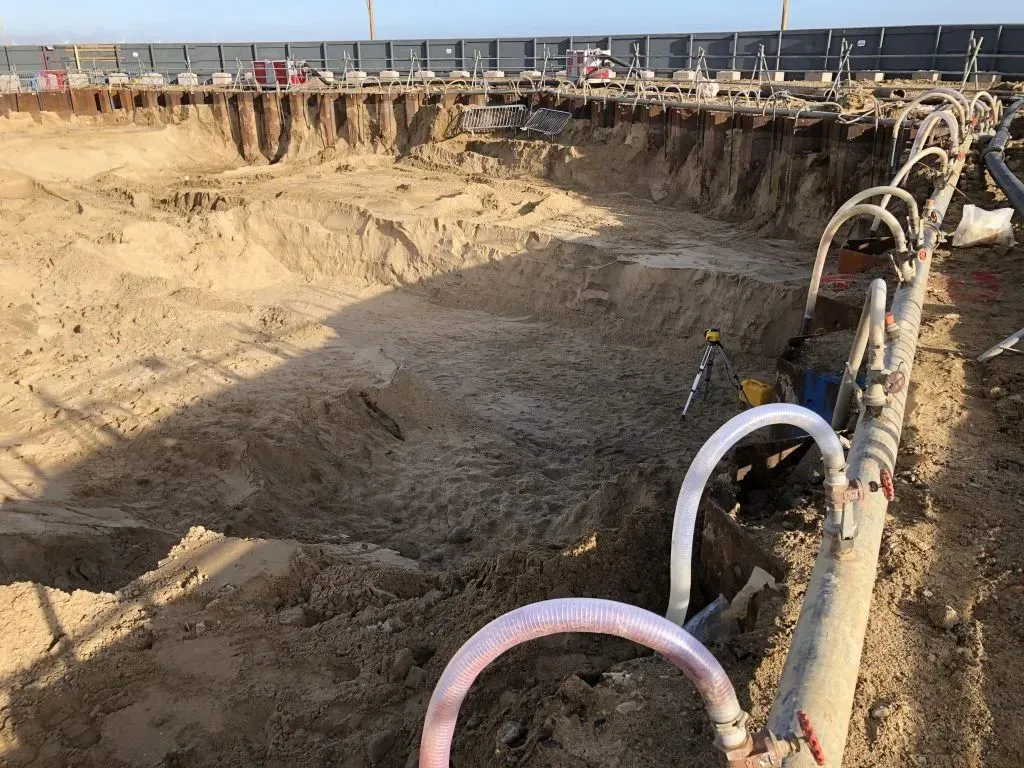
The new Regulatory Position Statement from the UK’s Environment Agency (EA) that introduces a more proportionate approach to support small-scale abstractions for construction dewatering has been welcomed by specialist contractor Stuart Wells.
The new Regulatory Position Statement (RPS 368) issued by the EA is aimed at streamlining the regulatory process for low-risk construction dewatering.
For many years, the abstraction licensing process for construction dewatering has presented significant challenges for contractors and developers. While the protection of groundwater resources remains essential, the regulatory framework has often been viewed as overly complex, slow-moving, and disproportionate when applied to temporary, tightly controlled construction abstractions.
This has increasingly become a barrier to the timely delivery of construction projects across the UK where dewatering is a critical enabling activity on many sites, particularly where excavation below the water table is required.
However, extended timescales and administrative complexity linked to abstraction licences have frequently resulted in delays and uncertainty.
Unlike long-term water supply abstractions, construction dewatering is typically short-term, site-specific, and carefully managed.
Despite this, projects have often been required to navigate the same licensing pathway regardless of environmental risk, which has created a situation where the regulatory process itself becomes a constraint on project delivery, rather than a proportionate safeguard.
Industry engagement driving change
Over the past year, David Wright, Stuart Wells managing director, has engaged in sustained consultation with the Environment Agency to explore opportunities to deregulate and streamline the dewatering licence process, particularly for low-risk construction abstractions.
While complex, these discussions with industry professionals have reflected a growing recognition within the regulator that the current approach has not always served industry or environmental oversight effectively.
New Regulatory Position Statement introduced
Following Wright’s engagement, the EA has now implemented a dedicated RPS for low-risk construction dewatering.
The statement provides a clearer, more pragmatic regulatory posture, acknowledging that certain temporary abstractions—when appropriately controlled—should not be subject to unnecessary delay.
Wright said: “For too long, the abstraction licensing process has acted as a significant blocker to construction delivery, even in cases where environmental risk is demonstrably low. This RPS is an important step toward a more proportionate approach.
“The introduction of this Regulatory Position Statement reflects growing recognition that construction dewatering requires a regulatory framework aligned with practical site realities. It provides greater certainty for contractors while maintaining essential groundwater protections.”
The RPS in Practice
The RPS does not remove the legal requirement for an abstraction licence, and the statutory framework remains unchanged. However, it sets out clear conditions under which the Environment Agency will not normally take enforcement action.
This provides a practical route for contractors undertaking low-risk dewatering works to proceed with greater certainty, provided activities remain within defined parameters.
Wright said that the introduction of this RPS represents meaningful progress in reducing unnecessary regulatory barriers to construction dewatering projects. “It is a significant step forward in aligning regulation with risk and construction realities, offering improved certainty for contractors while maintaining environmental safeguards.”