









Target’s stock may be on a tear, but shoppers are still hating on the company


Target’s (TGT) stock is up a solid 9.2% in April as investors bet on a long-awaited turnaround taking shape.

But the move papers over a reality that investors may be forgetting: It’s going to be hard to outrun the company’s recent checkered past in pursuit of brighter days financially.

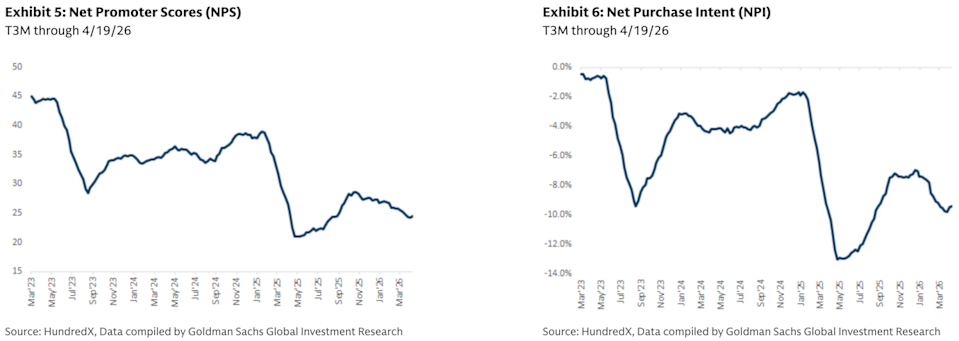
What some new data says: Goldman Sachs analyst Kate McShane has a new note looking at how consumers perceive Target. Consumer perceptions of retailers are often gauged through net promoter scores (NPS).

As McShane details in the chart below, “We looked at Net Promoter Scores and Net Purchase Intent (NPI) for Target on a trailing 3-month basis. For both metrics, Target reached a 2025 low in early May (-13.0% for NPI, 20.9 for NPS), which was followed by sequential improvement, trends flattening in the latter half of the year, and is now declining year to date.”

How consumers perceive Target.
How consumers perceive Target. · Goldman Sachs

“As of the week beginning 4/12/26, Target’s NPI was at -9.4% and its NPS was at 24.5, an improvement from the lows in mid-2025 but a sequential decline from December levels (-7.0% NPI and 27.3 NPS),” McShane added. “That said, we note sequential improvement in both metrics for the most recent week.”

The read-through: A low net promoter score is more than a byproduct of unhappy customers. It’s a flashing red light signaling other operational challenges, according to retail consultancy Zipline.

Poor execution, inconsistent customer experiences, and inefficiencies all contribute to a weak NPS. If this is left unchecked, a retailer could see fewer repeat purchases and visits.

Read more: Best credit cards for shopping at Target (April 2026)

Target’s recent past at a glance: Target has no doubt been hurt by the perception that it’s a more expensive place to shop than Walmart (WMT). This has been shown consistently in quarterly results comparisons between the two retail giants.

But in recent years, Target has also become a figure in the culture wars, facing intense backlash from both ends of the political spectrum. This has weighed on performance.

In 2023, conservative consumers launched a boycott of the retailer’s Pride Month collection, specifically targeting children’s merchandise and “tuck-friendly” swimsuits for adults. The outcry grew so volatile that Target moved displays to the back of stores or removed them entirely, citing employee safety.

However, this pivot backfired, upsetting LGBTQ+ advocates and liberal shoppers who accused the brand of “rainbow-washing” and failing to stand by its values under pressure.


Most recently, in 2025 and early 2026, the retailer faced a new wave of criticism for rolling back its diversity, equity, and inclusion initiatives, including ending its racial equity program (REACH).

CHICAGO, ILLINOIS - FEBRUARY 10: A sign hangs outside of a Target store on February 10, 2026 in Chicago, Illinois. Target plans to cut about 500 jobs at distribution centers and regional offices, but plans to increase the number of employees at their retail stores. (Photo by Scott Olson/Getty Images)
A sign hangs outside of a Target store on Feb. 10, 2026, in Chicago. (Scott Olson/Getty Images) · Scott Olson via Getty Images

Here’s why Target’s stock has been doing OK in April: Target, under new CEO Michael Fiddelke, is trying to better cater to its customers’ needs, creating easier-to-shop stores, lowering prices, and stepping back from cultural messaging. The Street appears to be banking on a slow sales recovery for Target as the year stretches on and as these efforts take hold.

Also worth keeping in mind: First, the company’s performance over the past year from a sales and profit perspective has been awful, so comparisons moving forward are easy — meaning performance should look better. Second, Target has cut a lot of headcount lately to improve its profit margins, and that will also pad results this year.

Speaking of awful: Target’s holiday season was terrible, a culmination of its heavy exposure to discretionary items and shoppers’ perception that its merchandise was too expensive.

Not helping matters was lingering consumer angst over how Target management handled the highly publicized social issues. The retailer notched a fourth straight quarter of falling customer transactions (aka traffic). Comparable sales fell 2.5%, while Walmart US saw a comparable sales gain of 4.6%.

For the full year 2025, Target’s net sales fell 1.7% to $104.8 billion, down from $106.6 billion in 2024. The decline was more pronounced in profitability, as operating income dropped 8.1% to $5.1 billion.

The bottom line: I said it several months ago, and it warrants repeating: Target is the ultimate “prove it” story in retail in 2026. There’s a new CEO at the helm, and high expectations are built into valuations. Delivering results in line with expectations reset by the Street won’t be easy for Target.

Brian Sozzi is Yahoo Finance’s Executive Editor and a member of Yahoo Finance’s editorial leadership team. Follow Sozzi on X @BrianSozzi, Instagram, and LinkedIn. Tips on stories? Email brian.sozzi@yahoofinance.com.

Click here for in-depth analysis of the latest stock market news and events moving stock prices

Read the latest financial and business news from Yahoo Finance


Source link

Leave a Reply

Your email address will not be published. Required fields are marked *