






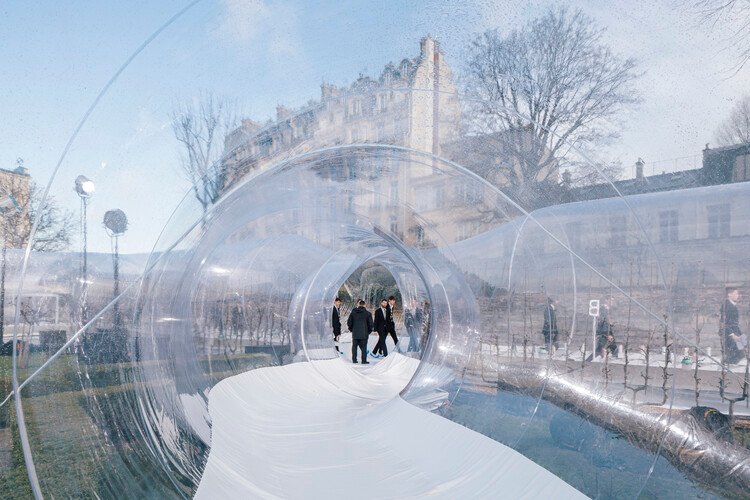
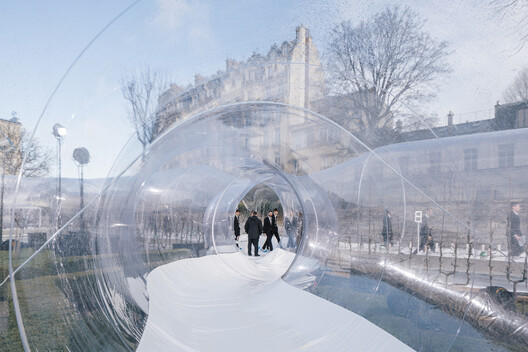
In Six Memos for the Next Millennium, Italo Calvino explores lightness from a literary perspective and argues, “Opposed to lightness is weight. Removing weight produces lightness; it is a value, not a defect.” Drawing on Greek mythology, he reflects on one of Perseus’s feats after severing the head of the terrible Gorgon Medusa without being turned to stone. Assisted by the gods Hades, Hermes, and Athena, Perseus flies with his winged sandals and uses a bronze shield as a mirror to reflect her image. Relying, like many architects, on what is lightest—the wind and the clouds—he also fixes his gaze on what is revealed through indirect vision: an image reflected in a mirror.
Historically, transparency has been naturalized as an inherent condition of modern architecture. With the shift from the heavy load-bearing wall to the lightweight glass envelope, glass was introduced into the discipline, blurring the boundaries between interior and exterior spaces. In connection with inflatable architecture, transparency is linked to lightness and impermanence, leaving temporary traces on the landscapes it inhabits. By using textiles or plastics as main materials and air as a structural system, the search for lightness in the built environment now recognizes more than a single atmosphere of application.
From glass to inflatable structures, architecture has come a long way, shaped by different movements, styles, and ideals. Between Perseus’s myth and the architectural pursuit of lightness, transparency emerges as a way to move away from mass, relying instead on emptiness and the play of opposites, where the translucent meets the opaque and the visible meets the invisible. In architecture, the origins of glass can be traced back to the Chicago School, when structures shifted to column systems that allowed openings to be created in façades. With Le Corbusier and his Five Points of Architecture, the wall disappears, replaced by a structure of slender pilotis and large windows that allow natural light and ventilation while strengthening the relationship with the outdoors and blending with the surrounding environment.
Façades began to free themselves, shedding structural functions to become lightweight membranes. Mies van der Rohe also challenged the traditional enclosure in projects such as the Farnsworth House and the Barcelona Pavilion. In the Farnsworth House, transparency allows the building to merge with nature, fully engaging with the surrounding landscape. In the Barcelona Pavilion, broad continuous glass surfaces establish the outer edge within a space shaped by an orthogonal arrangement of offset planes. In this context, the boundaries of architecture begin to disappear, and floor plans are liberated to create greater spatial continuity.
Over time, the pursuit of lightness has gone beyond simply making structures seem to float. It has also involved a growing use of transparent surfaces, which strengthens the sense of visual lightness. In Glass Architecture, Paul Scheerbart explains that increasingly slender columns, for example, appear lighter when clad in glass with illumination inside them. As if they carried no weight, they generate the sensation of a freer architecture, as though floating in the air.
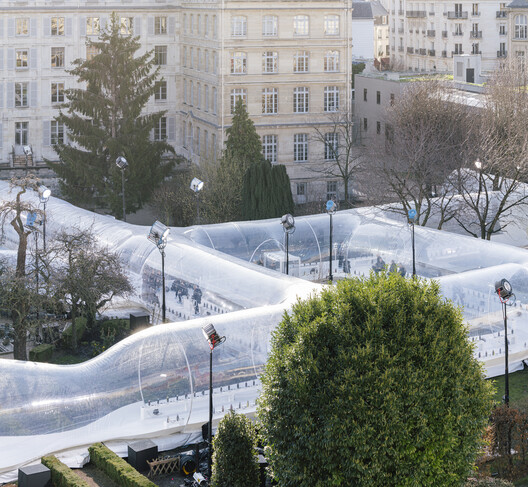
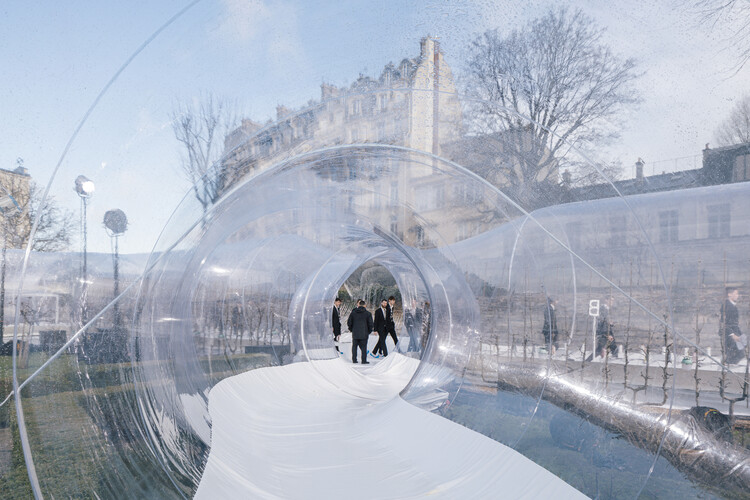
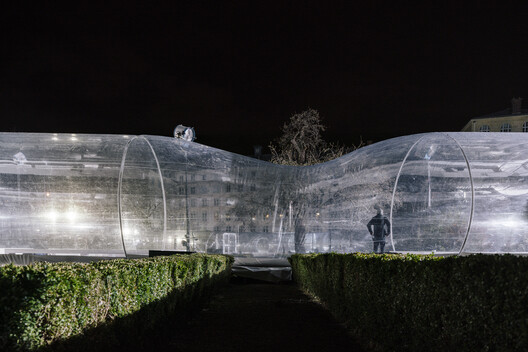
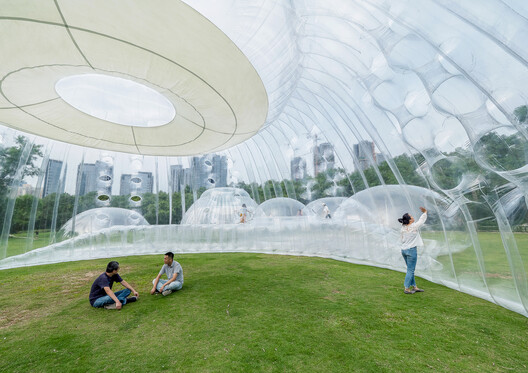
Just as the transparency of water changes according to the angle of light, the inflatable qualities of structures are also shaped by their surroundings and intended uses. While the living pneumatic structure of Dosis’s Pipeline Installation in Paris adapts dynamically to each situation and site, Air Mountain Pavilion by Aether Architects combines an interior space for concerts, theatrical performances, forums, and workshops with an exterior space for public leisure. Through a multidimensional surface, the project merges architecture and environment, different activities, states, and behaviors, enhancing the relationship between the artificial and nature. The building’s transparent qualities, along with the horizontal and vertical connections within the space, create visual links between overlapping landscapes and events.
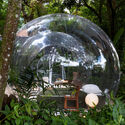
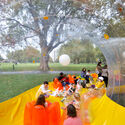
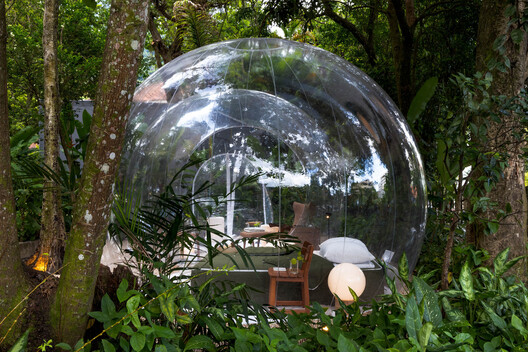
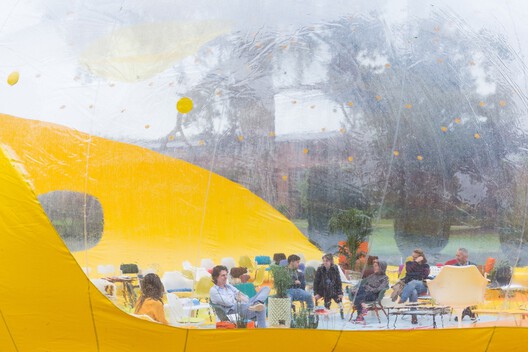
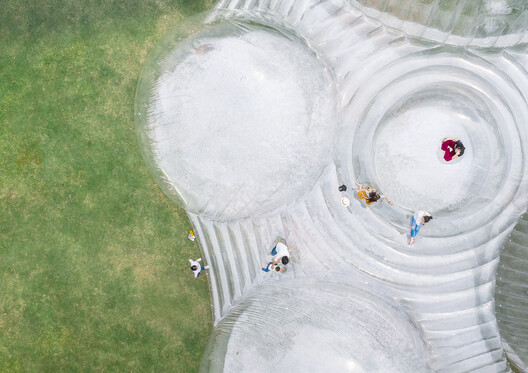
The habitable pneumatic structure Second Dome, inflated in London Fields, was designed to host free community events for local families and children. From a 65-square-meter bubble to a multi-room structure of more than 400 square meters and 8 meters in high, it forms a technological artifact that responds to wind and air pressure while requiring minimal energy for fabrication and assembly. Another project that also works with inflatable bubbles—this time in Brazil—is the Secret Garden by Diego Raposo + Arquitetos. With diameters ranging from 3 to 4 meters, these bubbles adapt to the terrain, creating spaces in a natural and organic way. By minimizing impact on the site and integrating with nature, the project employs a low-impact construction method and creates an environment that imitates its surroundings.
Although inflatable structures are often designed for artistic or sculptural purposes, many of their forms and geometries are inspired by nature, such as the geodesic dome, thanks in part to the American architect Buckminster Fuller. His legacy endures in the philosophy of the Copenhagen-based architecture studio Atelier Kristoffer Tejlgaard, which challenges the traditional construction industry through its architectural approach. The Droplet Pavilion, shaped like a resting drop of water, explores transparency and precision through a self-supporting dome structure. The design is composed of 6 mm transparent polycarbonate sheets assembled with stainless steel nuts and bolts for quick and simple assembly and disassembly. Its rhombus-based geometry, developed through 3D modeling, also reduced material waste by about 30 percent compared with a geodesic dome system based on pentagons and hexagons.
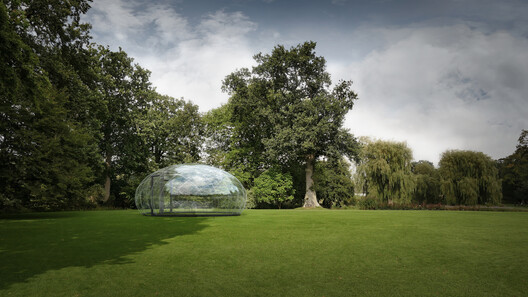
So, does architectural lightness respond to a structural necessity, an environmental strategy, or a conceptual desire? Why do contemporary architects choose inflatable and transparent structures as a way to connect with the natural environment? In nature, lightness appears again and again. Wind, clouds, and water bubbles become sources of inspiration for many architectural projects and installations. At the same time, strategies of recycling, reuse, and resource minimization emerge within creative processes, employing materials with varying degrees of transparency while seeking to generate the least possible environmental impact. Reflecting on how to foster the development of structures that embody these ideals requires learning to integrate technique, materiality, and the study of multiple disciplines in unison. Ultimately, in the search for lightness, as Paul Valéry reminds us, “One must be light like the bird, not like the feather.”
This article is part of the ArchDaily Topic: Light, Lighter, Lightest: Redefining How Architecture Touches the Earth, proudly presented by Vitrocsa, the original minimalist windows since 1992.
Vitrocsa designed the original minimalist window systems, a unique range of solutions, dedicated to the frameless window boasting the narrowest sightline barriers in the world. Manufactured in line with the renowned Swiss Made tradition for 30 years, Vitrocsa’s systems “are the product of unrivaled expertise and a constant quest for innovation, enabling us to meet the most ambitious architectural visions.”
Every month we explore a topic in-depth through articles, interviews, news, and architecture projects. We invite you to learn more about our ArchDaily Topics. And, as always, at ArchDaily we welcome the contributions of our readers; if you want to submit an article or project, contact us.