!['Batwara 1947' box office collection Day 4 [LIVE]: Sunny Deol film sees steep weekday drop but eyes Rs 30 crore milestone](https://dailysamchar.in/wp-content/uploads/2026/08/1786951593_photo.jpg "‘Batwara 1947’ box office collection Day 4 [LIVE]: Sunny Deol film sees steep weekday drop but eyes Rs 30 crore milestone")



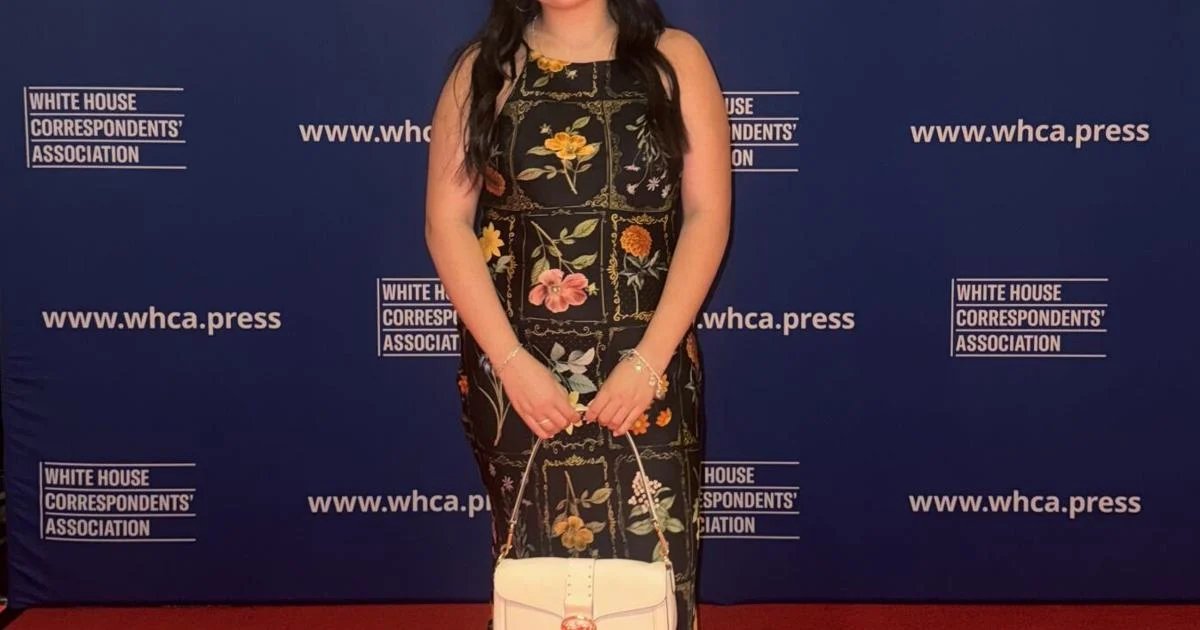

Kansan Associate News Editor and Multimedia Journalism student Julia Hanson poses on the red carpet on April 25, at the White House Correspondents’ Dinner at the Washington Hotel. The dinner honors student scholarship recipients but was cut short after a gunman shot at Secret Service officials in an attempt to assassinate the President.
Editor’s Note: A gunman charged past Secret Service officials on Saturday, April 25 and fired just outside the ballroom on of the White House Correspondents’ Dinner at the Washington Hilton. Officials escorted President Trump out while journalists took cover under tables. Associate News Editor Julia Hanson shares and reflects on her first-person account as a guest at the dinner.
My phone continuously pinged with emails and texts from professors, friends and family checking on me. I sat across from my mom at breakfast Sunday morning, unable to engage in conversation or focus on the menu. The White House Correspondents’ Dinner and its abrupt cancellation left me dazed.
Twenty-eight scholars and I spent the weekend touring the White House and meeting the greatest journalists in the country. The White House Correspondents’ Association (WHCA) and the University of Kansas Journalism school awarded me a scholarship which included an invitation to their annual dinner, better known as “nerd prom.”
As a longtime student journalist, this was huge. I would stay in the Washington Hilton where the dinner was held, network with correspondents and see President Donald Trump as he makes his first-ever appearance at the dinner.
“It’ll be long,” is the first thing most journalists told us. “Wear comfortable shoes.” They agreed: no one knew what to expect from Trump’s speech or journalists’ reactions. One told me, with the president’s attendance, she refused to go.

WHCA scholarship recipients from universities around the country take a mirror photo minutes before the start of the White House Correspondents’ Dinner on Saturday, April 25 at the Washington Hilton. Below the mirror is the staircase to enter the ballroom where a gunman attempted to enter.
The scholars, in dresses and rented tuxedos, took photos on the red carpet, peeked into the pre-parties of major news networks and eventually went through the TSA-like security. We gathered around our table at 8 p.m. in the ballroom and craned our arms, phone in hand, to catch the president’s entrance just fifty feet from us.
When the dinner began, us scholars had been mingling and soaking in the event for hours. WHCA President Weijia Jiang, a CBS correspondent that spoke with us the previous day, gave a speech and introduced the president. The first lady and the vice president also sat on the stage next to other correspondents on the WHCA board.
The National Anthem had just played and we sat down to eat the first course. I chatted and laughed with the other scholars. We felt special to be there, gawking at our names on the booklets and giggling over the customized White House wine bottles. Then at 8:34 p.m., I heard commotion, turned around and saw thousands of journalists hit the ground. We were sitting by an exit, with Secret Service members standing at the door. “Get down!” they yelled.
After a second of disbelief, I knew I had to get out. I crawled towards the exit. When I turned back, I saw journalists half-ducked and filming what was happening. I peeked up to the center stage and saw a Secret Service member with a massive rifle in hand. Other members ran past me with handguns drawn, yelling “shots fired.”
A few minutes passed, and we believed that the shooter wasn’t in the room. I crawled back to my seat, grabbed my phone and texted my family that I was okay, even though I still wasn’t sure that I was. A few journalists sarcastically chanted, “God Bless America” and “U.S.A.”
I thought the same.

Six minutes after taking cover under tables, journalists message family members and take photos in the Washington Hilton ballroom on Saturday, April 25. The journalists heard shots fired just outside the ballroom, and Secret Service officials evacuated the President.
After immediate reporting by all the outlets, we now know that the shooter never entered the ballroom. But in those moments, I was waiting for more shots to go off, waiting to see where exactly the gunman was so I knew when to book it through the exit. When that time never came, us scholars slowly rose to see journalists already reporting.
Just a few tables away, CNN reporters used the camera and flashlights of their iPhones and the microphone on their AirPods to report straight from the event. Videos from every angle circulated around news outlets, demonstrating every journalists’ immediate responses.

CNN reporters use the cameras and flashlights on their iPhone and the audio from AirPods to report from the White House Correspondents’ Dinner on Saturday, April 25. Journalists throughout the room immediately began reporting after a gunman attempted to assassinate the President at the Washington Hilton.
Jiang first said we would resume upon the president’s request. I was somewhat relieved but also thought, we just ducked for our lives, and now we’re going to eat dinner? She later said that authorities decided to cancel the dinner, and the president wants to reschedule within 30 days. The president would have a press briefing at the White House in 30 minutes, she said.

Wine spilled on the white tablecloth when WHCA scholars ducked under tables after a gunman fired shots outside the ballroom of the Washington Hilton on Saturday, April 25. The scholars listened for instructions from the WHCA after Secret Service officials took down the gunman.
We went to the lobby, taking in the reactions of journalists around us– stress, intensity and care. As a student, I had mixed feelings. I still do. Being in the thick of everything—the dinner, the shooting and the aftermath—was terrifying, disappointing and since no one was killed, exciting, all at the same time. As student journalists, we saw first-hand, on-the-ground reporting from the best in the field.
The following morning I was interviewed by Weekend White House Correspondent Julia Benbrook of CNN. I saw blue walls behind her and knew she was calling in from the White House press briefing room. I took a moment to be selfish and express my disappointment that, after flying out to Washington D.C. and counting down the days until the dinner, violence ended it so early.
And so when Benbrook asked what my long-term career plans are, she didn’t ask specifically if I wanted to be a journalist. Still, I wish I could’ve told her, with certainty, that I do. I do know that I met some of the bravest and kindest journalists in the country last weekend. Their responses to the incident represent the nature of the profession exactly—shouldering the responsibility to inform others—even in the most dangerous situations.