The protests took place as PM Modi visited the state.
As Prime Minister Narendra Modi visited Tamil Nadu on March 11, anti-Hindi protests erupted in the state.
Participants of the ‘May 17 Movement’, under the leadership of the movement’s organiser Thirumurugan Gandhi, walked into the Chennai Park Railway Station and painted black the recently placed station signage boards, which prioritised Hindi in the centre, with Tamil above and English below. An activist of the movement Siva Dileepan also jumped in front of a train entering the station and shouted, “Long live Tamil, down with Hindi.” He is undergoing treatment.
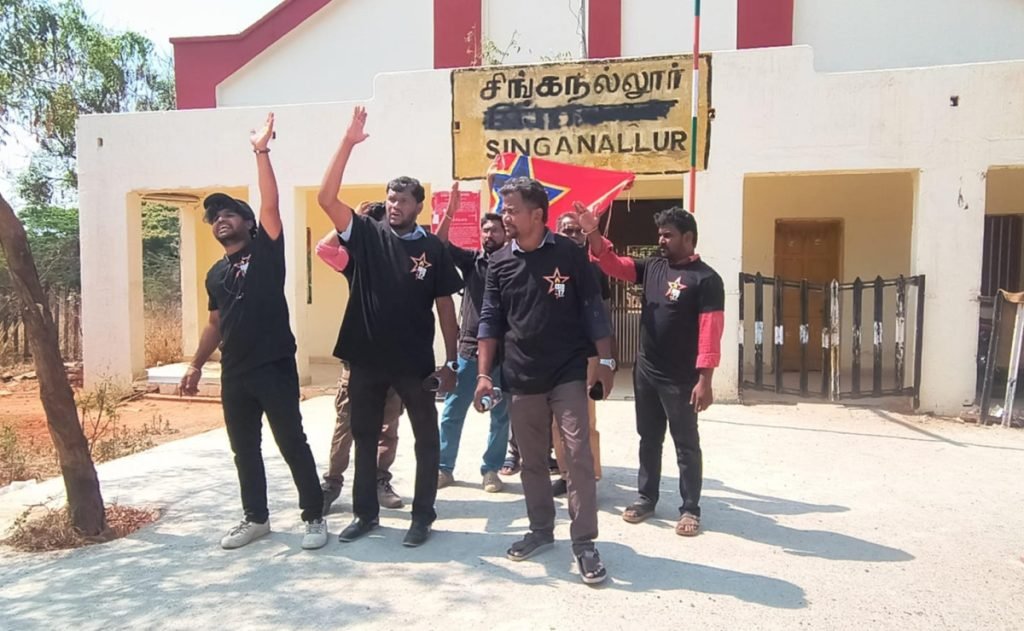
Activists of the May17 Movement spraying black paint and erasing Hindi letters in Singanallur Railway Station, Coimbatore on March 12, 2026. Photo: By arrangement.
The incident echoes a long history of resistance in Tamil Nadu against the imposition of Hindi.
In December 1963, when Chief Minister M. Bhaktavatsalam entered Egmore Railway Station, language activist Keezhapazhavur Chinnasamy caught hold of the CM and begged him not to let Hindi become the sole official language. The former CM shrugged him off and ordered the police to arrest Chinnasamy. After one month of imprisonment, Chinnasamy was released. Early on January 25, 1964, Chinnasamy walked to the front gate of the Trichy Railway Station, immolated himself and died shouting, “Long Live Tamil, down with Hindi.”
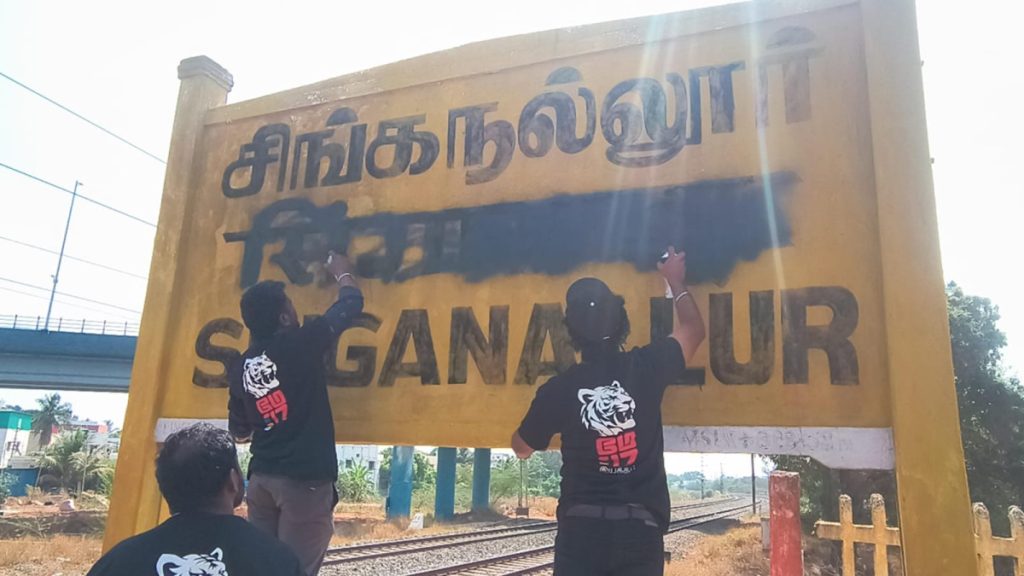
Activists of May17 Movement spraying black paint and erasing Hindi letters in Singanallur Railway Station, Coimbatore on March 12. Photo: By arrangement.
Tamil Nadu’s anti-Hindi resistance started in the year 1937 when the first chief minister of the Madras Presidency, Congress leader C. Rajagopalachari, introduced the compulsory teaching of Hindi in the schools of the Madras Province. It was vehemently resisted by E.V. Periyar and the Justice Party. Periyar spearheaded three years of multifaceted protests involving fasts, public conferences, rallies and demonstrations against Hindi imposition. On August 1, 1938, a group of Tamil enthusiasts called “Tamizhar Padai” held the first Anti-Hindi Conference at Trichy and rallied from there to Madras. Agitations were held in various Tamil-speaking districts in the province. More than a thousand people were arrested. In 1939, two imprisoned agitators, Natarajan and Thalamuthu, died in prison on January 15 and March 11 respectively. The 1965 anti-Hindi agitations against the Nehru government’s move to make Hindi the official language of India saw widespread student resistance across the state. Thousands of people were arrested; official records state that 70 people were shot dead during the anti-Hindi agitations.
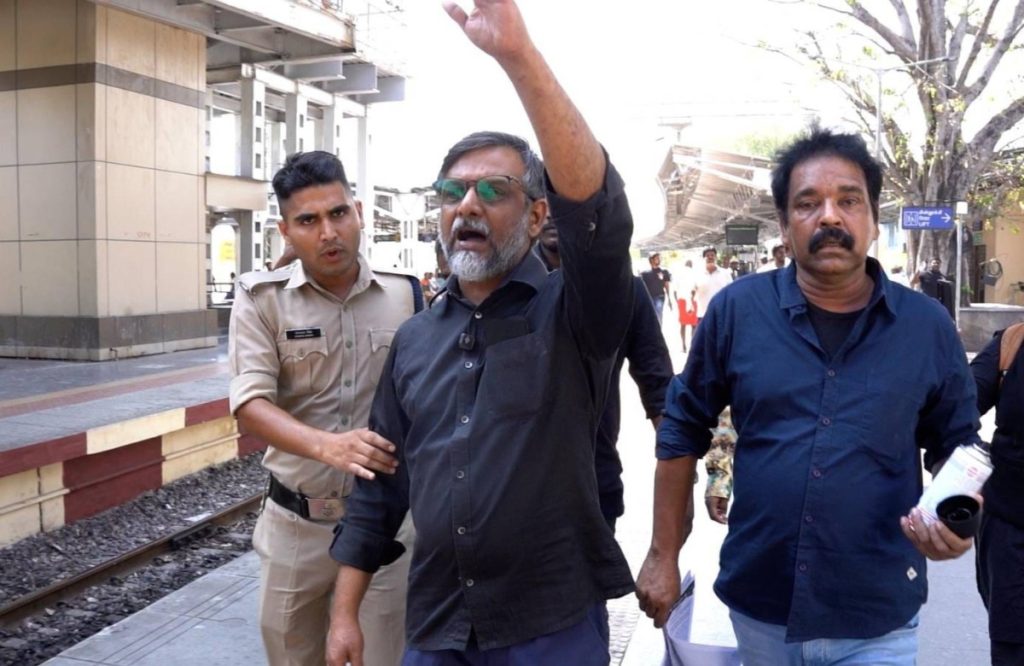
May 17 Movement’s Siva Dileepan (right) along with Thirumurugan Gandhi at Chennai Park Station on March 11. Photo: By arrangement.
While Tamil people have always resisted language imposition post-Independence, in the last 14 years under the Modi-led BJP rule, their language struggle has sharpened. From common people to elected representatives, many have opposed what they see as the BJP government’s Hindi imposition. These include Hindi letters written from central ministries to Tamil elected representatives, Hindi names for federal government buildings, Hindi and English safety announcements in regional flights, the struggle the whole state and the state government faced in bringing out the Keeladi findings, and the constant struggle with the governor who wanted to rename Tamil Nadu ‘Tamilagam’. The struggle against Hindi imposition in the state continues.
In January, as part of a modernisation drive under the “Amrit Bharat Station Scheme”, the BJP government renovated approximately 75 railway stations across the state, including cities like Chennai, Madurai and Coimbatore. Earlier, station name signboards displayed Tamil at the top, English in the centre and Hindi below. But the new signboards placed across the state moved Hindi above, pushing English below. The new hierarchy of languages on the signage created an uproar as soon as they were put up. Political leaders and elected members of the state and parliament noted and condemned the priority given to Hindi and how English, the link language, was pushed down. While condemning it, many recalled the close to a century-old anti-imposition resistance movement in the state.
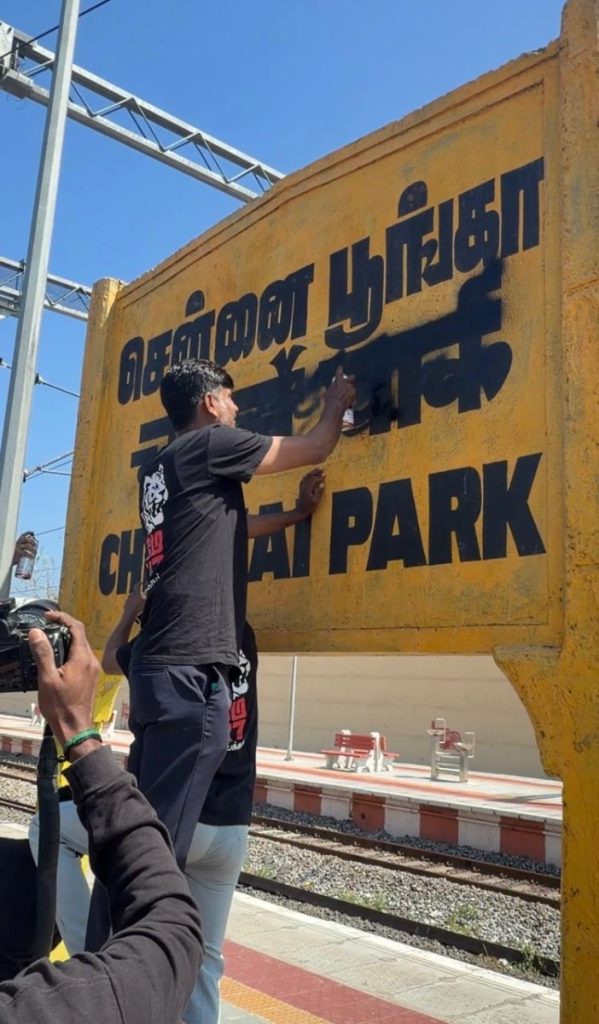
Activists of May17 Movement spraying black paint and erasing Hindi letters at Chennai Park Station on March 11. Photo: By arrangement.
Condemning the new displays, on February 21, International Mother Language Day, the organiser of the May 17 Movement, along with cadres, staged a protest in front of Egmore Railway Station with the slogan, “Erase Imposed Hindi – Unite to Defeat the Hindi Imposition.” They demanded the removal of Hindi letters from all railway signage displays in the state. Following this, the movement staged anti-Hindi protests on March 1, 2026 at Coimbatore and Chidambaram, remembering the ‘Tamil martyrs’ of the 1965 anti-Hindi resistance.
On March 11, remembering the Tamil martyr Thalamuthu, who died on March 11, 1939 resisting the compulsory imposition of Hindi in schools, comrades of the May 17 Movement walked into Chennai Park Railway Station to erase the letters on newly displayed signboards. As they raised slogans, common people waiting on the platform joined in with slogans. Cadres of the May 17 Movement held anti-Hindi protests in various places. They removed Hindi letters from Chrompet and Nungambakkam railway stations in Chennai and from a station in Coimbatore. Cadres were arrested after the protest.
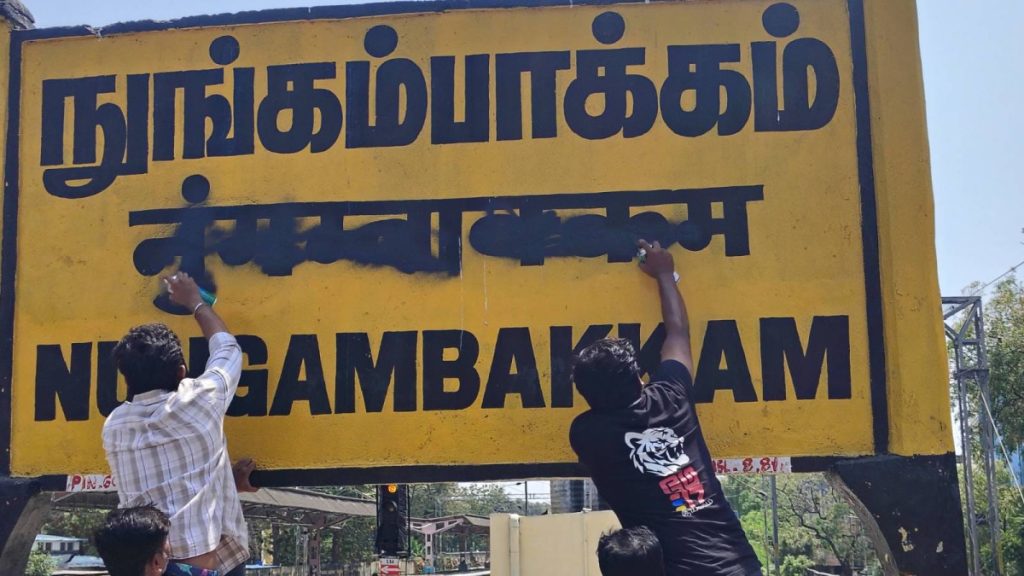
Activists of the May 17 Movement spraying black paint and erasing Hindi letters in Nungambakkam Railway Station, Chennai on March 12. Photo: By arrangement.
Organiser of the May 17 Movement, Thirumurugan Gandhi, says, “We said that every time Modi visits Tamil Nadu, we will protest his arrival with a black flag. As he visited the state, we expressed our protest by painting black the Hindi letters in Chennai Park Railway Station. And we demand that the Southern Railways remove the Hindi letters from Tamil Nadu railway stations. We also see Hindi-speaking North Indians being employed for most of the jobs in the Southern Railway offices. Hindi imposition steals away jobs of Tamil students and Tamil youth. Even though Tamils pay our taxes, railway and bank jobs are given to Hindi-speaking North Indians.”
On March 4, 2026, CPI(M) Member of Parliament S. Venkatesan posted on X that the Southern Railways had named the entrance gate of the Tiruchirappalli Divisional Railway Office “Kartavya Dwar” in Hindi, and demanded that the name be removed immediately. Following this, the CM of Tamil Nadu posted on X saying that it was not just Hindi letters that were removed. It was the arrogance of hegemonic hatred too.
As Tamil Nadu saw anti-Hindi protests on March 11, the day Prime Minister Modi visited the state, Malayalis also wrote on X about Kerala’s Changanasseri Railway Station, where Hindi was given centre spot on the station’s main name boards and Malayalam was pushed to the sides. Malayalis took to social media platforms with the hashtag #StopHindiImposition.
Siva Dileepan, who hurled himself in front of the train on Wednesday shouting “Long live Tamil, down with Hindi”, had made a Facebook post before the protest, saying “உடல் மண்ணுக்கு, உயிர் தமிழுக்கு”, meaning, “body to the soil, but life to the Tamil language.” As Siva battles for life in the hospital, his wife Geetha says her husband did this for the language.
Kavitha Gajendran is a Chennai-based activist, writer and translator. She works on women-centric issues and stories.
This article went live on March thirteenth, two thousand twenty six, at thirty-eight minutes past six in the evening.
The Wire is now on WhatsApp. Follow our channel for sharp analysis and opinions on the latest developments.