








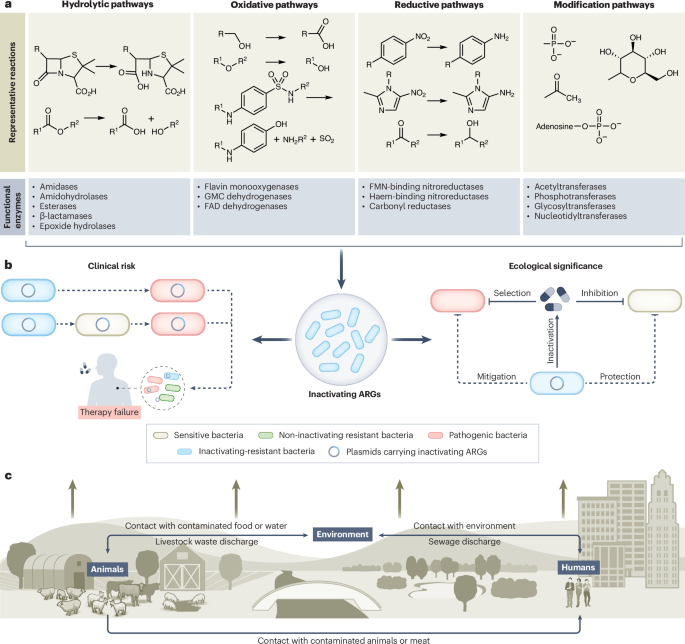
Djordjevic, S. P. et al. Genomic surveillance for antimicrobial resistance—a One Health perspective. Nat. Rev. Genet. 25, 142–157 (2024).
Larsson, D. G. J., Gaze, W. H., Laxminarayan, R. & Topp, E. AMR, One Health and the environment. Nat. Microbiol. 8, 754–755 (2023).
Hernando-Amado, S., Coque, T. M., Baquero, F. & Martínez, J. L. Defining and combating antibiotic resistance from One Health and Global Health perspectives. Nat. Microbiol. 4, 1432–1442 (2019).
Rodriguez-Mozaz, S. et al. Occurrence of antibiotics and antibiotic resistance genes in hospital and urban wastewaters and their impact on the receiving river. Water Res. 69, 234–242 (2015).
Larsson, D. G. J. & Flach, C.-F. Antibiotic resistance in the environment. Nat. Rev. Microbiol. 20, 257–269 (2022). This review synthesizes the environmental dimensions of antibiotic resistance, establishing a framework for understanding the origins, evolution and transmission of resistance determinants that involves the external environment.
Kraupner, N. et al. Evidence for selection of multi-resistant E. coli by hospital effluent. Environ. Int. 150, 106436 (2021).
Zhao, Y. et al. Antibiotic resistome in the livestock and aquaculture industries: status and solutions. Crit. Rev. Environ. Sci. Technol. 51, 2159–2196 (2021).
Berglund, F., Ebmeyer, S., Kristiansson, E. & Larsson, D. G. J. Evidence for wastewaters as environments where mobile antibiotic resistance genes emerge. Commun. Biol. 6, 321 (2023).
Ashbolt Nicholas, J. et al. Human health risk assessment (HHRA) for environmental development and transfer of antibiotic resistance. Environ. Health Perspect. 121, 993–1001 (2013).
World Health Organization. Guidance on Wastewater and Solid Waste Management for Manufacturing of Antibiotics (World Health Organization, 2024); https://www.who.int/publications/i/item/9789240097254
United Nations Environment Programme. Bracing for Superbugs: Strengthening Environmental Action in the One Health Response to Antimicrobial Resistance (Unied Nations, 2023); https://www.unep.org/resources/superbugs/environmental-action
Yurtsev, E. A., Chao, H. X., Datta, M. S., Artemova, T. & Gore, J. Bacterial cheating drives the population dynamics of cooperative antibiotic resistance plasmids. Mol. Syst. Biol. 9, 683 (2013).
Sorg, R. A. et al. Collective resistance in microbial communities by intracellular antibiotic deactivation. PLoS Biol. 14, e2000631 (2016).
Lee, D.-H. et al. Colistin-degrading proteases confer collective resistance to microbial communities during polymicrobial infections. Microbiome. 10, 129 (2022).
Bottery, M. J., Pitchford, J. W. & Friman, V.-P. Ecology and evolution of antimicrobial resistance in bacterial communities. ISME J. 15, 939–948 (2021).
Dantas, G., Sommer, M. O. A., Oluwasegun, R. D. & Church, G. M. Bacteria subsisting on antibiotics. Science 320, 100–103 (2008).
Allen, H. K. et al. Call of the wild: antibiotic resistance genes in natural environments. Nat. Rev. Microbiol. 8, 251–259 (2010).
Wright, G. D. The antibiotic resistome: the nexus of chemical and genetic diversity. Nat. Rev. Microbiol. 5, 175–186 (2007).
Benveniste, R. & Davies, J. Aminoglycoside antibiotic-inactivating enzymes in actinomycetes similar to those present in clinical isolates of antibiotic-resistant bacteria. Proc. Natl Acad. Sci. USA 70, 2276–2280 (1973).
D’Costa, V. M. et al. Antibiotic resistance is ancient. Nature 477, 457–461 (2011).
Van Goethem, M. W. et al. A reservoir of ‘historical’ antibiotic resistance genes in remote pristine Antarctic soils. Microbiome 6, 40 (2018).
Boolchandani, M., D’Souza, A. W. & Dantas, G. Sequencing-based methods and resources to study antimicrobial resistance. Nat. Rev. Genet. 20, 356–370 (2019).
Darby, E. M. et al. Molecular mechanisms of antibiotic resistance revisited. Nat. Rev. Microbiol. 21, 280–295 (2023).
Blair, J. M. A., Webber, M. A., Baylay, A. J., Ogbolu, D. O. & Piddock, L. J. V. Molecular mechanisms of antibiotic resistance. Nat. Rev. Microbiol. 13, 42–51 (2015).
Meredith, H. R., Srimani, J. K., Lee, A. J., Lopatkin, A. J. & You, L. Collective antibiotic tolerance: mechanisms, dynamics and intervention. Nat. Chem. Biol. 11, 182–188 (2015).
Vega, N. M. & Gore, J. Collective antibiotic resistance: mechanisms and implications. Curr. Opin. Microbiol. 21, 28–34 (2014).
Bush, K. & Bradford, P. A. Epidemiology of β-lactamase-producing pathogens. Clin. Microbiol. Rev. 33, e00047-19 (2020).
Tao, W. et al. Inactivation of chloramphenicol and florfenicol by a novel chloramphenicol hydrolase. Appl. Environ. Microbiol. 78, 6295–6301 (2012).
Dhindwal, P. et al. A neglected and emerging antimicrobial resistance gene encodes for a serine-dependent macrolide esterase. Proc. Natl Acad. Sci. USA 120, e2219827120 (2023).
Fillgrove, K. L., Pakhomova, S., Newcomer, M. E. & Armstrong, R. N. Mechanistic diversity of fosfomycin resistance in pathogenic microorganisms. J. Am. Chem. Soc. 125, 15730–15731 (2003).
Gasparrini, A. J. et al. Tetracycline-inactivating enzymes from environmental, human commensal, and pathogenic bacteria cause broad-spectrum tetracycline resistance. Commun. Biol. 3, 241 (2020).
Ma, X. et al. Molecular mechanism of chloramphenicol and thiamphenicol resistance mediated by a novel oxidase, CmO, in Sphingomonadaceae. Appl. Environ. Microbiol. 89, e0154722 (2022).
Huang, Y. et al. Strain-level diversity in sulfonamide biodegradation: adaptation of Paenarthrobacter to sulfonamides. ISME J. 18, wrad040 (2024).
Chen, Z. et al. Deglycosylation inactivation initiated by a novel periplasmic dehydrogenase complex provides a novel strategy for eliminating the recalcitrant antibiotic kanamycin. Environ. Sci. Technol. 57, 4298–4307 (2023).
Liu, L.-K. et al. The structure of the antibiotic deactivating, N-hydroxylating rifampicin monooxygenase. J. Biol. Chem. 291, 21553–21562 (2016).
Olaitan, A. O. et al. Decoding a cryptic mechanism of metronidazole resistance among globally disseminated fluoroquinolone-resistant Clostridioides difficile. Nat. Commun. 14, 4130 (2023).
Crofts, T. S. et al. Discovery and characterization of a nitroreductase capable of conferring bacterial resistance to chloramphenicol. Cell Chem. Biol. 26, 559–570.e556 (2019).
Löffler, P., Escher, B. I., Baduel, C., Virta, M. P. & Lai, F. Y. Antimicrobial transformation products in the aquatic environment: global occurrence, ecotoxicological risks and potential of antibiotic resistance. Environ. Sci. Technol. 57, 9474–9494 (2023).
Hu, J., Lyu, Y., Chen, H., Li, S. & Sun, W. Suspect and nontarget screening reveal the underestimated risks of antibiotic transformation products in wastewater treatment plant effluents. Environ. Sci. Technol. 57, 17439–17451 (2023).
Bhattacharya, A. & Khare, S. K. Utilizing the β-lactam hydrolyzing activity of ß-lactamase produced by Bacillus cereus EMB20 for remediation of β-lactam antibiotics. Int. Biodeterior. Biodegrad. 168, 105363 (2022).
Gal, M. & Brazier, J. S. Metronidazole resistance in Bacteroides spp. Carrying nim genes and the selection of slow-growing metronidazole-resistant mutants. J. Antimicrob. Chemother. 54, 109–116 (2004).
Li, Q. et al. Positive contribution of antimicrobial biodegradation in mitigating conjugative transfer of antibiotic resistance genes. Environ. Sci. Technol. 59, 21645–21656 (2025). This study provides direct experimental evidence that antimicrobial biodegradation can reduce conjugative transfer of ARGs to high‑risk pathogens, highlighting how antibiotic fate processes can modulate AMR dissemination risk across microbiotas.
Robicsek, A. et al. Fluoroquinolone-modifying enzyme: a new adaptation of a common aminoglycoside acetyltransferase. Nat. Med. 12, 83–88 (2006).
Majewsky, M. et al. Antibacterial activity of sulfamethoxazole transformation products (TPs): general relevance for sulfonamide TPs modified at the para position. Chem. Res. Toxicol. 27, 1821–1828 (2014).
Halling-Sørensen, B., Sengeløv, G. & Tjørnelund, J. Toxicity of tetracyclines and tetracycline degradation products to environmentally relevant bacteria, including selected tetracycline-resistant bacteria. Arch. Environ. Contam. Toxicol. 42, 263–271 (2002).
Deng, Y. et al. Microbiome assembly for sulfonamide subsistence and the transfer of genetic determinants. ISME J. 15, 2817–2829 (2021). This study links sulfonamide subsistence to the sadA gene and shows that this genetic capability is evolutionarily conserved with limited spread beyond the Micrococcaceae boundary, helping to constrain concerns about widespread horizontal transfer of this inactivating ARGs.
Qi, M. et al. Microbial interactions drive the complete catabolism of the antibiotic sulfamethoxazole in activated sludge microbiomes. Environ. Sci. Technol. 55, 3270–3282 (2021).
Ma, X. et al. Novel pathway for chloramphenicol catabolism in the activated sludge bacterial isolate Sphingobium sp. CAP-1. Environ. Sci. Technol. 54, 7591–7600 (2020).
Woappi, Y., Gabani, P., Singh, A. & Singh, O. V. Antibiotrophs: the complexity of antibiotic-subsisting and antibiotic-resistant microorganisms. Crit. Rev. Microbiol. 42, 17–30 (2016).
Deng, Y., Li, B. & Zhang, T. Bacteria that make a meal of sulfonamide antibiotics: blind spots and emerging opportunities. Environ. Sci. Technol. 52, 3854–3868 (2018).
Ebmeyer, S., Kristiansson, E. & Larsson, D. G. J. A framework for identifying the recent origins of mobile antibiotic resistance genes. Commun. Biol. 4, 8 (2021).
Poirel, L., Kämpfer, P. & Nordmann, P. Chromosome-encoded Ambler class a β-lactamase of Kluyvera georgiana, a probable progenitor of a subgroup of CTX-M extended-spectrum β-lactamases. Antimicrob. Agents Chemother. 46, 4038–4040 (2002).
Klümper, U. et al. Selection for antimicrobial resistance is reduced when embedded in a natural microbial community. ISME J. 13, 2927–2937 (2019).
Wen, X., Langevin, A. M. & Dunlop, M. J. Antibiotic export by efflux pumps affects growth of neighboring bacteria. Sci. Rep. 8, 15120 (2018).
Denk-Lobnig, M. K. & Wood, K. B. Spatial population dynamics of bacterial colonies with social antibiotic resistance. Proc. Natl Acad. Sci. USA 122, e2417065122 (2025).
Laborda, P., Gil-Gil, T., Martínez, J. L. & Hernando-Amado, S. Preserving the efficacy of antibiotics to tackle antibiotic resistance. Microb. Biotechnol. 17, e14528 (2024).
Bottery Michael, J., Wood, A. J. & Brockhurst Michael, A. Selective conditions for a multidrug resistance plasmid depend on the sociality of antibiotic resistance. Antimicrob. Agents Chemother. 60, 2524–2527 (2016).
Nicoloff, H. & Andersson, D. I. Indirect resistance to several classes of antibiotics in cocultures with resistant bacteria expressing antibiotic-modifying or -degrading enzymes. J. Antimicrob. Chemother. 71, 100–110 (2016).
Bottery, M. J. et al. Inter-species interactions alter antibiotic efficacy in bacterial communities. ISME J. 16, 812–821 (2022).
Kelsic, E. D., Zhao, J., Vetsigian, K. & Kishony, R. Counteraction of antibiotic production and degradation stabilizes microbial communities. Nature 521, 516–519 (2015). This study reveals that antibiotic-degrading species, unlike intrinsically resistant ones, can robustly stabilize microbial communities against species loss even under high dispersal rates by attenuating inhibitory interactions, highlighting a fundamental role for degradation-mediated resistance in maintaining ecosystem diversity and stability.
Chen, J., Chen, X., Zhu, Y., Yan, S. & Xie, S. New insights into bioaugmented removal of sulfamethoxazole in sediment microcosms: degradation efficiency, ecological risk and microbial mechanisms. Microbiome 12, 43 (2024). This study shows that bioaugmentation with sulfonamide degraders (including a sadA-encoded ipso-hydroxylation pathway) can accelerate sulfamethoxazole removal while reducing the abundance of key sulfonamide resistance genes (for example, sul1 and sul2) and lowering overall community ARG and MGE loads, highlighting the potential for antibiotic-inactivating functions to mitigate broader resistome burden at the community level.
Frost, I. et al. Cooperation, competition and antibiotic resistance in bacterial colonies. ISME J. 12, 1582–1593 (2018).
Yurtsev, E. A., Conwill, A. & Gore, J. Oscillatory dynamics in a bacterial cross-protection mutualism. Proc. Natl Acad. Sci. USA 113, 6236–6241 (2016).
Estrela, S. & Brown, S. P. Community interactions and spatial structure shape selection on antibiotic resistant lineages. PLoS Comput. Biol. 14, e1006179 (2018).
Meredith, H. R. et al. Applying ecological resistance and resilience to dissect bacterial antibiotic responses. Sci. Adv. 4, eaau1873 (2018). This study establishes a quantitative ecological framework to dissect bacterial responses to antibiotics, highlighting how antibiotic-degrading traits (specifically β-lactamase activity) significantly enhance population resilience by accelerating recovery after antibiotic stress, in contrast to target modification mechanisms that primarily improve resistance but not recovery speed.
Allen, H. K. & Stanton, T. B. Altered egos: antibiotic effects on food animal microbiomes. Annu. Rev. Microbiol. 68, 297–315 (2014).
Hou, L. et al. Effects of sulfamethazine on denitrification and the associated N2O release in estuarine and coastal sediments. Environ. Sci. Technol. 49, 326–333 (2015).
Wepking, C. et al. Prolonged exposure to manure from livestock-administered antibiotics decreases ecosystem carbon-use efficiency and alters nitrogen cycling. Ecol. Lett. 22, 2067–2076 (2019).
Pathak, A., Angst, D. C., León-Sampedro, R. & Hall, A. R. Antibiotic-degrading resistance changes bacterial community structure via species-specific responses. ISME J. 17, 1495–1503 (2023).
Cubillos-Ruiz, A. et al. An engineered live biotherapeutic for the prevention of antibiotic-induced dysbiosis. Nat. Biomed. Eng. 6, 910–921 (2022). This study demonstrates a therapeutic application of inactivating ARGs by engineering a Lactococcus lactis strain to express a β-lactamase in the gut, effectively protecting the microbiome from antibiotic-induced dysbiosis without interfering with systemic antibiotic efficacy.
Fishbein, S. R. S., Mahmud, B. & Dantas, G. Antibiotic perturbations to the gut microbiome. Nat. Rev. Microbiol. 21, 772–788 (2023).
Kaleko, M. et al. Development of SYN-004, an oral β -lactamase treatment to protect the gut microbiome from antibiotic-mediated damage and prevent Clostridium difficile infection. Anaerobe 41, 58–67 (2016).
He, Q. et al. Designing a reengineered probiotic yeast to spontaneously degrade residual antibiotics in gut during antimicrobial therapy. J. Clean. Prod. 483, 144177 (2024).
Zhang, L. et al. Complementary biotransformation of antimicrobial triclocarban obviously mitigates nitrous oxide emission toward sustainable microbial denitrification. Environ. Sci. Technol. 57, 7490–7502 (2023).
Wang, H. et al. Mechanisms linking triclocarban biotransformation to functional response and antimicrobial resistome evolution in wastewater treatment systems. Water Res. 260, 121909 (2024).
Wei, Y. et al. Synergistic control of trimethoprim and the antimicrobial resistome in electrogenic microbial communities. Environ. Sci. Technol. 58, 2847–2858 (2024).
Langdon, A., Crook, N. & Dantas, G. The effects of antibiotics on the microbiome throughout development and alternative approaches for therapeutic modulation. Genome Med. 8, 39 (2016).
Ebmeyer, S., Kristiansson, E. & Larsson, D. G. J. Unraveling the origins of mobile antibiotic resistance genes using random forest classification of large-scale genomic data. Environ. Int. 198, 109374 (2025).
Lund, D. et al. Genetic compatibility and ecological connectivity drive the dissemination of antibiotic resistance genes. Nat. Commun. 16, 2595 (2025).
Parras-Moltó, M. et al. The transfer of antibiotic resistance genes between evolutionarily distant bacteria. mSphere 10, e00114–e00125 (2025).