










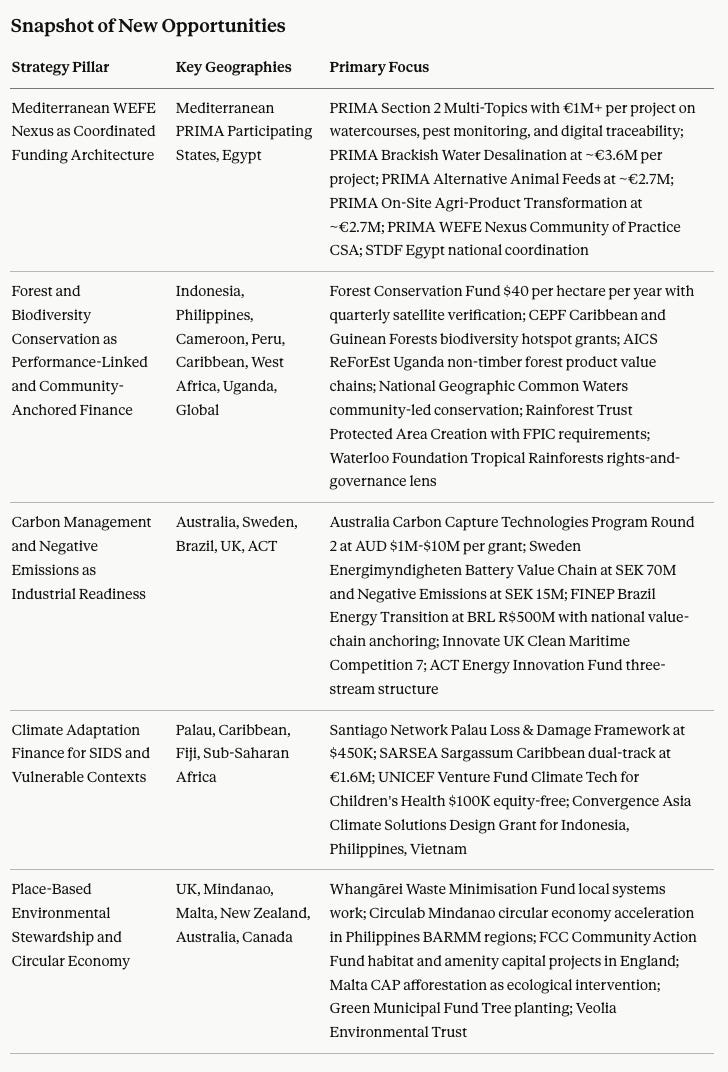
The May update for Agriculture, Climate, Environment, Energy & Food Systems brings new calls that cluster around three distinct movements: PRIMA emerging as a coordinated funding architecture deploying €33M+ across the Mediterranean water-energy-food-ecosystems nexus in a single cycle, forest and biodiversity conservation shifting decisively toward performance-linked finance and community-anchored stewardship, and carbon management and negative emissions moving from R&D curiosity into industrial readiness with national value-chain anchoring.
In Mediterranean WEFE Nexus as Coordinated Funding Architecture, the dominant signal of the month is PRIMA’s deployment of five parallel calls all closing May 15 that collectively treat water, energy, food, and ecosystems as a connected regional system rather than separate silos. The Section 2 Multi-Topics call funds policy-driven research consortia with €1M+ minimum requested per project across watercourse governance, remote pest monitoring, and digital traceability. The Decentralized Brackish Water Desalination topic deploys ~€3.6M per project with €10.815M total, demanding renewable-powered systems suited to smallholder and peri-urban agriculture with operational validation and circular brine management. The Alternative Animal Feeds topic at ~€2.7M per project targets feed supply chain sovereignty by funding regionally adapted alternatives built from local biomass and agri-food waste streams. The Sustainable On-Site Transformation topic at ~€2.7M per project funds compact, modular processing solutions to address post-harvest spoilage at production sites. The WEFE Nexus Community of Practice CSA at ~€1.05M institutionalizes the connective governance tissue needed to scale validated practices across diverse Mediterranean contexts. Around PRIMA, Egypt’s STDF runs a coordinated national call setting Egyptian institutional participation rules with higher caps for consortium coordinators (€250K vs €200K). The pattern: PRIMA has matured beyond a research collaboration program into a regional funding architecture where individual topics are designed to interlock, with adoption pathways, business model development, and governance scaling explicitly funded as part of the research package rather than as afterthoughts.
In Forest and Biodiversity Conservation Shifting Toward Performance-Linked and Community-Anchored Finance, the calls this month are notable for how decisively they’re moving away from traditional project-funding toward stewardship payments tied to verified outcomes and community ownership. The Forest Conservation Fund’s structure deploys USD $40 per hectare per year over five years to indigenous peoples, local communities, private landholders, and local NGOs protecting tropical forests, with quarterly disbursement only after Starling satellite verification confirms intact forest cover — an explicitly performance-linked finance model that connects forest stewardship directly to corporate supply-chain insetting. CEPF deploys $50K-$250K through its Twelfth Call for Letters of Inquiry in the Caribbean Islands biodiversity hotspot and parallel large-grant call in the Guinean Forests of West Africa, channeling resources through civil society organizations with demonstrated regional expertise rather than international intermediaries. AICS ReForEst Uganda commits €3M-€4M to a green entrepreneurship platform that explicitly links non-timber forest product value chains to forest restoration as a livelihoods-plus-conservation play. National Geographic’s Common Waters program funds individual project leaders deeply embedded in their communities, prioritizing integration of traditional ecological knowledge with conservation practice. Rainforest Trust’s Feasibility and Protected or Conserved Area Creation grants ($10K-$1M) require demonstrated FPIC processes and Indigenous Peoples or Local Community support. Waterloo Foundation’s Tropical Rainforests Programme (£100K-£150K) explicitly screens out carbon finance pathways and funds rights-and-governance work over tree-planting models. The pattern: conservation funders are increasingly treating measurable outcomes plus community ownership as the structural basis for finance, not as nice-to-haves at the application stage.
In Carbon Management and Negative Emissions Moving from R&D into Industrial Readiness, several calls this month deploy substantial capital against carbon capture, negative emissions, and energy transition technologies with explicit positioning as national industrial competitiveness instruments rather than research-stage exploration. Australia’s Department of Climate Change, Energy, the Environment and Water deploys AUD $1M-$10M per grant through Round 2 of the Carbon Capture Technologies Program for pilot and demonstration projects across CO2 capture, utilization, and engineered removal, with explicit emphasis on technical performance, scalability, and durability under Australian conditions. Sweden’s Energimyndigheten runs two parallel calls: the Battery Value Chain research call at SEK 70M total (up to SEK 10M per project) requiring cross-cutting analyses on commercial viability and industrial readiness, and the Negative Emissions research call at SEK 15M with explicit framing toward implementation-ready evidence and Sweden’s industrial transition toolkit. FINEP Brazil’s Mais Inovação Round 2 deploys BRL R$500M (~$100M) across hydrogen, advanced storage, grid resilience, sustainable fuels, and carbon capture, structured explicitly as a national industrial competitiveness tool with reserved pools for Norte, Nordeste, and Centro-Oeste regions. The ACT Government’s Energy Innovation Fund deploys AUD $20K-$1M per grant through three streams targeting technology demonstrations, policy experimentation, and ecosystem-building. Innovate UK’s Clean Maritime Demonstration Competition 7 commits £100K-£1M for feasibility work that can credibly lead to real-world demonstrations of clean maritime technologies. The pattern: carbon and energy transition funders are no longer treating these technologies as speculative research investments but as anchor industrial capabilities, with national value-chain anchoring, supply chain depth, and commercial readiness becoming explicit deliverables.
For Mediterranean researchers and consortia, the five PRIMA topics together represent the deepest concentration of WEFE-nexus capital available this cycle — pair the Section 2 Multi-Topics call (Stage 1 May 15) with one of the four single-topic calls if your work spans both research methodology and applied technology, since the same May 15 Stage 1 deadline allows efficient parallel preparation. For tropical forest and biodiversity organizations, the Forest Conservation Fund’s $40/hectare/year quarterly-verified model is the most genuinely novel finance structure available right now — pair it with CEPF’s biodiversity hotspot grants for organizations operating in the Guinean Forests or Caribbean. For carbon and energy transition organizations, the Australia Carbon Capture (May 6 deadline), Sweden Energimyndigheten Battery and Negative Emissions calls, and FINEP Brazil energy transition round (August 31 deadline) together represent a near-quarterly cadence of substantial industrial-readiness capital — applicants should match their pipeline to the specific national value-chain logic each funder is anchoring. For climate adaptation work in SIDS and Caribbean contexts, the Santiago Network Palau Loss & Damage call ($450K, May 15 deadline) and SARSEA Sargassum Caribbean call (€1.6M total across two tracks, May 19 deadline) together represent a meaningful concentration of vulnerability-focused adaptation capital. For climate-tech founders and circular economy ventures, UNICEF Venture Fund Climate Tech, RAISEAfrica, Circulab Mindanao, DEEPSCALE Chile, and Audi Environmental Foundation Scholarship form an unusually deep youth-and-emerging-markets pipeline this cycle.
Total Estimated Funding Pool: $400 Million USD+ USD
-
Open Calls: Current grant and opportunities with a deadline. Grants are listed by closing date. 45 open opportunities – 13 new!
-
Rolling Applications: current grant and opportunities with rolling applications (but it’s still best to submit as early as possible). 22 rolling opportunities!
-
Long term planning: Grants that have closed their current rounds, but are expected to open new windows. 3 long term opportunities!
A quick tip for returning readers: if you want to jump straight to the newest additions, use CTRL F to search for “New!” and navigate quickly to the latest funding opportunities
This post is for paid subscribers. This helps support the time and effort it takes to curate and organize these opportunities.
To keep this accessible to everyone who needs it, we’re happy to offer pay what you can rates. You can find more details here.
Carbon Capture Technologies Program Round 2, Department of Climate Change, Energy, the Environment and Water. *Closing soon!*
Australia’s climate portfolio increasingly depends on technologies that can address hard-to-abate industrial emissions and the residual emissions that remain even under deep decarbonization. Through Round 2 of the Carbon Capture Technologies Program, the Australian Government seeks to speed up research, development, and demonstration of emerging carbon management pathways, including CO2 capture, CO2 utilization, and engineered CO2 removal. The program is structured to fund pilot and demonstration projects that can prove technical performance, scalability, and durability in Australian conditions, while also strengthening domestic capability and accelerating pathways to commercial readiness. The funder’s emphasis on measurable abatement, permanence, and replicability signals a preference for projects that can unlock broader industrial deployment and contribute to net zero by mid-century.
-
Geographies: Australia.
-
Who can apply: Australian incorporated entities (including eligible trustees), state or territory bodies, and corporate Commonwealth entities; joint applications allowed with an eligible lead organization.
-
Funding amount: AUD $1 million–$10 million per grant; grant covers up to 50% of eligible project costs.
-
Targeted Sectors / SDGs: Climate & Environment; Focus areas: carbon capture, carbon dioxide removal, carbon utilization, pilot and demonstration.
-
Deadline: May 6, 2026 (5:00 PM Australian Eastern Standard Time).
This is a scale-readiness instrument: it is designed to move engineered carbon management from promising concepts into validated pathways that industry and policymakers can adopt.
Aberdeen Group Charitable Trust – Ideas Fund (Pilot Project Grants), Aberdeen Group Charitable Trust. *New!* *Closing soon!*
The Aberdeen Group Charitable Trust seeks to catalyze innovation by funding nonprofits to pilot solutions addressing persistent challenges in financial capability, employability, and environmental stewardship. The foundation supports organizations testing new approaches that generate sustainable impact and scalable models. Through its Ideas Fund, the trust prioritizes pilot projects that combine rigorous design with measurable learning outcomes, enabling charities to validate concepts before broader implementation. The foundation particularly calls for proposals exploring how artificial intelligence affects social inclusion, signaling strategic interest in emerging technology’s role in equitable access to economic opportunity. By funding exploratory work over 12-18 month periods, the trust emphasizes testability and adaptive learning, recognizing that breakthrough solutions often require experimentation and iteration. This approach positions the Ideas Fund as a launchpad for evidence-based innovation within communities where the foundation maintains active engagement.
-
Geographies: Global.
-
Who can apply: Non-profit organisations (charities) working directly and practically on financial capability, employability, or nature in communities where Aberdeen Group colleagues live and work.
-
Funding amount: Funding of between £20,000 and £180,000 is available worldwide for organisations working in the communities where Aberdeen Group is based. Average grant size of £50k over 12-18 months.
-
Targeted Sectors / SDGs: Economic Development & Livelihoods; Focus areas: financial literacy, employability, pilot projects, nature-based solutions.
-
Deadline: May 7, 2026.
This fund demonstrates a funder’s deliberate strategy to identify and support emerging solutions at the intersection of technology and social inclusion before they scale.
ReForEst Uganda Restricted Call for Proposals: Development of Sustainable Non-Timber Value Chain Enterprises and Strategies for Enhanced Livelihood and Forest Conservation, Italian Agency for Development Cooperation (AICS). *Closing soon!*
AICS (with EU financing under the Partnership for Forest framework) is seeking an implementing consortium to operationalize a market-facing “Green Entrepreneurship Platform” that can convert conservation incentives into durable rural income streams across Eastern Uganda and Napak. The call’s investment logic is explicitly systems-oriented: strengthen five non-timber forest product value chains while improving governance, standards, and market access so community livelihoods become structurally aligned with forest restoration and biodiversity protection. The expected action combines field-based producer support with incubation and acceleration for nature-based enterprises, alongside practical infrastructure for value addition (including cottage-industry facilities and quality assurance). Proposals are expected to coordinate tightly with government counterparts and sector institutions, show strong delivery capacity at scale, and demonstrate how evidence, skills, and market linkages will translate into measurable jobs and household income gains without increasing pressure on forest resources.
-
Geographies: Uganda (Eastern Region districts: Jinja, Luuka, Kamuli, Mbale, Sironko, Bulambuli, Namisindwa, Soroti, Kaberamaido, Amuria, Kapelebyong, Katakwi, Kumi, Ngora, Serere; Karamoja: Napak).
-
Who can apply: Legal entities (profit or nonprofit) including NGOs, private companies, public sector operators, local authorities, and international organizations registered and authorized to operate in Uganda; lead applicant must meet minimum experience and capacity requirements.
-
Funding amount: EUR 3M–EUR 4M (Total pool: EUR 4M).
-
Targeted Sectors / SDGs: Climate & Environment; Focus areas: non-timber forest products, green entrepreneurship platform, MSME incubation and acceleration, agroforestry value chains, cottage industry facilities
-
Deadline: Concept Note: May 7, 2026 (16:00 EAT); Full Application: July 20, 2026 (16:00 EAT)
This is a livelihood-plus-conservation play: the strongest proposals will show how enterprise services and value-chain infrastructure will lock in long-term behavior change around forest stewardship.
Research for a Competitive and Sustainable Battery Value Chain, Swedish Energy Agency (Energimyndigheten). *Closing soon!*
The Swedish Energy Agency seeks to strengthen Sweden’s competitiveness and security of supply in the European battery ecosystem by funding research that makes battery value chains more resource-efficient, scalable, and resilient to disruption. This call is designed to push beyond laboratory advances by explicitly prioritizing projects that pair technical progress with cross-cutting analyses on commercial viability, industrial readiness, and environmental and techno-economic performance. The funder is also using this round to deepen international and cross-sector collaboration, encouraging partnerships with top-tier research groups and companies in leading countries while requiring clear knowledge transfer to Sweden-based actors. Strong proposals will show credible pathways from research outputs to adoption, including how results can reduce time and cost in scaling, strengthen access to critical inputs (including recycled materials), or accelerate next-generation technologies like solid-state batteries.
-
Geographies: Europe (Northern Europe); Sweden; Global (international collaboration).
-
Who can apply: Companies (legal entities), universities/colleges, research institutes, public sector organizations; international actors may be funded under specific conditions.
-
Funding amount: Total pool: approximately 70 million SEK; up to 10 million SEK per project.
-
Targeted Sectors / SDGs: Innovation & Technology; Focus areas: battery value chain, manufacturing process optimization, solid-state batteries, battery recycling, critical raw materials, AI-enabled manufacturing.
-
Deadline: May 7, 2026 (23:59).
This is an evidence-to-industrial-readiness call, so proposals that integrate technical work with adoption-oriented analyses tend to match the Agency’s selection logic best.
EIT Jumpstarter Call for Participants 2026, EIT Food. *Closing soon!*
EIT Jumpstarter seeks to widen Europe’s innovation pipeline by helping early idea holders in moderate and emerging innovation ecosystems turn research and problem insights into investable startup pathways. The program is designed as an equity-free, skills-and-validation journey: participants move from application screening into structured online bootcamps, then advance through pitching and business plan development toward a public Grand Demo Day. Across its thematic tracks (including food and agritech, health, energy, manufacturing, raw materials, and smart cities), the funder prioritizes innovations with clear problem definition, market relevance, and credible execution capacity, reinforced by peer learning and expert mentoring. Financial support is performance- and deliverable-linked, culminating in category prizes and targeted special prizes that reward strategic EU priorities such as rebuilding Ukraine and New European Bauhaus-aligned solutions.
-
Geographies: Europe (eligible countries and territories include Bulgaria, Croatia, Cyprus, Czechia, Estonia, Greece, Hungary, Italy, Latvia, Lithuania, Malta, Poland, Portugal, Romania, Slovenia, Slovakia, Spain; EU Outermost Regions; Albania, Armenia, Bosnia & Herzegovina, Kosovo, Moldova, Montenegro, North Macedonia, Serbia, Ukraine, Türkiye).
-
Who can apply: Natural persons only (individuals or teams); researchers, students, professionals, and idea holders with at least one eligible-country citizen on the team.
-
Funding amount: Total budget EUR 241,000; prizes EUR 10,000, EUR 5,000, EUR 3,000 per category plus EUR 2,500 special prizes; EUR 1,000 subgrants at Startup Builder Training and Award Ceremony stages.
-
Targeted Sectors / SDGs: Innovation & Technology; Focus areas: pre-acceleration, startup formation, idea validation, business modeling, market validation
-
Deadline: Application: May 8, 2026 (23:59 CEST); Business Plan: September 30, 2026; Award Ceremony deliverables: November 30, 2026
This structure signals a funder strategy focused on building execution-ready founders and channeling early innovation into EU priority pathways through staged proof and selective rewards.