







Film star-turned-politician C Joseph Vijay is on the cusp of history in Tamil Nadu state.
On Monday, his political party Tamilaga Vettri Kazhagam (TVK) defied all naysayers to almost sweep the state election, marking a break in the established political order.
Vijay’s spectacular rise is being compared with that of matinee idol MG Ramachandran, who broke away from the established Dravida Munnetra Kazahagam (DMK) to form his own party and become chief minister in 1977.
But even as Vijay’s victory has delighted fans and supporters, he has hurdles to cross to reach the top post. To form a government in the 234-member Tamil Nadu assembly, a party needs 118 seats. Vijay’s Tamilaga Vettri Kazhagam (TVK) has won 108 – leaving him 10 seats short of a majority.
That means over the next few days, Vijay will need to change from crowd-puller to coalition-builder, negotiating with smaller parties and independent legislators to cross the threshold and stake a claim to power.
Even then, his performance marks a striking political moment in a state that has, for decades, chosen between two established regional parties – the DMK and its rival the All India Anna Dravida Munnetra Kazhagam (AIADMK).
For some, the explanation lies as much in persona as in politics.
“Vijay carries a different kind of verve,” says social scientist Shiv Visvanathan. “He offers a sense of fun, confidence and an aura of competence rooted in individuality and that gives him a different kind of power.”
In the weeks since voting took place, Vijay has been carefully crafting his public image – not on screen, but by visiting prominent temples and churches.
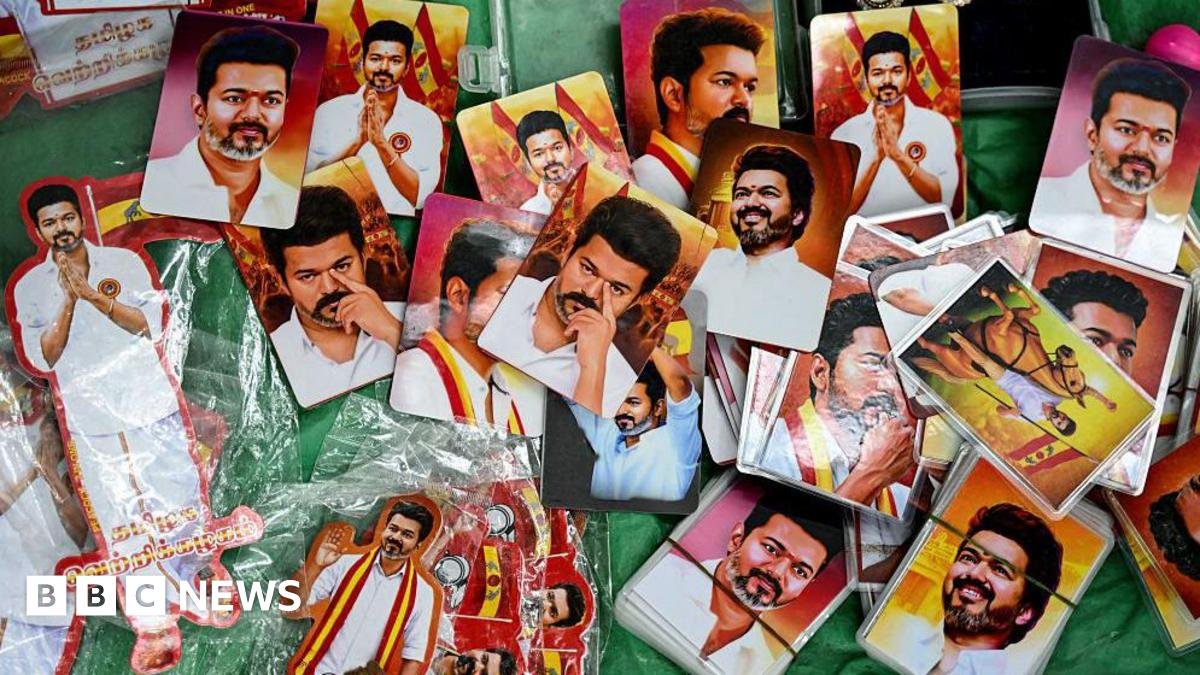
Images of these visits have flooded TV screens and mobile phones. In a state where modern politics was shaped by rationalist thought and the Self-Respect Movement – which envisioned a society where marginalised castes would have equal rights – the visible turn to faith feels deliberate.
Tamil Nadu has long been attuned to political theatrics, where cinema and power often blur into one continuum. From Ramachandran to his successor J Jayalalithaa, film stars have entered politics and gone on to lead the state.
Vijay steps into that lineage, but at a different political moment.
Analysts say he is entering a landscape still dominated by the DMK and the AIADMK – a duopoly that mostly appears stable on paper, yet shows signs of fatigue on the ground. That, they argue, is opening space for new political experiments – and for figures like Vijay to test how far star power can translate into durable political authority.
“Vijay’s timing as a politician is immaculate,” says Visvanathan. “He arrives at a moment when established leaders are seen as jaded. He represents youth – and a new interplay of memory and messaging in how voters imagine their leaders.”