







This is our home. If we destroy it, and we can’t build it up, then that’s a part of the Earth that’s destroyed, and we won’t be able to get it back.
Matthew, aged ten, isn’t alone in feeling this way.
We interviewed 15 Australian primary school children aged between nine and 12-years-old about environmental change, which includes things such as pollution, climate change and deforestation.
Every child knew the environment was changing, and all of them had feelings about it too.
Worry was most common. We also heard sadness, anger and hopelessness.
These were thoughtful, complex responses from children paying attention to the world around them.
Most research focuses on teens and young adults
We have known for some time that environmental change profoundly impacts mental health. Eco-anxiety refers to worry about environmental decline. It is not a clinical diagnosis and sits within the range of normal emotions for most people.
Eco-anxiety is a rational response to a real threat. However, for some, it impacts functioning (such as sleep and cognition) and can cause significant distress.
Global studies, including a survey of 10,000 young people across ten countries have documented high rates of eco-anxiety in adolescents and young adults – 59% of respondents were very or extremely worried.
But to date, almost all eco-anxiety research has focused on young people aged 16-25-years-old.
The handful of studies conducted in primary school children only offer a preliminary picture, with small samples from Canada and the US.
The experiences of primary school children are therefore poorly understood.
Our interviews offer new insights into this overlooked group.
‘I’m gonna have to deal with it’
The Australian primary school children we interviewed were not vague about their fears.
They worried about animals going extinct, about rising sea levels, about whether the planet would be liveable when they grew up.
One 12-year-old described thinking about
what will happen when I’m older, and how I’m gonna have to deal with it.
They also understood that human activity played a large role and were frustrated that more hadn’t been done by governments and past generations. One ten-year-old told us:
(I’m) mad at the people who could have solved the problem before now, but they didn’t. They just thought “It’s fine, this problem doesn’t really matter”. And then look at the world now, it’s such a big problem.
Eco-anxiety also shaped children’s behaviours and thoughts.
Some attended protests, put up posters or reduced their plastic use, to help them feel calmer. This problem-focused coping can help reduce negative eco-emotions and build a sense of agency.
Importantly, for most children their worries about the environment were not persistent and did not affect their daily lives. We know from research on older children that eco-anxiety can increase over time; persistently high eco-anxiety can be linked to mental health concerns in young adults.
It’s crucial we understand what shapes the early development of these feelings and what makes them manageable.

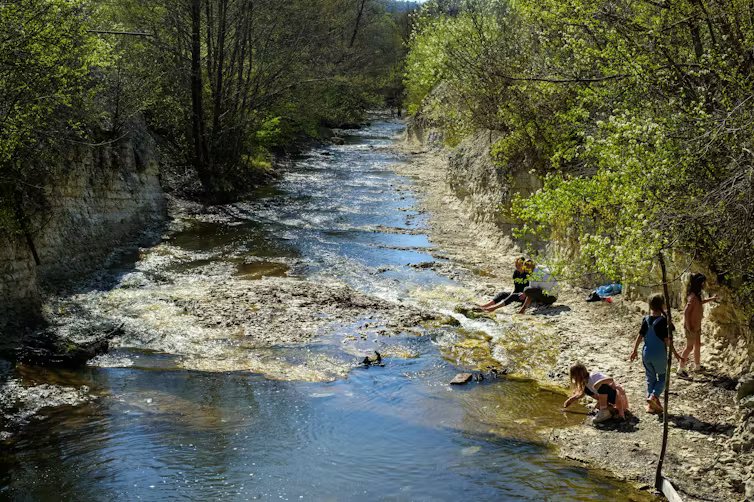
Oleksiy Konstantinidi/Pexels
A role for schools
One unexpected finding was how hopeful children were.
A third of children expressed genuine belief that the environment could recover. One ten-year-old told us:
I just think there’s a possibility that it can get better. And if we try hard enough, we’ll all get there eventually, and we can help it survive.
Hope seems to be more common in younger children than older children and can be protective. It offers the potential for children to channel concern into action rather than helplessness.
However, schools and parents need to create more opportunities for children to act, alongside acknowledging their fears.
Our ongoing research suggests that teachers regularly face children’s eco-emotions about environmental change – which might include curiosity or information-seeking – without adequate training or guidance.
One child in our study noted that her school “wasn’t doing it very effectively” and wanted teachers to take the topic more seriously.
Without the opportunity to discuss their feelings and with a heavy focus on individual actions (such as recycling) children can feel disproportionately responsible, which increases distress rather than reducing it.
Collective action, open discussions of emotions, and education that reflects the true extent of environmental change is likely to help children.
These feelings deserve to be taken seriously
The goal is not to eliminate eco-anxiety in children, but to keep it at a manageable level that doesn’t affect their ability to function in day to day life.
We can then help children to use eco-anxiety as a foundation for action.
It’s important to note we spoke to only 15 children, mostly from metropolitan areas. We cannot say how widespread these experiences are, or how they differ by age, gender, or location. Answering those questions requires more research over longer time frames and with bigger cohorts.
Children are watching, thinking and feeling things about the future of the environment. Those feelings deserve to be taken seriously.