









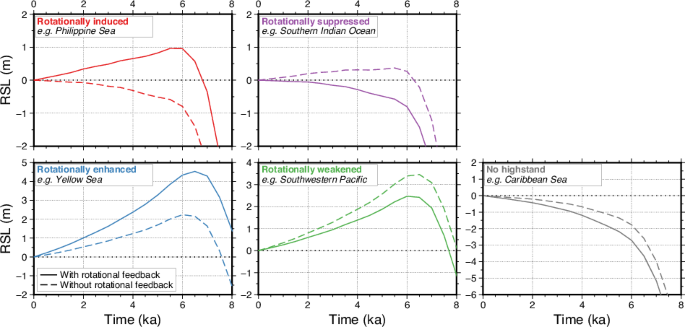
At the end of the last deglaciation, sea level rose in some locations and fell in others. This well-documented Earth response to ice unloading and water loading, called glacio-isostatic adjustment, is geophysically well-described, but the spatio-temporal distribution of rise and fall observations is unclear. Here, we elucidate the Holocene sea-level highstand frequently observed in the far-field of the former ice sheets by analysing the specific feedback mechanism by which Earth’s rotation affects sea level. By assessing the role of this rotational feedback in four models simulating the glacio-isostatic adjustment processes, we identify the height of the highstand as rotationally induced or enhanced in the Southwest Atlantic, Northeast Pacific, and Northern Indian Ocean, and rotationally weakened or suppressed in the southern Indian Ocean and parts of Pacific Ocean. Holocene relative sea-level proxy data broadly confirm this spatial pattern. Thus, Earth’s rotation is a driving mechanism which modulates the impact of other concurrent glacio-isostatic adjustment processes and, hence, shapes the observed postglacial relative sea-level histories.